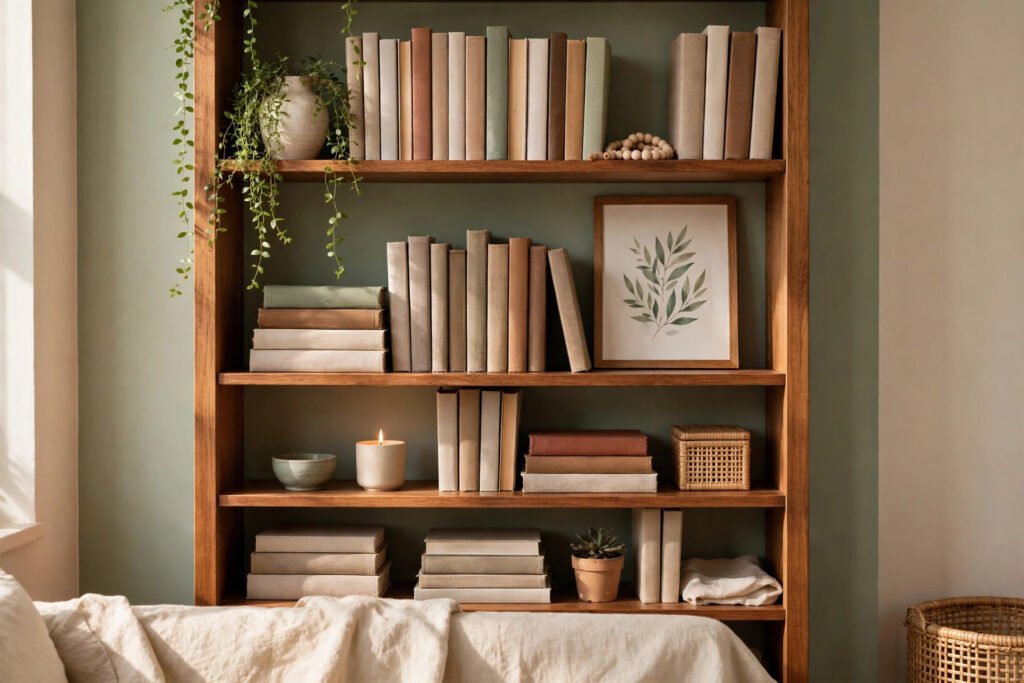

Learning how to style a bookshelf is one of the cheapest ways to make a room look designed rather than just furnished. A well-styled bookshelf adds personality, colour and texture to a living room or bedroom, and it costs almost nothing if you shop your own home first. Designers follow a handful of simple rules — odd-numbered groups, mixed heights, breathing room — and once you know them, you can style any shelf in a single afternoon.
Start With a Clean Slate
Before you style anything, empty the shelf completely and give it a proper clean. Most bookshelves look cluttered not because the owner has too much stuff, but because everything was placed wherever it fit over months or years.
Sort what you own into three piles: books you want to display, decorative objects (vases, candles, framed photos, small sculptures), and things that belong somewhere else entirely. That third pile is usually bigger than people expect — old chargers, paperwork and random boxes do not belong on a display shelf.
The Rules Designers Use
You do not need a design degree to style a shelf well. These six rules do most of the work.
1. Group in odd numbers
Designers group objects in threes and fives because odd numbers look natural and relaxed, while even pairs can look stiff. A trio of candlesticks, a vase with two small books, or three framed prints leaning together all read as intentional. The exception is a deliberate pair — two matching lamps or bookends — which works when symmetry is the point.
2. Mix vertical and horizontal
A shelf full of upright books looks like a library; a shelf full of horizontal stacks looks like a pile. The designer look comes from mixing the two. Stand most books upright, then break the row with a short horizontal stack of two or three books, and place a small object — a candle, a tiny plant, a decorative box — on top.
3. Layer, don’t line up
Never place everything in a single straight row along the front edge. Layer instead: a framed print leaning against the back, a stack of books in front of it, and a small vase in front of that.
4. Vary the heights
If everything on a shelf is the same height, the eye slides straight past it. Mix tall and short: a tall vase beside a low stack of books, a medium plant next to a short candle. Aim for a gentle zigzag of heights across each shelf.
5. Leave breathing room
The most common styling mistake is filling every centimetre. Designers leave roughly a third of each shelf empty. Empty space is not wasted space; it is what lets the eye rest and makes the objects you kept look deliberate.
6. Repeat a colour
Pick two or three colours from the room and repeat them across the shelves — the warm wood of your coffee table, the sage green of a cushion, the brass of a lamp. Repeating a colour in a vase here, a book spine there and a frame on the top shelf ties the whole bookcase to the room.
A Shelf-by-Shelf Styling Plan
Work from the top down, and treat each shelf as its own small display.
Top shelf: Keep it light and tall. This is the place for your tallest pieces — a large vase, a framed print leaning against the back, a trailing plant. Tall objects up high draw the eye upward and make the whole bookcase look taller.
Middle shelves: These are at eye level, so they carry the most visual weight. This is where most of your books belong, mixed with your best decorative objects. Put the pieces you love most here, where you will actually see them every day.
Bottom shelf: Keep it heavy and simple. Large books, storage baskets or oversized coffee table books work well down low, where their weight looks grounded rather than top-heavy. Baskets are also the honest way to hide things that need to live on the shelf but are not pretty — remote controls, chargers and board games. Our roundup of the best budget coffee table books for styling has plenty of oversized options that look great on a bottom shelf.
Anchor each shelf with books. Even if you are not a big reader, books are the cheapest styling material there is. A row of books gives a shelf structure, and their spines add colour and pattern for free. Charity shops and library sales are the best places to find hardbacks for very little.
Budget Bookshelf Decor That Looks Expensive
You do not need designer prices to get a designer look. These are the pieces designers reach for again and again. Prices below are rough ranges only — check the current price before buying — and recommendations here are based on specifications, features and customer feedback, not hands-on lab testing.
Small vases (roughly $5 to $15 each). A ceramic or glass vase in a simple shape is the workhorse of shelf styling. Group two or three in different heights, or use one on top of a stack of books.
Candles and candle holders (roughly $5 to $20). Candles add warmth and a finished feel, especially in the evening. A chunky pillar candle on a wooden board, or a pair of brass candlesticks, fills a gap that books cannot. Keep them away from trailing plants and paper, and never leave a lit candle unattended.
Framed prints (roughly $10 to $25 framed). A small framed print leaning against the back of a shelf adds depth and a personal touch. Print your own photos or free artwork at home and buy a simple frame. Our budget-friendly gallery wall ideas use the same trick on a bigger scale.
Small plants (roughly $5 to $15). A trailing pothos or a small succulent softens the hard lines of a bookshelf and adds a living element. Faux plants work just as well on high shelves where watering is awkward. Our guide to the best affordable planters and indoor plants for beginners covers the easiest plants to keep alive.
Decorative boxes and baskets (roughly $10 to $25). A lidded box or a woven basket hides clutter and adds texture. Use one on the bottom shelf for remotes and cables, or a small decorative box on a middle shelf for coasters and trinkets.
A Bookshelf That Looks Like You
The designer secret is not a particular vase or a magic formula — it is restraint, repetition and a little patience. Start with what you own, group in odd numbers, mix heights and directions, leave a third of each shelf empty, and repeat two or three colours from the room. Then step back, look at the whole bookcase from across the room, and remove one more thing. That final edit is usually the one that makes it look designed. The best-styled shelves also evolve: swap a vase for a plant or rotate in a new framed photo every few weeks. If you enjoy rearranging, our guide on how to style a console table uses the same layering and grouping ideas on a smaller surface.
FAQs
How do I style a bookshelf without buying anything new?
Shop your own home first. Pull books from other rooms, move a vase from the kitchen, lean a framed photo against the back of a shelf, and add a plant from a windowsill. Remove everything, then rebuild each shelf using the rules above.
How many books should be on a styled bookshelf?
There is no fixed number, but a good guide is that books should fill about two-thirds of the shelf space, with the remaining third left for objects and empty space. A single shelf might hold 15 to 25 books depending on their size, broken up by a horizontal stack and one or two objects.
Should books be arranged by colour or by size?
Both work, and it depends on the look you want. Arranging by colour gives a calm, coordinated shelf and suits modern rooms. Arranging by size, tallest to shortest, looks more traditional. Avoid mixing the two approaches on the same shelf, or it will look accidental.
How do I style a bookshelf with a TV on it?
Treat the TV as the largest object on the shelf and style around it, not against it. Keep the shelves beside and below the TV simpler than the rest, use lower objects so they do not compete with the screen, and repeat the TV’s black frame colour in a frame or a vase elsewhere on the bookcase. Leave the shelf above the TV mostly empty.
What is the 60-30-10 rule for bookshelves?
It is a colour guide borrowed from interior design: roughly 60% of the shelf should be your dominant colour (usually the wood of the shelf and the main book colours), 30% a secondary colour, and 10% an accent colour that pops. You do not need to measure it — just check that your accent colour appears in at least two or three small places across the bookcase.