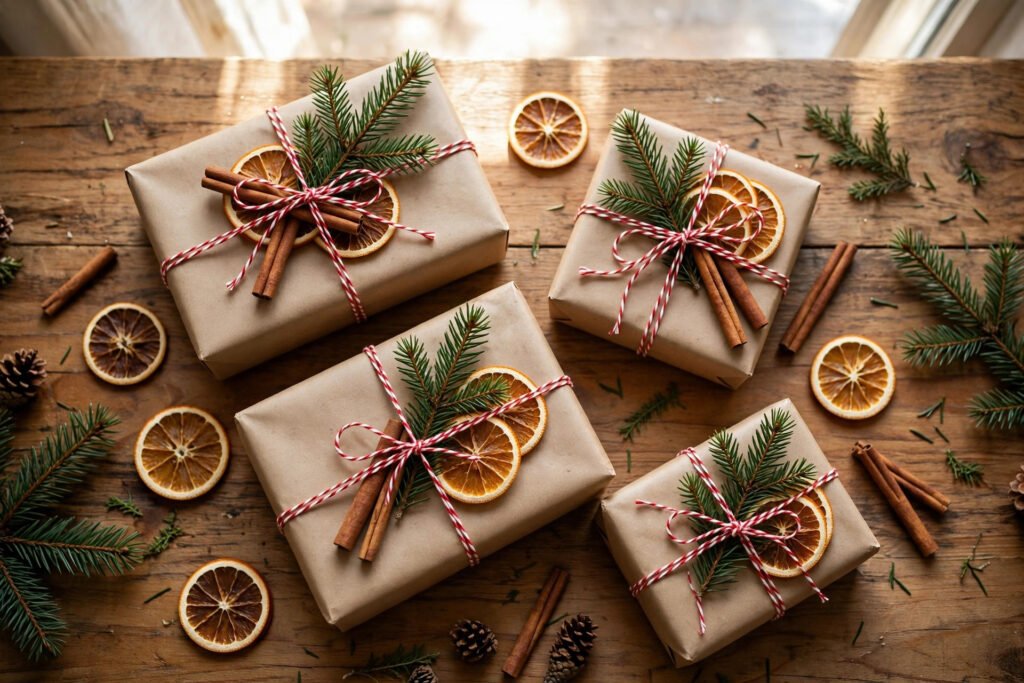

Christmas gift wrapping ideas budget shoppers will actually use do not start in the wrapping paper aisle. They start with what you already have at home: brown paper, string, fabric scraps, old maps and a few sprigs of greenery. A beautifully wrapped present is not about expensive paper; it is about a little care, one good colour and a finish that looks deliberate. The seven ideas below cost almost nothing, and most of them can be done in an evening with things already in your cupboards.
1. Brown Kraft Paper, Dressed Up
Plain brown kraft paper is the cheapest wrapping paper you can buy, and it is also the most forgiving. A roll usually costs roughly $3–$6 — check the current price before buying — and it wraps dozens of gifts. The trick is treating it as a blank canvas rather than a boring fallback.
Stamp it with a potato stamp cut into a star or tree shape, using ordinary craft paint or an ink pad. Tie it with red and white bakers twine, and tuck a sprig of rosemary or a cinnamon stick under the bow for scent and colour.
Kraft paper suits every gift, from books to bottles, and it never clashes with the rest of your Christmas decor. If you want the whole house to match, our budget Christmas decor ideas show how the same natural, low-cost palette works across the tree, the table and the mantel.
2. Fabric Wrap, Japanese Furoshiki Style
Furoshiki is the Japanese art of wrapping gifts in cloth, and it is perfect for a tight budget because the wrapping becomes part of the gift. A square of fabric — a tea towel, a scarf, a fat quarter from a craft shop or a piece cut from an old curtain — wraps a box beautifully, and the recipient can keep the cloth and use it again.
Place the gift in the centre of the square, fold two opposite corners over it, then tie the other two corners in a neat knot on top. A square of about 50 cm works for most books and small boxes; larger gifts need a bigger cloth. Fabric offcuts usually cost roughly $2–$5 each — check the current price before buying — and tea towels are often cheaper still. Add a small tag tied into the knot — the knot itself is the decoration, so there is no need for ribbon or tape.
3. Free Printable Gift Tags and Paper
Your printer is a surprisingly good wrapping station. Free printable gift tags are widely available online — search for a design you like, print it on card, cut it out and punch a hole for the string. A sheet of tags costs pennies, and they look far more polished than a handwritten label.
You can also print simple patterns — dots, stripes, tiny trees — on ordinary A4 paper; two or three sheets taped together will cover a small gift. Use the draft setting to save ink.
Keep the tags in one style across all your gifts and the presents will look like a coordinated set under the tree. Pair them with plain paper and a single ribbon colour for the most pulled-together result.
4. Newspaper, Maps and Old Book Pages
Old newspaper, road maps and damaged book pages make wonderfully characterful wrapping paper, and they cost nothing. A black-and-white newspaper page tied with red string looks classic and graphic, while a map page suits a gift for someone who loves to travel.
Pick pages with clear print and no glossy adverts, and layer a sheet of plain tissue paper over the print for a softer finish.
Old book pages work best for small gifts: wrap a candle, a jar of jam or a small box, then add a sprig of dried lavender or a pine cone on top. The result looks like something from a vintage Christmas card. If you enjoy making things from what you already own, our DIY home decor projects under $20 has more ideas in the same thrifty spirit.
5. Ribbon, String and Natural Trims Instead of Bows
Shop-bought bows are expensive for what they are, and a gift wrapped with a simple length of string often looks better. Bakers twine, jute string and thin velvet ribbon all cost very little, and a single roll will last for years of Christmases.
Wrap the string around the gift twice, cross it on the back, and tie a small bow on top. Then add one natural trim: a sprig of evergreen, a dried orange slice, a cinnamon stick or a small pine cone. The greenery adds colour and scent, and it costs nothing if you clip it from the garden or pick it up on a walk.
Dried orange slices are easy to make at home — slice an orange thinly and bake on a low heat until dry — and they look beautiful against brown paper and deep green ribbon.
6. Reuse Gift Bags, Boxes and Tissue
The cheapest wrapping is the wrapping you already own. Save every gift bag, box and sheet of tissue paper you receive during the year, and keep them in one bag or box so you can find them in December. A good gift bag can be reused three or four times before it looks tired.
Iron tissue paper on a low setting to smooth out the creases, flatten boxes for storage, and cover any shop logo with a gift tag.
Matching tissue paper inside a reused bag makes the gift feel fresh rather than second-hand. A few sheets of tissue usually cost roughly $2–$4 for a pack — check the current price before buying — and one pack lasts for many gifts. Our guide to affordable home decor finds under $25 has more ways to stretch a small budget without the result looking cheap.
7. Personal Touches That Cost Nothing
The most memorable wrapping is often the most personal. A hand-drawn tag, a photo of you and the recipient tucked under the ribbon, or a short handwritten note on the back of the tag costs nothing and means more than any expensive paper.
For children, let them decorate the paper with stamps or handprints. For a foodie, tie on a recipe card; for a gardener, a packet of seeds.
Write the recipient’s name by hand, even if your handwriting is not perfect. A handwritten tag looks warmer than a printed one, and it tells the person the gift was wrapped for them, not just wrapped. Keep the handwriting legible and the tag big enough to read at a glance under the tree.
Frequently Asked Questions
What is the cheapest way to wrap Christmas gifts?
Use what you already have: brown kraft paper, newspaper, old maps, fabric scraps and gift bags saved from the year. A roll of kraft paper costs only a few dollars and wraps dozens of gifts, and natural trims like pine cones are free.
How can I make cheap wrapping paper look expensive?
Keep the palette simple — one paper, one ribbon colour and one natural trim — and wrap neatly with sharp folds and a tidy bow. A single sprig of greenery or a dried orange slice on plain brown paper looks far more expensive than busy patterned paper with a plastic bow. Neatness matters more than price.
Can I reuse wrapping paper and gift bags?
Yes. Smooth out tissue paper with a cool iron, flatten gift bags and boxes for storage, and reuse them until they look worn. Cover any shop logos with a gift tag. Good-quality paper can be reused two or three times, and sturdy gift bags often last for years.
What can I use instead of ribbon?
Bakers twine, jute string, yarn, thin velvet ribbon or even a strip of torn fabric all work well and cost very little. Tie a simple bow and add a natural trim such as a cinnamon stick, a pine cone or a sprig of evergreen. String is cheaper than ribbon, easier to store and looks just as good.
How do I wrap awkwardly shaped gifts on a budget?
Put the gift in a box first — a shoe box, a cereal box or any sturdy box you have at home — then wrap the box. For round or soft gifts, use a fabric wrap or a gift bag with tissue paper instead of forcing paper around the shape. A box makes any gift look tidy and is much easier to wrap neatly.
Beautiful Christmas wrapping is not about how much you spend on paper. It is about one neat fold, one good colour and one thoughtful touch — and the best of those cost nothing at all. Start with brown paper and string, add a sprig of something green, and your gifts will look like they came from a shop that charges far more than you did.