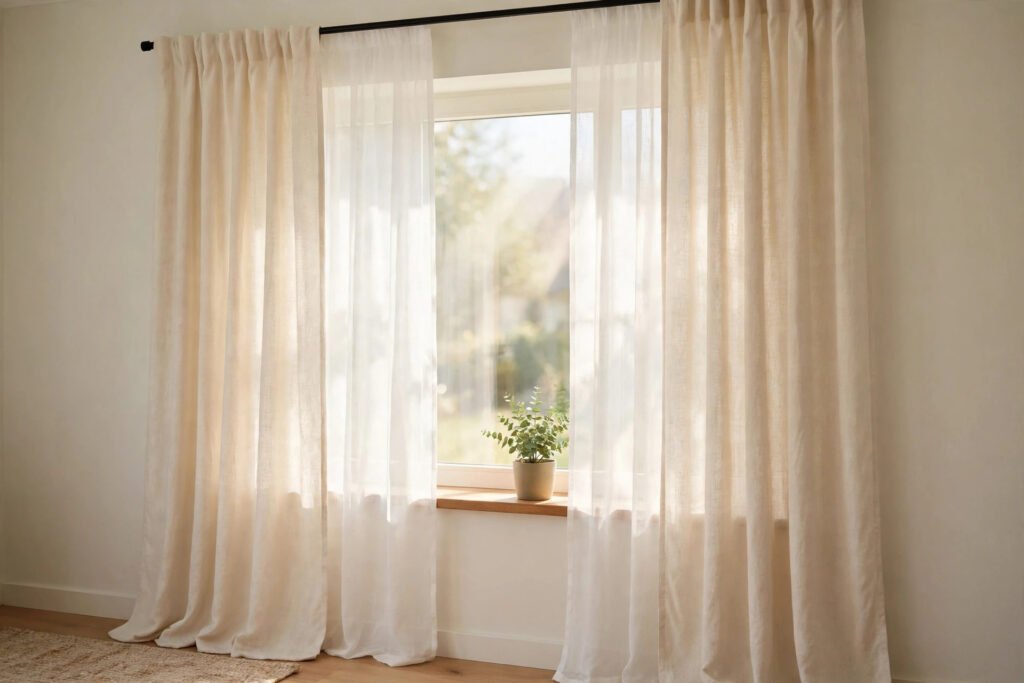

Learning how to choose curtains for small window spaces is mostly about proportion. Curtains that are too heavy, too short, or hung too low make the window look even smaller and the whole room feel cramped. Get the choices right, though, and the same window can look taller, wider, and far brighter than it really is. These seven tips cover length, fabric, colour, and hanging height.
1. Hang the Rod High and Wide
The single most effective trick is to hang the curtain rod higher and wider than the window itself: mount it 10–15 cm above the top of the frame, or closer to the ceiling if the gap is small, and extend it 15–20 cm past each side. When the curtains are open, they will sit against the wall rather than covering the glass, so the full window shows and the room gets more light. When closed, the curtains cover a larger area than the window, which makes the window look bigger than it is.
The eye reads the curtain, not the frame, as the size of the window. If you are renting and cannot drill, try removable adhesive hooks rated for the rod’s weight. Our guide to how to hang curtains the right way walks through the measuring and hanging steps in detail.
2. Choose the Right Length
For a small window, floor-length curtains are almost always the best choice. Curtains that stop at the sill chop the wall in half and draw attention to the window’s small size, while curtains that fall to the floor create one long vertical line and make the wall — and the window — look taller. The hem should just brush the floor; pooling fabric looks untidy in a small room and collects dust.
The one exception is a window above a radiator, a desk, or a kitchen counter, where long curtains would get in the way or become a fire risk. In that case, choose sill-length curtains ending 1–2 cm below the sill, in a light fabric. Avoid the awkward in-between length that ends halfway down the wall: it looks like a measuring mistake.
3. Pick a Light, Flowy Fabric
Heavy fabrics such as thick velvet or lined blackout curtains can overwhelm a small window. They add bulk at the sides, block light even when open, and make the window feel boxed in. Light fabrics work better: linen-look polyester, cotton voile, lightweight cotton, or a sheer weave. They hang in soft folds and let daylight through, which keeps the room feeling airy.
If you need privacy or darkness, layer instead of going heavy: a sheer panel closest to the glass gives daytime privacy while letting light in, and a light cotton or linen curtain on top closes the room off at night. Sheers on their own suit bathrooms and kitchens, where privacy matters more than drama. Our roundup of the best velvet curtains includes lighter options that work in smaller rooms.
4. Choose Colours That Open the Room Up
Curtains in the same colour family as the wall — white, cream, pale grey, or a soft tone matched to the paint — blend into the wall and make the window feel like part of a larger surface. This is the safest choice for a very small window or a dark room. A bold, contrasting colour does the opposite: it draws the eye straight to the window and advertises its size.
A subtle pattern — a fine stripe, a small geometric print, or a delicate floral — adds interest without shrinking the window, as long as the background colour stays light. Vertical stripes add a sense of height. Avoid large, dark, busy patterns: they dominate a small window and make it feel smaller.
5. Pick a Simple Header Style
The header — the top of the curtain where it attaches to the rod — affects how the curtain hangs and how much space it takes up. For a small window, simple headers work best. A rod pocket or a tab top hangs flat and neat, a simple grommet (eyelet) top creates soft, even folds, and a pinch pleat gives a tailored look without much bulk.
Avoid headers that add volume at the top, such as deep gathered ruffles or heavy valances. A valance across a small window eats into the glass area and makes the window look shorter, which is the opposite of what you want. Keep any pelmet shallow — no more than 15 cm deep — so it frames the window rather than swallowing it.
6. Keep the Width Generous
Curtains that are too narrow for the window look stretched and skimpy, and they never hang in proper folds. A good rule is that the total width of the curtain panels should be about one and a half to two times the width of the rod. For a small window with a rod of around 120 cm, that means panels totalling roughly 180–240 cm wide. Generous fullness is what makes curtains look expensive — and it lets the panels stack neatly against the wall when open, instead of covering the glass.
When buying ready-made curtains, check the stated width of each panel, not just the drop. Many budget pairs are sold as two narrow panels that together barely cover the rod, so measure first and buy the wider option if you are between sizes. For affordable options in light colours, see our guide to the best budget curtains.
7. Don’t Forget the Hardware
A slim rod in matte black, brushed nickel, or white suits most small windows; a very thick or ornate rod can overpower the window. Choose small, simple finials (the decorative ends) — a plain ball or a flat disc — rather than large or fussy shapes that stick out into the room.
Tiebacks are useful too: a simple fabric tieback or a magnetic tieback holds the curtain neatly against the wall during the day, keeping the glass fully clear. If your current rod is too short, replacing it is one of the cheapest upgrades you can make — our roundup of the best budget curtain rods and hardware covers slim, affordable options.
Mistakes to Avoid
The most common mistake is hanging the rod at the top of the frame instead of above it, which locks the window into its small size. The second is choosing curtains that are too short, which cuts the wall in half visually. The third is picking heavy, dark fabric for a small window in a room that is already short on light — it makes the whole corner feel gloomy. And the fourth is buying panels that are too narrow, so the curtains look stretched flat instead of falling in soft folds. Measure the rod, the drop, and the wall space on each side before you order anything.
If the room still feels dark after the curtains are up, keep the window clean and the sill clear of clutter, and consider a light-coloured blind behind the curtains for privacy instead of a heavy lining. If you need darkness for sleep, our guide to the best affordable blackout curtains explains how to get blackout performance without a heavy look.
Frequently Asked Questions
What length curtains are best for a small window?
Floor-length curtains are best for most small windows because they create a long vertical line that makes the window and the wall look taller. The hem should just brush the floor. Choose sill-length curtains only when something sits below the window, such as a radiator, desk, or kitchen counter.
Should curtains for a small window be light or dark?
Light colours work best: white, cream, pale grey, or a tone close to the wall colour blends the window into the wall and makes it feel larger. Dark or bold colours draw attention to the window’s small size. If you want pattern, choose a small, light print.
How high should I hang curtains above a small window?
Hang the rod 10–15 cm above the top of the window frame, or closer to the ceiling if the gap is small. Extend it 15–20 cm past each side of the frame so the open curtains stack on the wall instead of covering the glass.
Can I use blackout curtains on a small window?
Yes, but choose a lightweight blackout fabric rather than a thick, heavy one, and hang it high and wide like any other curtain. A light-coloured blackout curtain gives you darkness at night without making the window feel boxed in during the day.
What is the best curtain style for a small bedroom window?
A simple grommet or rod-pocket curtain in a light, flowy fabric, hung floor-length on a slim rod mounted high and wide, is the best all-round choice. Add a sheer panel behind it for daytime privacy without losing light.

