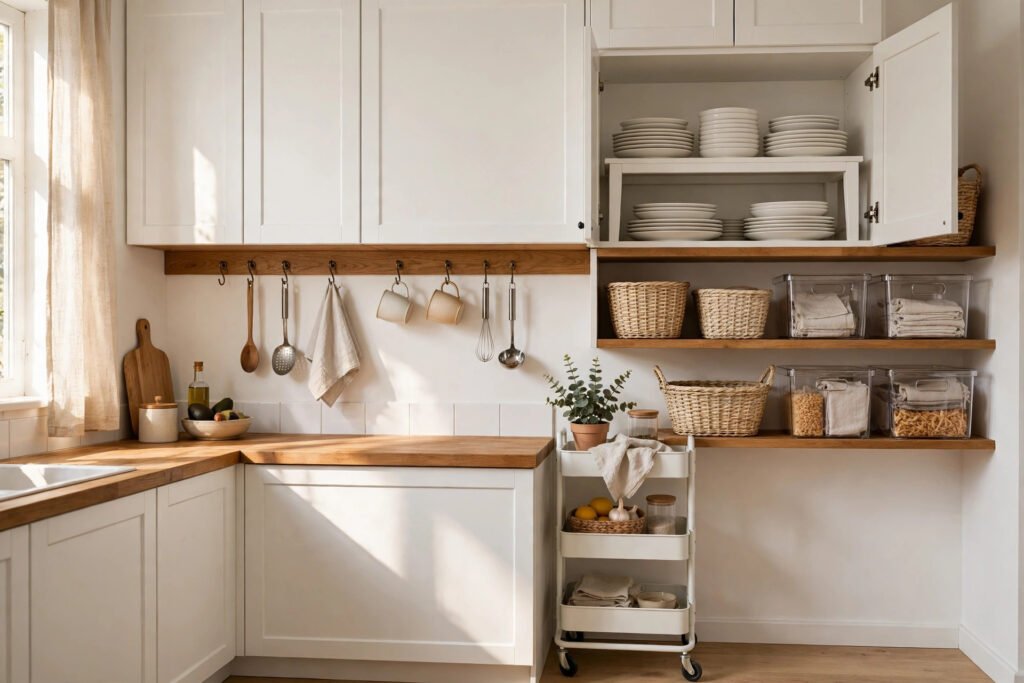

These affordable kitchen storage ideas are for anyone whose kitchen feels full before the shopping is even unpacked. Small kitchens are not short on storage because the room is small — they are short on storage because most of the space in them is wasted. The insides of cabinet doors sit empty, the wall above the worktop is bare, and the cupboard under the sink is a dark jumble. The five ideas below use the space you already have, cost very little, and most take less than an hour to put in place.
1. Use the Inside of Your Cabinet Doors
The inside of a cabinet door is the most overlooked storage in a small kitchen, and it is completely free to start using. A few small adhesive hooks or a slim wire rack fixed to the inside of a door gives you a home for measuring spoons, measuring cups, cleaning cloths, pot lids, chopping boards, or a roll of cling film.
Start with the doors you open most often: under the sink for cleaning sprays, nearest the cooker for lids and small utensils. Self-adhesive hooks cost roughly $3–$8 for a pack, and a door-mounted rack costs roughly $8–$15. Keep fixings slim so the door still closes properly. If you rent, stick with adhesive fixings rather than screws so you can remove them without damage when you move out.
2. Add a Shelf Inside a Tall Cupboard
Most kitchen cupboards have one shelf and a huge empty space above it, which means stacks of plates and bowls grow taller and taller until the bottom one is impossible to reach. A small freestanding shelf riser fixes this in seconds. It sits inside the cupboard and creates a second level, so mugs go underneath and plates go on top, or bowls below and small dishes above.
A stackable shelf riser costs roughly $10–$20, and you can use two in one cupboard if it is wide enough. They also work in the pantry for tins and jars. Measure the cupboard height first — you need enough room for the riser plus whatever sits on top of it.
3. Go Vertical With a Wall Rail and Hooks
When the worktop is full and the cupboards are full, the wall is the only space left — and it is usually empty. A wall rail with hooks turns a bare stretch of wall above the worktop into storage for the things you reach for every day: cooking utensils, mugs, scissors, a tea towel, and a small herb pot.
A basic rail with hooks costs roughly $12–$25, and it takes about fifteen minutes to fix to the wall. Keep it to one rail, and only hang things you actually use daily — a rail crowded with gadgets you never touch just becomes wall clutter. If you rent and cannot drill, look for a rail with strong adhesive mounts or a tension rod that fits between two walls, and check the current price before buying any fixings. Our tips for small kitchen decor ideas on a budget show how to style a wall rail so it looks deliberate rather than improvised.
4. Stack, Don’t Pile: Use Baskets and Bins
Piles are the enemy of small-kitchen storage. A pile of baking trays, a pile of tea towels, a pile of food bags — each one wastes space and hides what is at the bottom. Baskets and bins turn piles into stacks, and stacks are far easier to manage.
Use a basket on top of the fridge for the things you rarely need, such as spare baking trays or a picnic set. Use small bins inside deep cupboards to group similar things together: one bin for baking supplies, one for snacks, one for cleaning products. A set of small storage baskets costs roughly $10–$20, and you can use old shoeboxes or sturdy cardboard boxes for free if the budget is really tight. Clear bins work best inside cupboards because you can see the contents without pulling them out, while woven baskets look better on open shelves.
5. Free Up Worktop Space With a Rolling Cart
If your worktop is crowded, a small rolling cart can change the whole feel of the kitchen. It gives you an extra surface for food preparation, plus two or three shelves underneath for the things that currently live on the worktop: the toaster, the fruit bowl, the chopping board, or the coffee maker.
A basic three-tier rolling cart costs roughly $25–$45, and because it has wheels you can push it against a wall when you are not cooking and pull it out when you need the space. Measure the gap where you plan to keep it before buying — a cart that is a few centimetres too wide will not fit, and a cart that is too deep will block a walkway. For renters, a cart is one of the best storage buys of all, because it needs no drilling and moves with you to the next home. Our guide to how to make a rental kitchen look better without renovating has more no-drill ideas that work in the same way.
Mistakes to Avoid
The biggest mistake is buying storage before decluttering. A small kitchen does not need more containers — it needs fewer things. Before you spend anything, take everything out of one cupboard and ask whether you use it, whether it works, and whether it has a duplicate. Most small kitchens have three spatulas, two whisks, and a drawer of gadgets that have never been used. Get rid of the duplicates first, and the storage you already have will suddenly feel bigger.
The second mistake is buying storage that does not fit — measure every cupboard, shelf, and gap, depth included, before ordering anything. The third mistake is storing things where they are used least: keep everyday items at waist height, occasional items up high, and rarely used items at the very top or the very bottom.
How Much Does It Cost?
You can add useful storage to a small kitchen for roughly $40–$90 in total, and far less if you start with the free ideas: decluttering one cupboard at a time and repurposing boxes you already own. The three purchases that make the biggest difference are a set of shelf risers, a wall rail with hooks, and a few baskets or bins. Start with the cupboard doors and the shelf risers, then add the wall rail and the rolling cart only if you still need more room. Our guide to affordable kitchen backsplash ideas for renters has more low-cost ways to improve a small kitchen, and our tips for how to organise a small closet on a budget use the same sort-and-store method for the rest of the house.
Frequently Asked Questions
How do I add storage to a small kitchen without renovating?
Use the space you already have: the inside of cabinet doors, a shelf riser inside tall cupboards, a wall rail with hooks, and baskets and bins inside deep cupboards. A rolling cart adds a work surface and shelves without any drilling. None of these ideas needs a renovation or a landlord’s permission.
What is the cheapest way to organise a small kitchen?
Declutter first, because it costs nothing and it is the single most effective step. Then use free or nearly free fixes: adhesive hooks inside cabinet doors and old boxes as cupboard bins. If you buy anything, buy shelf risers first — a pair costs roughly $10–$20 and doubles the usable space inside a cupboard.
How do I store pots and pans in a small kitchen?
Hang them if you can — a wall rail or hooks under a shelf work well for the pans you use most. Otherwise, stack them with a pan organiser or a shelf riser inside a deep cupboard, with lids stored separately on the inside of the door. Keep daily pans within easy reach and move rarely used ones to the top of the cabinets.
How can I make a small kitchen look less cluttered?
Clear the worktop first — it is the single biggest visual change you can make. Move the toaster, the fruit bowl, and the utensil jar onto a rolling cart or a wall rail, and keep only one or two items on the worktop. Use matching baskets inside cupboards, and keep the wall rail to things you use every day.
What kitchen storage is best for renters?
Anything that needs no drilling: adhesive hooks inside cabinet doors, a rolling cart, shelf risers, and baskets. A wall rail with strong adhesive mounts also works if the wall is smooth and clean. Avoid screwing anything into walls or cabinets, and check the current price before buying any adhesive fixings so you get a type that removes cleanly.


