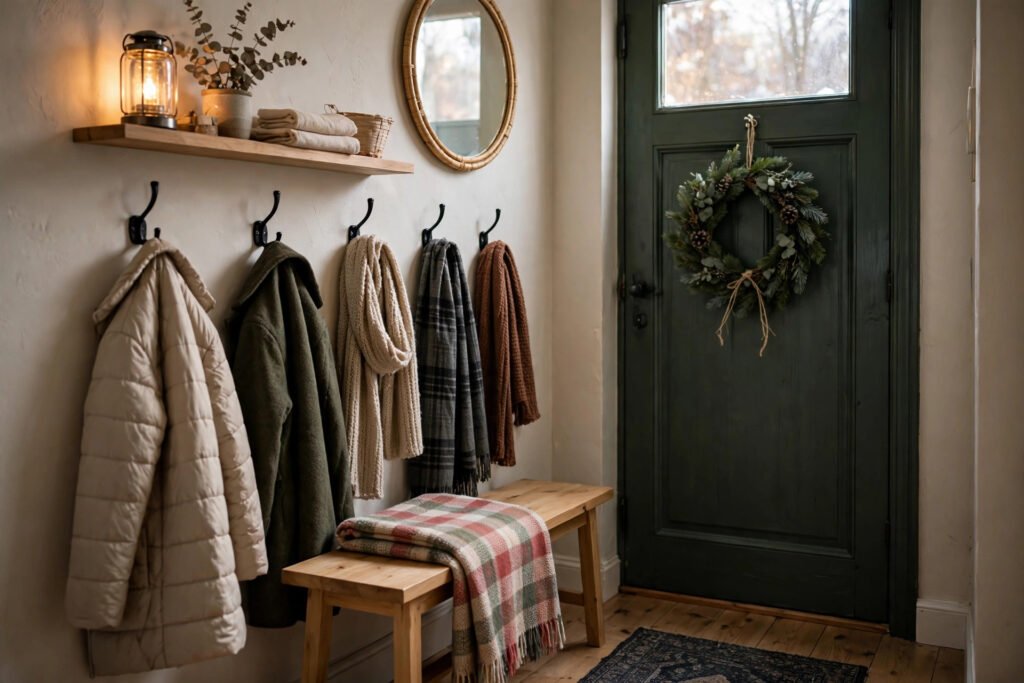

How to Decorate a Small Entryway for Winter on a Budget
Winter is when a small entryway works hardest. Coats, boots, scarves and wet umbrellas all pile up by the door, and a space that looked fine in summer suddenly feels crowded and cold. Learning to decorate small entryway winter budget ideas well is one of the cheapest ways to make your whole home feel warmer the moment you walk in. You do not need new furniture — a good mat, a few hooks, a small rug and some warm light are enough, and most of the ideas below cost under $25.
Before You Start: Measure and Set a Budget
Measure the wall and floor space you can spare before buying anything, and leave at least 90 cm of clear walkway so the door opens fully. Then set a total budget: roughly $10–$20 for a doormat, $10–$25 for hooks, $15–$30 for a rug, and $10–$20 for lighting and seasonal touches. Prices vary by shop and season, so always check the current price before buying.
1. Start With a Hard-Wearing Winter Doormat
The doormat is the hardest-working item in a winter entryway, so buy it before anything decorative. It catches slush, grit and salt that would otherwise spread across your floor. Choose a coir or heavy rubber-backed mat with a rough texture; smooth fabric mats look pretty but soak through and slide around.
The mat should be at least as wide as your door, and ideally a little wider, so both feet land on it. Shake it out weekly; a mat full of grit stops doing its job and starts scratching the floor. For more options, see our roundup of the best affordable doormats for every season.
2. Add Hooks and a Slim Coat Rack
Coats are the main reason small entryways feel chaotic in winter. A row of hooks keeps them off chairs and out of the walkway, and it costs very little. A rail with three to five hooks is usually enough for a household of two or three — one hook per person for a coat, one for a bag or scarf.
Mount the rail at about 170 cm high and fix it into a wall stud or use proper wall plugs — a rail full of wet winter coats is heavy. If you cannot drill, a slim freestanding coat stand works, but choose one with a heavy base so it does not tip. Our guide to affordable wall-mounted coat rack ideas has more layouts for narrow walls.
3. Give Shoes a Home With a Tray or a Bench
Wet shoes are the second biggest winter problem. A shallow boot tray by the door catches drips and keeps the floor dry, and it costs roughly $10–$20. Choose one with a raised edge and a ribbed base so water sits below the soles. In a very small space, a tray alone is enough — you do not need a full shoe rack.
If you have room for one piece of furniture, make it a bench with storage underneath. A slim bench gives you somewhere to sit while you pull on boots, and the space below holds two or three pairs of shoes out of sight. A second-hand bench, a painted crate, or a sturdy storage ottoman all work. Our budget entryway bench ideas show how to pick one that fits a narrow hall. Only the shoes you wore today stay by the door — the rest go in a closet.
4. Layer a Small Rug for Warmth
A small rug changes how a winter entryway feels underfoot. Cold tile or wood at the door is unpleasant in January, and a rug softens it instantly. Pick a low-pile, washable rug in a dark or patterned colour — light colours show every muddy footprint, and high pile traps grit.
Layer it a step beyond the doormat, where you stand to put shoes on. A runner suits a long narrow hall; a small rectangle or round rug suits a square landing. Add a thin non-slip pad underneath if the rug moves — a sliding rug in a small space is a trip hazard. For more seasonal ideas, our winter home decor ideas guide covers the rest of the house too.
5. Add Warm Light Without Rewiring
Most small entryways have one dim ceiling light, and in winter you come home in the dark. Warm light makes the space feel welcoming instead of gloomy, and you do not need an electrician. A battery-operated lantern on a small shelf or the bench gives a soft glow and costs roughly $10–$15.
Choose warm white bulbs, around 2700K, rather than cool daylight bulbs. Cool light makes a small space feel like a corridor; warm light makes it feel like a room. If your entryway has no socket at all, a motion-sensor light stuck under a shelf is a good fix — it switches on when you open the door and off when you leave.
6. Hang a Mirror to Bounce the Light
A mirror is the cheapest way to make a small entryway feel bigger and brighter in winter, when daylight is scarce. Hang it opposite or beside your light source so it bounces the glow around the space, and opposite the door if you can — it will catch the light every time the door opens.
Pick a simple rectangular or arched mirror, hang it at eye level, and keep it clear of the hooks. A mirror with a thin wooden or black metal frame suits most halls and costs roughly $15–$30 second-hand or on sale.
7. Add One Seasonal Touch, Not Ten
Winter decorating in a small entryway works best when it is restrained. Pick one seasonal piece and let it carry the theme: a simple wreath on the door, a small pine garland along the coat rail, or a basket of pinecones on the bench. One strong piece looks intentional; five small ones look cluttered.
Natural materials work well and cost little. A few evergreen sprigs in a jar, a cinnamon-scented candle on a safe surface away from coats, or a plaid throw folded over the bench arm all add warmth without taking up floor space.
Keeping a Small Entryway Tidy All Winter
Decorating is the easy part; keeping a small entryway tidy through winter is the habit that makes it work. Shake out the mat and rug once a week, wipe the boot tray when it fills, and do a two-minute reset each evening: coats on hooks, shoes in the tray, scarves in the basket. Edit ruthlessly — if a coat has not been worn in two weeks, it goes in the closet. For the rest of the hall, our budget entryway decor ideas guide has more layouts for rented homes and narrow spaces.
Frequently Asked Questions
How do I decorate a small entryway for winter on a budget?
Start with the practical pieces: a hard-wearing doormat, hooks for coats, a boot tray, and a small washable rug. Then add one warm light and one seasonal touch, such as a wreath or garland. Most small entryways can be done well for roughly $50–$100 in total.
What is the best rug for a small winter entryway?
A low-pile, washable rug in a dark or patterned colour works best. It handles muddy footprints, dries quickly, and can go in the washing machine when it gets grubby. Avoid high-pile and light-coloured rugs, which trap grit and show every mark.
How can I keep a small entryway from looking cluttered in winter?
Give everything a home and limit the numbers: one hook per person, one pair of shoes per person by the door, and one seasonal decoration. Do a two-minute reset each evening and move anything unused into a closet.
Do I need a bench in a small entryway?
Not necessarily. A bench is useful for sitting to put boots on and for hiding shoes underneath, but in a very narrow hall a boot tray and wall hooks do the same job in less space. Only add a bench if you can keep at least 90 cm of clear walkway after it is in place.
What colours work best in a small winter entryway?
Warm neutrals with one deeper accent work best: cream, warm grey or soft beige, with a deep green, burgundy or navy accent in the throw, wreath or basket.
Final Thoughts
To decorate small entryway winter budget ideas well, you need very little: a good mat, hooks, a tray or bench, a small rug, warm light, a mirror, and one seasonal touch. Keep the colours warm and simple, leave the walkway clear, and edit until the space looks calm. Your entryway will feel cosier all winter for very little money.