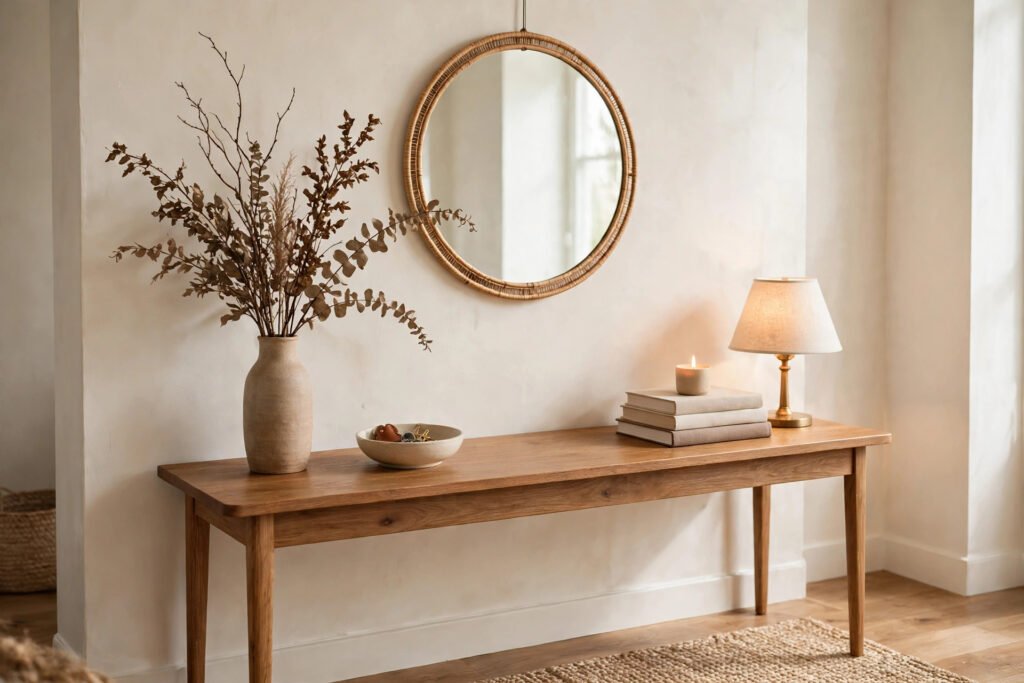

How to Style a Console Table
A console table is one of the easiest pieces of furniture to style — and one of the easiest to get wrong. It is narrow and sits against a wall, so everything on it is on display. Learning how to style a console table is mostly about a few simple rules: layer items at different heights, keep the look balanced, and leave enough empty space for the eye to rest. You do not need expensive pieces or a designer budget to get it right.
Start With the Right Spot
Most console tables sit in an entryway, behind a sofa, or along a hallway wall. An entryway console needs a place for keys, a small tray or bowl, and something welcoming. A living room console behind a sofa works better with low, soft pieces that do not block the view.
Whatever the spot, the table should suit the wall: leave at least 75 cm of clear walking space in front of it, and choose a table that fills about two-thirds of the wall’s width. Our guide to budget entryway decor ideas covers layout, lighting and storage basics.
The Golden Rule: Work in Odd Numbers
Odd numbers look natural; even groupings can look stiff. Think in small groups of three rather than lining up one item after another.
One classic grouping is a tall item, a medium item and a low item together on one side — a tall vase with branches, a stack of two books, and a small candle. Their different heights create a pleasing triangle that draws the eye upward. Repeat a smaller version on the other side, and the whole table feels intentional.
Build Height in Layers
A flat row of same-height objects looks like a shop shelf. Build height in layers, from the wall outward.
Anchor the wall first
Start with what hangs above the table: a mirror, a framed print, or a small piece of art — the anchor for everything below it. A round mirror softens a rectangular table, while a rectangular frame suits a long, low table. Hang it so its bottom edge sits 15–20 cm above the tabletop — close enough to feel connected, far enough that tall objects below do not touch it. A mirror also bounces light around the room; see our roundup of the best budget mirrors.
Add one tall piece, then fill the middle
Every console table needs at least one tall element to balance the anchor on the wall. A tall vase with dried branches, a table lamp, or a candlestick works well — keep it to one side rather than dead centre, since off-centre height feels more relaxed.
Books, a small plant, a decorative box or a framed photo fill the middle layer. Stack two or three books horizontally and place a small object on top — a candle, a tiny plant, a sculptural piece — to create a mini vignette.
Leave the front edge mostly clear, with only low items such as a small tray, a bowl for keys, or a short candle. Low pieces at the front keep the table from looking crowded and make it practical: you can set things down without knocking over a tall vase.
Balance Without Symmetry
Balance does not mean matching both sides. A table with identical lamps at each end looks formal and can feel dated. Instead, balance visual weight: a tall vase on the left can be balanced by a stack of books plus a small lamp on the right, because the two sides carry roughly the same weight even though the objects differ.
To check balance, step back and squint. If one side feels much heavier or emptier than the other, move one item across. Colour helps too: repeating one colour in two or three spots — a green plant on the left, a green book spine on the right — ties the two sides together.
Add Light and Something Living
A small table lamp is the easiest fix: it adds warmth and a soft glow in the evening. Pick a lamp that suits the table’s scale — slim for a narrow console, chunkier for a wide one. Our guide to the best budget table lamps lists affordable lamps that work on consoles and side tables alike. Candles are the cheaper alternative: a pair of candlesticks on one side and a single pillar candle on the other adds a warm, lived-in feel.
Almost every well-styled console table also has something living on it. A small potted plant, a vase of fresh flowers, or a bowl of greenery softens the hard lines of the table and adds colour that no decorative object can match. If you struggle to keep plants alive, dried stems, eucalyptus or faux greenery work well — modern faux plants look far better than the plastic-looking ones from a decade ago.
Keep It Practical
A console table is not a museum display: it has to work. In an entryway, that means a tray or bowl for keys and a clear spot to put down a parcel or a coffee. In a living room, it means space for a book or a remote control.
Build practical items into the styling instead of fighting them. A beautiful tray holds keys and looks deliberate. A lidded box hides clutter. A small basket under the table stores shoes out of sight.
Common Console Table Mistakes to Avoid
The most common mistake is overfilling the table. When every centimetre is covered, nothing stands out, and the table looks cluttered rather than curated. Aim to leave about a third of the surface empty — if unsure, remove one item and step back.
The second mistake is using objects that are all the same height. A row of similar-sized frames and candles reads as a flat line, so vary the heights by at least 10–15 cm between your tallest and shortest pieces.
The third mistake is ignoring the wall behind the table: a console without anything above it looks unfinished. And the fourth is forgetting scale: a tiny vase on a long, wide console looks lost, while a huge lamp on a narrow table looks top-heavy.
9 Quick Console Table Styling Ideas
Try one of these combinations:
- Classic entryway: round mirror, tall vase with branches, books with a candle, tray for keys.
- Minimalist: one large artwork, a single sculptural vase, nothing else.
- Cosy layered: table lamp, framed photo, small plant, basket underneath.
- Book lover’s: two book stacks at different heights, a small clock, a candle.
- Seasonal swap: keep lamp and mirror; change only the vase, books and one small object.
- Gallery: a small print leaning on the wall, a taller frame behind it, a low bowl.
- Behind the sofa: low pieces only — a long tray, two small plants, magazines.
- Hallway statement: one oversized vase with tall stems, a single print, a basket below.
- Budget refresh: rearrange what you own — a vase from the kitchen, a book from the bedroom, a candle from the bathroom. It costs nothing.
The same principles apply to open shelving: see our guide on how to style open shelves.
FAQs
How do you style a console table?
Start with an anchor on the wall, such as a mirror or artwork, then group objects in threes at different heights: one tall piece, a medium stack of books or a plant, and a low tray or candle. Leave about a third of the surface empty.
What should I put on a console table in an entryway?
A mirror or artwork above it, a tray or bowl for keys, a small lamp or candle for warmth, and one decorative piece such as a vase with branches. Keep the front edge clear so you can set things down.
How high should a mirror hang above a console table?
Hang the bottom edge of the mirror about 15–20 cm above the tabletop — close enough for the mirror and table to feel connected, but with room for tall objects below.
How many items should be on a console table?
Three to five main items is a good range for most console tables, grouped in clusters rather than spread evenly. Leave about a third of the surface empty so the arrangement can breathe.
Can I style a console table on a budget?
Yes — use things you already own: books, a vase from another room, a candle, a framed photo. Rearranging existing pieces costs nothing, and one small plant or thrifted tray often finishes the look.
The Bottom Line
Knowing how to style a console table comes down to a handful of habits: anchor the wall, group objects in threes, vary the heights, balance the two sides without mirroring them, and leave empty space. Add light, add something living, and keep the table practical. Once those habits are in place, you can restyle the same table in ten minutes — swap the vase, change the books, move the lamp.