
Disclosure: This article contains affiliate links. As an Amazon Associate, we earn from qualifying purchases. If you buy through these links, we may earn a small commission at no extra cost to you.
You do not need a designer budget to wake up in a bed that looks like it belongs in a boutique hotel. Bedding that looks expensive is rarely about one big purchase — it is about a handful of small choices: the right fabric, a calm colour palette, crisp layering and a few details that signal quality. All prices below are rough ranges only — check the current price before buying.
Start With the Fabric, Not the Thread Count
Thread count is the number most shoppers obsess over, but it is one of the least reliable signs of quality. A 400-thread-count sheet made from short, rough fibres can feel worse than a 200-thread-count sheet made from long-staple cotton.
Percale is a crisp, matte weave that feels cool and fresh — the classic hotel sheet. Sateen has a soft sheen and a silkier hand, which reads as more luxurious, especially in solid colours. Linen looks effortlessly expensive because of its relaxed texture, although it wrinkles, which is part of its charm. Spend your money on the fitted sheet and pillowcases first — those are the pieces your skin touches. A decent cotton percale set usually costs roughly $25 to $60 for a queen size; linen sets start at roughly $80.
Choose Solid Colours Over Busy Patterns
Busy prints are the fastest way to make bedding look cheap. Large, bright florals and novelty patterns draw the eye to the print rather than the bed, and they clash with everything else in the room. Solid colours, by contrast, look calm, intentional and far more expensive. White is the classic luxury choice — it signals cleanliness and makes any room feel brighter. If white feels too stark, try soft neutrals: warm ivory, pale grey, sage green or a muted dusty blue.
If you love pattern, keep it small and quiet: a thin stripe, a subtle geometric, or a tonal jacquard woven into the fabric rather than printed on top. Our guide on how to mix patterns in home decor (https://somedecor.com/mix-patterns-home-decor/) explains how to combine prints without the result looking chaotic.
Layer Like a Hotel
The single biggest difference between a bed that looks expensive and one that does not is layering. A bare mattress with a single flat sheet looks unfinished; a bed with three or four visible layers looks considered.
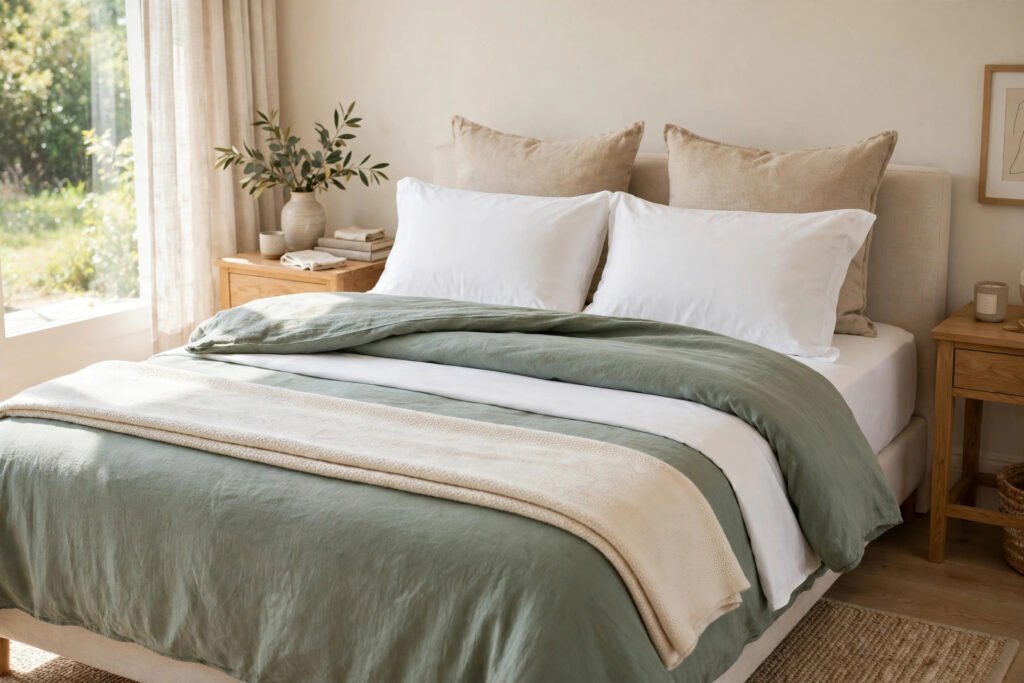
Start with a fitted sheet, then a flat sheet folded back about 30 cm at the top. Add a lightweight coverlet or quilt, folded down to show the sheet underneath, then a duvet folded back a third of the way. Finish with a folded throw across the foot of the bed.
You do not need to buy everything at once. A plain white flat sheet and a simple throw can transform bedding you already own.
Invest in the Duvet Insert, Not Just the Cover
A flat, limp duvet is the giveaway of budget bedding. What makes a duvet look plush is the insert inside it — and you can upgrade the insert without replacing the cover.
Look for an insert that is slightly larger than your duvet cover. A queen insert in a king cover, or a king insert in a queen cover, fills the corners properly and gives the duvet that overstuffed, cloud-like look. Down-alternative inserts are affordable and hypoallergenic; a decent one usually costs roughly $30 to $70.
Get the Pillow Situation Right
Two flat pillows on a made bed look sad. The hotel formula is simple: two sleeping pillows in front of the headboard, then two slightly larger pillows (or Euro shams) in front of those, then one or two small cushions for colour. The trick is height — the stack should fill the space between the mattress and the headboard.
You do not need expensive pillows. What matters is that they are plump, not lumpy. Replace sleeping pillows roughly every one to two years; once a pillow folds in half and stays folded, it is done. Good budget pillows usually cost roughly $10 to $25 each. A pair of Euro shams in a neutral linen-look fabric instantly makes the bed look styled — see our roundup of the best budget nightstands (https://somedecor.com/best-budget-nightstands/) for more small-bedroom upgrades that punch above their price.
Iron (or Steam) the Top Layer
This sounds fussy, but it is the cheapest luxury trick there is. A wrinkled duvet cover reads as untidy; a smooth one reads as expensive. You do not need to iron the whole set — just the top 30 cm of the duvet cover and the pillowcases that face the room. A handheld steamer costs roughly $20 to $40 and does the job in two minutes while the bedding is on the bed.
Keep the Palette to Three Colours
Designers use a simple rule: one main colour, one secondary colour, and one accent. For bedding, that might mean white sheets, a sage duvet cover, and a terracotta throw.
Three colours keep the bed looking calm and deliberate. More than that, and the bed starts to look busy, no matter how much you spent. If you are unsure, default to neutrals for the big pieces and let the accent live in the smallest item — the throw or a single cushion — so you can swap it seasonally for almost nothing. A velvet cushion is a good accent: our guide to the best velvet curtains (https://somedecor.com/best-velvet-curtains/) shows how a little velvet goes a long way on a budget. For the wall above the bed, our budget-friendly gallery wall ideas (https://somedecor.com/gallery-wall-ideas-budget/) show how to fill the space cheaply.
Tuck, Fold and Smooth Every Morning
A made bed takes two minutes and changes the whole room. Pull the flat sheet tight, fold the duvet back evenly, fluff the pillows and place the throw straight. Hospital corners on the flat sheet — tucking the sides under the mattress — give the bed a tailored, finished edge. A neatly made bed in any colour looks more expensive than an unmade one in the finest linen.
What to Avoid
A few things undo all the good work instantly:
- Shiny polyester satin sheets. They photograph well but feel clammy and look cheap in daylight.
- Mismatched sheet sets. A fitted sheet in one white and pillowcases in another is surprisingly noticeable.
- Too-small duvet covers. A cover that barely reaches the edges of the mattress makes the bed look underdressed.
- Overloading the bed with cushions. More than three or four decorative cushions looks cluttered. Keep it simple.
Common Bedding Mistakes to Avoid
- Buying the cheapest set available. The lowest-priced sets often use thin, rough fabric that pills within weeks. Spending a little more on cotton usually costs less in the long run than replacing a cheap set twice.
- Ignoring the size. Measure your mattress before ordering, including its depth. Deep mattresses need deep-pocket fitted sheets.
- Washing with too much detergent. Excess detergent builds up in fibres and makes sheets feel stiff and look dull. Use less than you think and skip fabric softener on cotton.
- Forgetting the bed skirt or base. A bare metal frame or a stained mattress edge showing below the fitted sheet ruins the look. A simple bed skirt hides it for roughly $15 to $30.
FAQs
What bedding looks the most expensive?
Solid-coloured cotton percale or linen in white, ivory or a soft neutral, layered with a folded flat sheet, a quilt and a throw. The fabric and the layering matter more than the brand or the price.
Is a high thread count worth it?
Not on its own. Fibre quality and weave matter more than the number. A 200 to 400 thread-count sheet in long-staple cotton usually feels better and lasts longer than a 1,000-thread-count sheet made from short fibres.
How can I make cheap bedding look expensive?
Layer it: a folded-back flat sheet, a quilt or coverlet, a plump duvet and a throw across the foot. Use solid colours, steam the visible top layer, and add two Euro pillows behind your sleeping pillows.
What colour bedding looks most luxurious?
White is the classic luxury choice, followed by warm neutrals such as ivory, pale grey and sage. Dark colours like charcoal and navy can also look rich, but they show lint and pet hair more easily.
How often should I replace my bedding?
Sheets and pillowcases usually last two to three years; pillows should be replaced every one to two years. A good duvet insert can last five years or more if aired regularly and kept in a washable cover.
Final Thoughts
Bedding that looks expensive is not about spending more — it is about spending wisely and styling carefully. Choose a natural fabric in a solid, calm colour, layer it properly, size the duvet generously and keep the bed made. Those five habits will make almost any bedding look like it cost three times what you paid.