
Disclosure: This article contains affiliate links. As an Amazon Associate, we earn from qualifying purchases. If you buy through these links, we may earn a small commission at no extra cost to you.
A gallery wall is one of the cheapest ways to make a room feel finished. Gallery wall ideas budget shoppers love start with what you already have — family photos, postcards, pages from old books — and add a few affordable pieces to fill the gaps. You do not need matching frames, expensive art or a designer’s eye. All prices below are rough ranges only — check the current price before buying.
Start With a Plan, Not a Purchase
The biggest mistake people make is buying frames first and figuring out the layout later. Start with the wall instead. Aim to fill about two-thirds of its width above a sofa or console table, leaving 15 to 20 centimetres (6 to 8 inches) between the bottom of the frames and the top of the furniture.
Lay your pieces on the floor before you buy anything. Shuffle them until the arrangement feels balanced: one or two larger pieces to anchor the display, several medium ones, and a few small ones to fill gaps. Keep gaps between frames fairly even — about 5 to 8 centimetres (2 to 3 inches) looks intentional rather than random.
1. Use Your Own Photos — Printed Large
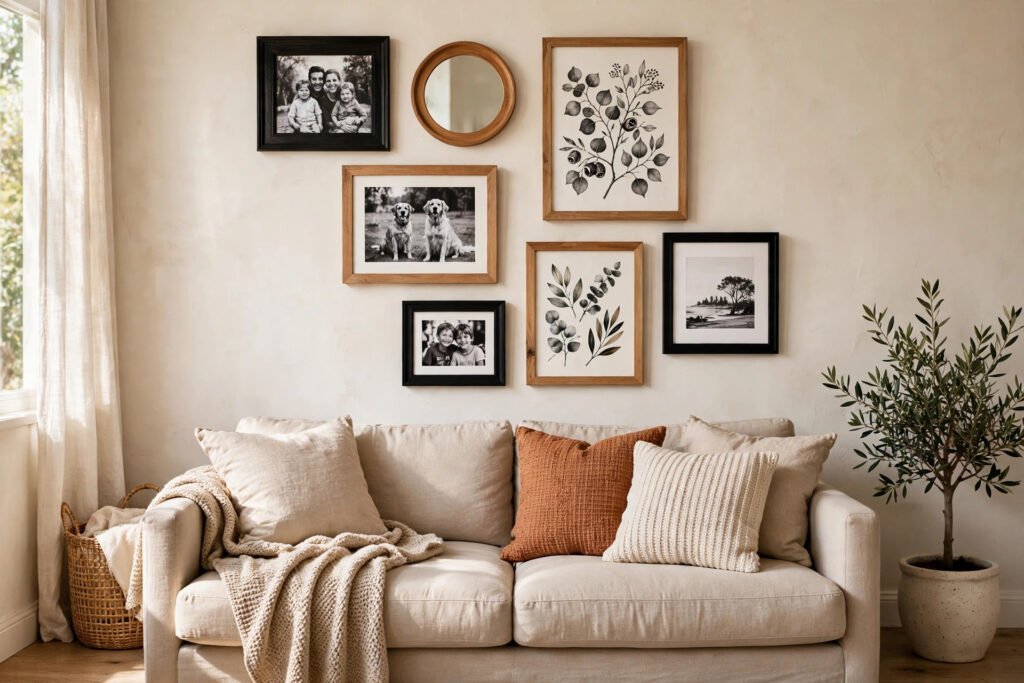
Your phone holds hundreds of photos, and a handful of them deserve a wall. A 20 x 25 cm (8 x 10 inch) print usually costs roughly $1 to $3, and a larger 30 x 40 cm (12 x 16 inch) print roughly $5 to $10. Black and white prints are a clever trick — they make mismatched photos from different holidays look like a deliberate set.
2. Mix Cheap Frames With One or Two Good Ones
Buy inexpensive frames in one or two finishes — black and natural wood work with almost anything — and spend a little more on one statement frame for your largest piece. Budget frames in standard sizes usually run roughly $3 to $10 each, while a solid wood frame for a large print might cost roughly $15 to $30. Check charity shops first — a secondhand frame and a coat of spray paint cost next to nothing.
3. Print Free and Low-Cost Art
You do not need to buy art to have art on your wall. Public-domain artworks — old botanical prints, vintage maps, classic paintings — are free to download from museum and library archives, and a local print shop can produce them cheaply. Digital downloads of abstract prints and typography posters usually cost roughly $5 to $15.
4. Add a Mirror to Break Up the Grid
A small mirror tucked into a gallery wall adds light and depth, and stops a wall of flat prints from feeling one-dimensional. A round mirror works particularly well among rectangular frames because it breaks the geometry. See our guide to the best budget mirrors for options that cost roughly $15 to $40 and suit small spaces.
5. Frame Postcards, Cards and Book Pages
Some of the best gallery wall pieces cost nothing at all: a beautiful greeting card, a postcard from a trip, a page from an old illustrated book, a favourite album cover. Mount them on a slightly larger piece of coloured card for a matted look — a sheet of card costs pennies and makes a small print feel much more considered. Test the layout first with paper templates taped to the wall.
6. Try a Ledge Instead of Nails
Picture ledges — narrow shelves that hold frames leaning against the wall — are ideal if you like to rearrange things. You can swap prints seasonally and layer smaller frames in front of larger ones. A single 60 cm ledge usually costs roughly $10 to $25. Ledges are also renter-friendly: one ledge needs two screws, while a traditional gallery wall can need twenty or more fixings.
7. Hang With Adhesive Strips (No Holes)
Adhesive picture-hanging strips hold frames up to a few kilos, remove cleanly, and let you adjust a crooked frame without a new hole. A pack usually costs roughly $5 to $10 and covers several frames. Follow the weight limits, clean the wall first, and press firmly for thirty seconds. For anything over about 3 kg, use a proper picture hook — heavy frames and textured walls do not suit adhesive strips.
8. Keep a Consistent Colour Palette
A gallery wall does not need matching frames, but it does need something tying it together. The easiest way is a limited colour palette: pick two or three colours that appear across your prints and repeat them. Black and white photos with one accent colour — a warm terracotta, a deep green — look pulled together even when the frames and subjects are completely different. Our guide on how to mix patterns in home decor explains how to combine colours and prints without clashing.
9. Go Symmetrical for a Calm Look
A symmetrical grid — four, six or nine frames of the same size, evenly spaced — is the easiest gallery wall to get right. It suits hallways, bedrooms and anywhere you want a calm, ordered feel. Buy a multipack of identical cheap frames, print a matching set of photos, and the whole wall can cost less than roughly $40.
10. Go Salon Style for an Eclectic Look
Salon style means filling the wall edge to edge with frames of different sizes, shapes and finishes, like the walls of a Paris art salon. Start with your largest piece slightly off-centre, then build outwards, keeping the outer edge roughly even. Lay the arrangement on the floor first and photograph it from above — it is much easier to spot a gap or a lopsided corner in a photo than on the floor.
11. Add Something That Isn’t a Picture
A gallery wall does not have to be all pictures. A small woven basket, a decorative plate, a tiny wall shelf with a plant, or a piece of fabric in an embroidery hoop adds texture and stops the wall from feeling flat. Our DIY wall decor ideas include several low-cost projects — painted hoops, pressed flowers, fabric panels — that slot neatly into a gallery arrangement.
12. Light It (Cheaply)
A gallery wall in a dark hallway can disappear after sunset. A battery-powered picture light above the largest frame, or a small LED strip along a picture ledge, costs roughly $10 to $20 and makes the whole display look far more expensive than it is. Warm white light suits most art; cool white can make photos look clinical.
Common Gallery Wall Mistakes to Avoid
- Hanging everything too high. The centre of the arrangement should sit at roughly eye level — about 145 cm (57 inches) from the floor.
- Spacing frames too far apart. Gaps wider than about 8 cm make the pieces look like separate pictures rather than one display.
- Using only small frames on a big wall. Small frames on a large empty wall look lost. Add at least one large piece, or group the small frames tightly so they read as one block.
- Forgetting to check the wall. Old plaster and hidden pipes are worth checking before you drill. Check for studs before hanging anything heavy.
FAQs
How much does a gallery wall cost?
A small gallery wall of six to eight frames can cost roughly $30 to $80 with budget frames and home-printed photos. Secondhand frames, free printable art and pictures you already own can bring that under $30.
How do I hang a gallery wall without damaging the wall?
Use adhesive picture-hanging strips for light frames, or a picture ledge that needs only two screws. Both remove cleanly in most rentals. Always check the weight limit on the strips you buy.
What is the best layout for a gallery wall?
Start with your largest piece slightly off-centre, then build around it, keeping gaps of 5 to 8 cm between frames. A symmetrical grid is easiest for beginners; a salon-style arrangement suits mixed frames and sizes.
How high should a gallery wall be?
The centre of the display should sit at about eye level — roughly 145 cm (57 inches) from the floor. Above furniture, leave 15 to 20 cm between the bottom of the lowest frame and the top of the furniture.
Can I make a gallery wall in a rental?
Yes. Use adhesive strips, picture ledges or freestanding frames on a console table to avoid holes. Our guide to decorating a rental has more damage-free ideas.
Final Thoughts
A gallery wall rewards starting, not planning forever. Pick the wall, gather what you already own, add a few budget frames and prints, and hang the first piece. The gallery wall ideas budget decorators rely on most are not about spending more; they are about using what you have, framing it well, and letting the wall tell your story.