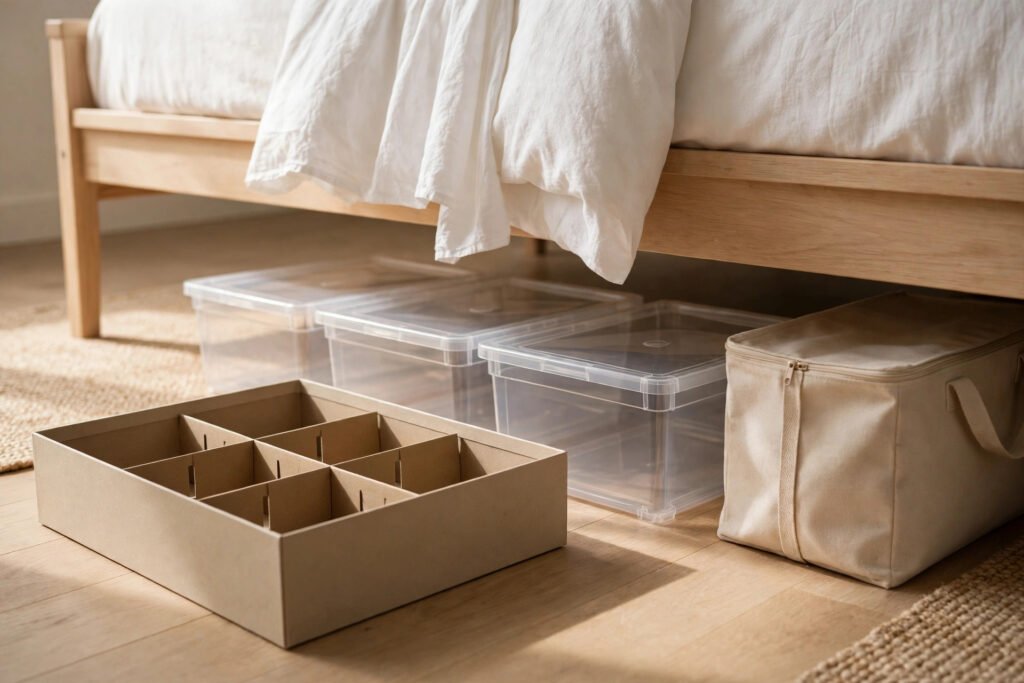

If you want to organize under bed storage budget style, start with the space you already own. The area under your bed is often the largest unused storage spot in the bedroom yet most of us fill it with a jumble of bags and boxes we forgot we owned. With a few cheap containers, a measuring tape and one afternoon, that dead space can hold out-of-season clothes, spare bedding, shoes and keepsakes, neatly and out of sight.
Measure First: Know What Fits Under Your Bed
Before you buy a single box, measure the space. Slide a tape measure underneath and note the height from the floor to the underside of the frame, the width from side to side, and the depth from head to foot. Most beds offer between 6 and 14 inches of clearance. A low platform bed may give you only 5 or 6 inches, which rules out deep bins but still fits flat fabric bags and shallow trays.
Check what is in the way, too. Some frames have a centre support leg or crossbars that split the space in two, so two narrower bins may fit where one wide one will not. Leave a finger’s width of spare height — a bin that scrapes the frame every time you pull it out will crack. If your bed sits almost on the floor, bed risers are a cheap fix: a set of four costs roughly $10–$20 and lifts most frames by 3 to 5 inches. Our guide to best budget bed frames has more on frames with useful clearance built in.
8 Budget Ideas to Organize Under-Bed Storage
1. Flat Bins With Lids
Flat, lidded bins are the workhorse of under-bed storage. Choose clear plastic so you can see what is inside without pulling the bin out, and pick lids that snap on rather than resting on top — a loose lid slides off and lets dust in. A pair costs roughly $15–$30. Sort by category, one bin per category: out-of-season clothes, spare sheets, wrapping paper.
2. Vacuum Bags for Bulky Bedding
Duvets, winter blankets and spare pillows eat space fast. Vacuum storage bags shrink them to about a third of their size, and a set of four costs roughly $10–$20. They suit items you will not need for months, like a heavy winter duvet in summer. Avoid them for feather or down you use weekly, and never store damp items in a sealed bag.
3. Rolling Drawers on Castors
If you reach under your bed often, rolling drawers are worth the small extra cost. A shallow drawer on castors slides out like a kitchen drawer, so you can grab a jumper or shoes without dragging a bin across the carpet. One drawer costs roughly $20–$40. They work best on hard floors: on thick carpet the wheels can stick, so test one before buying a set.
4. Divided Boxes for Shoes
Shoes are the classic under-bed clutter: pairs separate, soles get dusty, and you can never find the matching one. A divided shoe organiser — a flat box with compartments or a fabric organiser with slots — keeps each pair together and off the floor, for roughly $10–$25. Store rarely worn shoes under the bed and keep everyday pairs by the door. Our roundup of best storage ottomans covers another good spot for shoes and spare blankets.
5. Fabric Bags for Seasonal Clothes
Soft fabric bags are the gentlest option for clothes. They weigh almost nothing, fold flat when empty, and a set of two or three costs roughly $12–$25. Choose bags with a clear window or a label pocket on the end, so you can tell winter jumpers from summer dresses without opening them. Fold clothes flat so they stack evenly, and add a cedar block or lavender sachet to keep moths away.
6. DIY Dividers From Cardboard
You do not need to buy dividers. Sturdy cardboard boxes, cut down to the height of your bin, make free dividers that stop small items sliding into one big pile. Cut a cereal box or delivery box to size, wrap it in wrapping paper or fabric offcuts if you want it to look tidy, and slot it into a bin to create compartments for scarves, belts, gloves and hats. Cardboard suits dry rooms best; in a damp bedroom, use plastic dividers instead.
7. Label Everything
Labelling is the step most people skip, and it is the one that keeps the system working. A label on the end of every bin — the end that faces out — means you never have to pull out three boxes to find the one you want. Masking tape and a marker are all you need. Be specific: “Winter clothes” is useful, “Clothes” is not. See our guide on how to organize a small closet on a budget for labelling ideas that work in wardrobes too.
8. Hide It With a Bed Skirt
Once the storage is organised, a bed skirt — also called a dust ruffle or valance — hides it all and makes the room look instantly tidier. A simple cotton or linen-look bed skirt costs roughly $15–$30 and hangs from under the mattress to the floor. Choose a colour close to your bedding so it blends in. It also keeps dust out, which means less cleaning under the bed.
What Not to Store Under Your Bed
Not everything belongs under the bed. Avoid anything you need every day — digging underneath each morning gets old fast. Skip things that suffer in dust or damp: important papers, photographs, leather goods and electronics. Dust settles low and first, so anything valuable belongs in a closed cupboard. Also avoid food, candles and anything with a strong smell, and do not store anything heavy enough to damage the floor, like a deep bin full of books. Our ideas for a budget bedroom makeover under $100 show where to put the things that do not belong under the bed.
Keep Dust Out and the System Tidy
Dust is the biggest enemy of under-bed storage, but a few cheap habits keep it under control. Lids and zips matter more than anything else — open-top baskets look pretty but let dust settle straight onto your clothes. If your bins have no lids, drape an old sheet over them before sliding them in. Vacuum under the bed once a month with a flat nozzle, and wipe the bin lids while you are there so dust does not fall in when you open them.
The system only works if it is easy to keep up. Use one bin per category, labelled on the end, with the things you reach for most near the foot of the bed. Rotate seasonal items twice a year — spring and autumn — and use the rotation to clear out anything you have not used in a year. Check monthly that each label still matches what is inside. Our guide to make a small bedroom feel cozy on a budget has more small-bedroom storage ideas.
Frequently Asked Questions
How much weight can I store under my bed?
Most frames handle it easily, since the weight sits on the floor rather than on the frame. Keep each bin under about 10–15 kg so it stays easy to pull out.
What is the best container for under-bed storage?
Clear plastic bins with snap-on lids are the best all-round choice: they keep dust out and let you see what is inside. Fabric bags suit clothes, vacuum bags suit bulky bedding, and divided boxes suit shoes.
How do I keep things under my bed dust-free?
Use containers with lids or zips, keep the bed skirt in place, and vacuum under the bed once a month. Avoid open baskets.
Can I store clothes under the bed long term?
Yes, if they are clean, fully dry and sealed in a lidded bin or zipped bag with a cedar block or lavender sachet. Never store damp clothes sealed up — they will smell musty quickly.
Do bed risers damage the bed frame?
Good-quality risers made for your bed’s leg shape are safe for most frames, but check the weight limit first and make sure each leg sits squarely in its riser. Never stack risers.
Final Thoughts
Organising under-bed storage on a budget is mostly about measuring first, choosing the right container for each category, and labelling everything so the system survives real life. Start with one side of the bed and a couple of bins, see how it feels for a week, then finish the rest. The space is already there — it just needs a little structure to earn its keep.