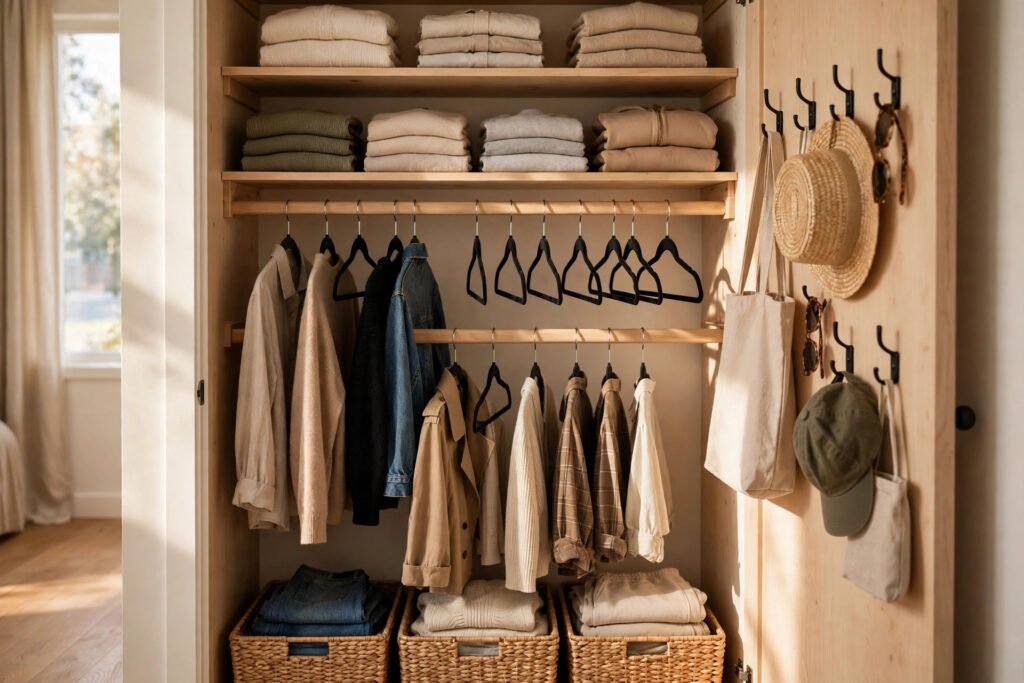

How to Organize a Small Closet on a Budget
A small closet does not have to stay a cramped, chaotic mess. With a plan and a few cheap fixes, you can organize small closet budget style — no renovation, no custom joinery, and no big spend — and end up with more usable space than you thought you had. Most small closets fail for the same reasons: too many clothes and wasted vertical space. Here are nine practical ideas, in the order you should do them, plus what the project is likely to cost.
1. Empty It Completely and Declutter First
Every closet makeover starts the same way: take everything out. You cannot organize a space you cannot see. Pull every item out, wipe the shelves and floor, and sort your clothes into three piles — keep, donate, and toss. Be honest. If you have not worn something in a year, if it does not fit, or if it is damaged beyond a simple repair, let it go.
Most people can remove a quarter to a third of what is in the closet. That alone frees up real space, and it costs nothing.
2. Measure Before You Buy Anything
Before you order a single bin or rail, measure your closet. Note the width, depth and height, the length of the existing rail, and the height from the floor to the rail and from the rail to the shelf above it.
Measuring matters because small closets punish guessing. A basket 5cm too wide wastes a whole shelf, and a second rail hung too low leaves shirts dragging on the floor. Hanging space needs about 100cm of height for shirts and about 140cm for dresses, so your numbers tell you immediately whether a second rail will fit.
3. Add a Second Hanging Rail
The single biggest win in a small closet is a second hanging rail. Most closets have one rail with a huge empty gap underneath it, where short items like shirts never reach. A second rail, hung about 100cm below the top one, instantly doubles your hanging space.
Adjustable tension rods cost very little and need no drilling, which makes them ideal for renters. If you are allowed to drill, a simple wall-mounted rail with two brackets is sturdier and costs roughly $10–$20. Hang shirts, blouses and folded trousers on the lower rail, and keep longer items like dresses and coats on the top rail.
4. Use the Shelf You Already Have
Almost every closet has a shelf above the rail, and almost every closet wastes it. That shelf is prime storage for the things you use least: out-of-season clothes, spare bedding, or bags. The trick is to stop stacking loose piles that topple over.
Use a few matching boxes or fabric cubes to contain the shelf. Fold out-of-season clothes into a box, label it, and put it at the back. Keep the things you reach for weekly at the front.
5. Switch to Slim Hangers
Bulky plastic and wooden hangers eat space. A row of thick hangers can take up 10cm more than the same clothes on slim velvet hangers, and in a small closet that 10cm is the difference between clothes that hang freely and clothes that are crushed together. Slim velvet hangers are also non-slip, so blouses and strappy tops stay put instead of sliding onto the floor.
A pack of 30–50 slim hangers usually costs roughly $10–$15. Replace your hangers gradually if you prefer, starting with the bulkiest ones. For more ways to stretch a small bedroom on little money, see our budget bedroom makeover ideas under $100.
6. Use the Back of the Door
The back of the closet door is free storage that most people ignore. An over-door hook rail needs no screws and holds belts, scarves, hats, bags and tomorrow’s outfit. Over-door shoe organizers with clear pockets work just as well for accessories as for shoes — use the pockets for scarves, gloves, jewellery and small bags.
Keep the door storage light. Heavy bags on a hollow door can strain the hinges, so hang the heavy items on the rail instead.
7. Bins, Baskets and Labels
Small things ruin a small closet faster than anything else. Socks, underwear, scarves, belts and accessories end up in one tangled drawer or piled on a shelf. The fix is simple: give every category a container and label it.
Cheap fabric cubes, small baskets or even sturdy shoe boxes work well. One cube for scarves, one for belts, one for swimwear — whatever your categories are. Labels matter more than matching boxes, because a label is what stops the system falling apart after a week.
8. Fold and File Instead of Stacking
Tall stacks of folded jumpers look neat for a day, then collapse the moment you pull one from the middle. The better method is filing: fold clothes into neat rectangles and stand them upright in a drawer or a bin, like files in a filing cabinet. You can see everything at a glance, and taking one item out does not disturb the rest.
This works best for T-shirts, jumpers, jeans and children’s clothes. Drawer dividers or small boxes keep the files upright. If your closet has no drawers, a couple of open bins on the floor do the same job. Extra storage that lives outside the closet helps too; our roundup of the best budget storage ottomans shows pieces that hide clutter in plain sight.
9. Rotate Seasonally
A small closet cannot hold a full year’s wardrobe at once, and it should not try. Twice a year, swap the seasons. Pack away heavy winter coats and thick jumpers when spring arrives, and do the reverse in autumn. Store the off-season clothes in a labelled box on the top shelf, under the bed, or in a vacuum bag.
Seasonal rotation frees up roughly a third of your hanging space overnight. For more small-space thinking, our small apartment decor ideas on a budget use the same rotate-and-edit approach for whole rooms.
What a Small Closet Makeover Costs
You can transform a small closet for very little. A realistic budget: a second hanging rail, roughly $10–$20; a pack of slim hangers, roughly $10–$15; two or three fabric cubes or baskets, roughly $10–$20; an over-door hook rail, roughly $8–$15; and labels, hooks and drawer dividers, roughly $5–$10. That puts the whole project at roughly $45–$80, and you can do it in stages — declutter and measure first, then add one piece at a time. Prices are rough ranges only — check the current price before buying.
Mistakes to Avoid
The most common mistake is buying storage before decluttering. Bins and baskets do not create space; they only organize what is already there. If the closet is overstuffed, new storage just hides the problem for a few weeks.
Another mistake is overfilling the rail. Clothes need a little air between them, or they crease and you cannot see what you own. Leave a finger’s width between hangers where you can.
FAQs
How do I organize a small closet with no money?
Start with the free steps: empty the closet, declutter honestly, and rehang what is left with a gap between hangers. Use shoe boxes as drawer dividers. You can organize small closet budget with zero spend — the rail, hangers and bins come later, only if the free steps are not enough.
What is the best way to double space in a small closet?
Add a second hanging rail below the first one. It is the single most effective change, roughly doubling hanging space for about $10–$20. Pair it with slim velvet hangers and you gain even more room without changing anything else.
How do I keep a small closet tidy long term?
Give every category a home and do a five-minute reset once a week — rehang anything that slipped and return strays to their bin. A seasonal rotation twice a year keeps the volume under control. If you like hands-on projects, our DIY home decor projects under $20 include a few cheap closet upgrades you can build yourself.
Should I fold or hang clothes in a small closet?
Hang anything that creases easily — shirts, blouses, dresses and trousers. Fold and file knitwear, T-shirts and jeans, because hanging stretches them out of shape. Use the rail for the first group and bins or a shelf for the second, and never stack folded clothes higher than about 25cm or the pile will topple.
How many clothes should fit in a small closet?
There is no magic number, but a good test is the hanger test: if you cannot slide a hanger along the rail easily, the closet is too full. Most people find that 30–50 hanging items plus a few bins of folded clothes is a comfortable limit for a standard single closet.