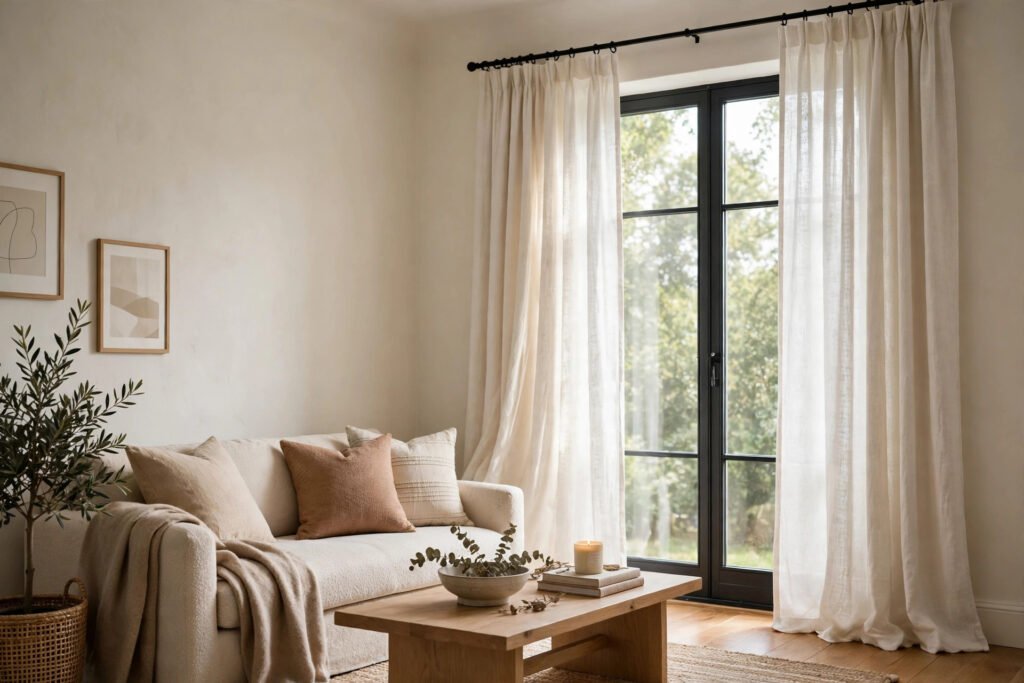

Curtains that are the wrong length can make a whole room look off. Too short, and the window looks unfinished, like trousers that shrank in the wash. Too long, and the fabric pools on the floor. Learning to choose curtain length every room correctly is one of the cheapest ways to make your home look polished — the right length makes windows look taller and rooms feel bigger.
The Four Standard Curtain Lengths
Almost every curtain falls into one of four lengths.
Sill length ends right at the windowsill, about 1 to 2 centimetres above it. It works best where a longer curtain would get in the way — above a radiator, over a kitchen sink, or in front of a desk.
Apron length hangs a few centimetres below the sill, roughly to the bottom of the window frame. It looks more finished than sill length while staying clear of anything underneath — a good choice for bedrooms and bathrooms.
Floor length is the classic choice for living rooms and bedrooms. The curtain ends about 1 to 2 centimetres above the floor — close enough to look elegant, but not so long that it drags or collects dust.
Puddle length is deliberately longer than the floor, with an extra 5 to 15 centimetres pooling on the ground. This luxurious look suits formal living rooms and master bedrooms, but pooled fabric collects dust and is a trip hazard, so save it for low-traffic spaces.
How to Measure for Curtains
Guessing causes most wrong-length curtains — a tape measure and five minutes will save you a return trip.
First, decide where the rod goes. Hang it 10 to 15 centimetres above the window frame, or halfway between the top of the frame and the ceiling — a higher rod makes the window look taller. For more on this, see our guide to how to hang curtains the right way.
Next, measure from the rod to your finish point. Hook the tape at the bottom of the rod, or at the bottom of the rings, and measure straight down to where the curtain should end. Measure in two or three places — floors are rarely level — and use the longest measurement so no corner floats.
Then check how the listed length is measured. Some styles, such as tab-top and rod-pocket curtains, sit differently on the rod, so confirm whether the drop is measured from the top of the curtain or from the rod. Curtains come in standard drops such as 137 cm, 183 cm, 213 cm, and 228 cm — pick the nearest size above your measurement.
Finally, do not forget the width. Curtains should be one and a half to two times the window width when closed, so they hang in soft folds rather than stretched flat. Measure the rod, not the window.
The Best Curtain Length for Each Room
The right length depends on what the room is used for. Here is a room-by-room guide to help you choose curtain length every room.
Living room: floor length. This is the default — it makes the room feel taller and more finished, and frames the window beautifully. In a formal, low-traffic room, a slight puddle adds drama. If there is a radiator under the window, switch to sill or apron length so heat is not trapped behind heavy fabric.
Bedroom: floor length or apron length. Floor-length curtains look soft and restful, and block light better than short ones because there is no gap for light to sneak under. Apron length is a good alternative if the bed sits against the window wall. Pair them with a sturdy rod; see our roundup of the best budget curtain rods and hardware for options that hold heavy fabric without sagging.
Kitchen: sill or apron length. Short curtains almost always win here — long curtains near a cooker or sink get wet and greasy, and they can catch on things. Sill-length curtains stay clear of worktops and water and are easy to wash. Cafe curtains, which cover only the lower half of the window, are another good option.
Bathroom: sill length. Sill-length curtains keep fabric away from water and steam, and a short cafe curtain works well on a small, high window. Avoid puddle length — wet fabric on a bathroom floor breeds mould.
Dining room: floor length. Floor-length curtains add softness to a room full of hard surfaces — a wooden table, hard chairs, a bare floor. If the table sits close to the window, make sure the curtains hang clear of the chairs when they are pulled out.
Curtain Length for Tricky Windows
Small windows. Short curtains make a small window look smaller. Hang the rod wider and higher than the window and use floor-length curtains, and the window looks much bigger — the eye reads the whole arrangement as one large window. For more tricks, see our guide to how to choose curtains for a small window.
Bay windows. Use floor-length curtains on a bay rod that follows the shape of the window, or a straight rod across the front of the bay. Sill length in a bay can look choppy.
Sliding doors and French doors. These need floor-length curtains — anything shorter looks wrong and leaves the bottom of the door exposed. Hang the rod high so the curtains do not catch on the handles, and for sliding doors use a track, which lets the curtains slide smoothly and stack neatly.
Windows above radiators or furniture. If a radiator, desk, or storage bench sits under the window, long curtains bunch up behind it. Sill or apron length is the answer — end the curtain just above the obstacle.
Common Curtain Length Mistakes
Buying the “standard” length without measuring. Lengths vary between shops. Always measure your own window and check the listed drop before ordering.
Curtains that end halfway down the wall. Curtains that stop between the sill and the floor look like a mistake. Pick one of the four standard lengths and commit to it.
Letting floor-length curtains touch the floor. A curtain that grazes the floor drags, picks up dust, and looks untidy within a week. Leave a gap of 1 to 2 centimetres.
Forgetting the heading and the rings. Measure from the bottom of the rod or rings, not from the top of the window frame.
Choosing puddle length for a busy room. Puddles are beautiful in a formal living room and a nightmare anywhere a dog runs through. If the room gets daily traffic, choose floor length instead.
A Quick Curtain Length Cheat Sheet
When in doubt, remember this: living room, floor length (or a slight puddle for a formal look); bedroom, floor length, apron length if the bed is against the window; kitchen, sill length or cafe curtains; bathroom, sill length; dining room, floor length; above a radiator or desk, sill or apron length; sliding or French doors, floor length on a track or wide rod.
Floor length is the safest choice for any main room — it suits almost every style, and makes budget curtains look most expensive. Heavy fabrics such as velvet look especially good at floor length, because the weight makes the folds hang beautifully — see our roundup of the best velvet curtains for a luxe look on a budget.
Measure carefully, pick one of the four standard lengths, and hang the rod higher and wider than you think you need. Those three decisions will do more for your windows than any expensive fabric.
Frequently Asked Questions
How long should curtains be for a living room?
Floor length is best — the curtain should end about 1 to 2 centimetres above the floor, which makes the window look taller and the room feel more finished. A slight puddle suits formal, low-traffic living rooms.
Should curtains touch the floor?
Only if you want the deliberate puddle look. Standard floor-length curtains should hover 1 to 2 centimetres above the floor so they do not drag or collect dust. Curtains that just graze the floor tend to look like a measuring mistake.
How do I choose curtain length for a small window?
Hang the rod higher and wider than the window and use floor-length curtains — the eye reads the whole arrangement as one large window. Avoid short curtains on small windows; they emphasise how small the window is.
What length curtains should I use above a radiator?
Use sill-length or apron-length curtains above a radiator. Long curtains trap heat behind the fabric and waste energy, while sill-length curtains keep the fabric clear of the heat.
Can I use long curtains in the kitchen?
It is best not to. Long curtains near a cooker or sink get wet and greasy, and they can be a safety hazard. Sill-length curtains or cafe curtains give privacy without getting in the way of cooking.