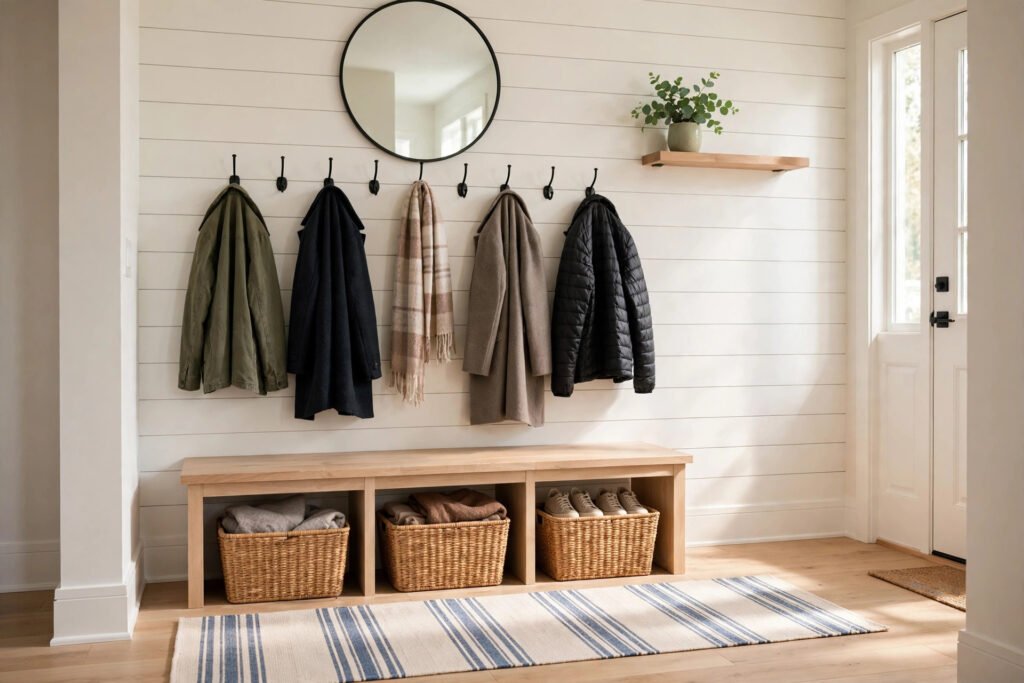

A mudroom is the first room you walk into and the last one you leave, yet it is usually the most neglected space in the house. Coats pile up, shoes wander across the floor and bags end up wherever they land. Affordable mudroom decor is not about turning a hard-working entry into a showroom — it is about giving everything a place, adding a few warm touches and making the space feel welcoming instead of chaotic. Here are seven ideas that cost very little and make a real difference.
1. Start With Hooks — the Cheapest Fix of All
If your mudroom has one problem, it is almost certainly coats with nowhere to go. Wall hooks solve it for a few pounds or dollars, and they look far better than a heap of jackets draped over a chair.
A row of sturdy hooks at different heights works for the whole family — higher hooks for adults, lower ones for children. A rail with four or five hooks typically costs roughly $10–$20. Check the current price before buying. Mount the rail into wall studs or use proper wall fixings, because hooks that pull out of plasterboard will not last a week under the weight of winter coats.
Keep one hook free per person and resist the urge to hang everything you own there. Out-of-season coats belong in a cupboard. Our guide to budget entryway decor ideas uses the same hook-first approach to tidy up small entrances.
2. Add a Bench — Even a Small One
A bench changes how a mudroom works. It gives you somewhere to sit while you put on shoes, a surface to drop bags on and a natural place to tuck baskets underneath.
You do not need a built-in bench. A simple wooden bench, a second-hand pew or even a sturdy storage bench from a discount store does the job. A basic bench typically costs roughly $30–$60, and a second-hand one costs far less. If you are handy, two crates and a plank of wood make a perfectly good bench for the price of a few screws.
Place the bench against the longest wall, and leave enough room in front of it to stand and put on shoes comfortably. A cushion on top — in a washable fabric, because muddy hands happen — makes it inviting. Affordable mudroom decor works best when the practical pieces come first and the pretty pieces follow.
3. Use Baskets and Bins to Hide the Mess
Open baskets are the mudroom’s best friend. They swallow scarves, gloves, hats, dog leads and all the small things that otherwise end up scattered across the floor.
Give each person or each category its own basket: one for hats and gloves, one for sports kit, one for the dog. Label them if you like — a simple tag tied with string looks charming and stops arguments about whose basket is whose. A set of three sturdy baskets typically costs roughly $12–$25. Woven seagrass looks warm and natural, while fabric cubes are cheaper and easier to wash.
Slide baskets under the bench or onto a low shelf so they are easy to reach but out of the way. If your mudroom is narrow, wall-mounted baskets or a row of hooks with hanging bags works just as well.
4. Lay Down a Rug That Can Take a Beating
A mudroom rug does two jobs: it catches dirt before it spreads through the house, and it makes a hard floor feel warmer and more welcoming. Choose one that can be shaken out, hosed down or thrown in the washing machine.
Indoor-outdoor rugs, coir mats and washable cotton runners are all good choices. A runner that fits the length of your mudroom typically costs roughly $15–$35. Dark patterns hide mud and paw prints far better than pale colours, so save the cream rug for the living room.
Layer a small coir doormat outside the door and a washable runner inside. Two layers catch far more dirt than one, and the runner is what makes the space feel like a room rather than a corridor.
5. Add a Mirror to Open Up the Space
Mudrooms are often small, dark and windowless, and a mirror is the cheapest way to make one feel bigger and brighter. It bounces light around, and it is genuinely useful — a last check before you leave the house.
A simple round or arched mirror hung above the bench looks polished and costs very little. A medium-sized mirror typically costs roughly $15–$30. Hang it at eye level, roughly 150 cm from the floor to its centre, so it is useful for adults and older children alike.
Keep the frame simple — black metal, light wood or plain white all work — and let the mirror do the work. Our guide to affordable hallway decor ideas uses the same mirror trick to brighten narrow spaces.
6. Bring in a Little Greenery
A mudroom is a working space, but it does not have to feel like a utility cupboard. A plant softens the hard surfaces and makes the room feel cared for.
Choose something tough that tolerates draughts and low light — a snake plant, a pothos or a hardy fern all survive neglect far better than delicate flowers. A small potted plant typically costs roughly $5–$12. If your mudroom has no natural light at all, a good faux plant is a sensible choice, and our roundup of the best affordable faux plants for home decor can help you find one that does not look plastic.
Set the plant on a shelf, on the end of the bench or in a hanging planter by the door. One plant is enough — this is a mudroom, not a greenhouse.
7. Finish With Small, Personal Touches
Once the practical pieces are in place, a few small touches make the mudroom feel like part of your home rather than a dumping ground.
A framed family photo, a small chalkboard with a welcome message, or a pretty tray for keys and sunglasses costs almost nothing and makes the space feel finished. A small wall shelf above the bench holds a candle, a photo and a few books, and it costs very little to put up. If you enjoy making things yourself, our guide to DIY home decor projects under $20 has several ideas that work beautifully in a mudroom.
Keep the decorative touches small and high up, away from muddy boots and wet coats. The rule is simple: anything at floor level should be washable, and anything decorative should be out of splash range.
How Much Should You Spend?
You can transform a mudroom for very little. Hooks, baskets and a rug — the three pieces that make the biggest difference — together typically cost roughly $40–$80 if you buy them new, and far less if you shop second-hand or use what you already own.
Start with what you have. Look around the house for spare baskets, a mirror from another room or a rug that could move to the mudroom. Then buy only the pieces that are genuinely missing, starting with hooks and storage, and check the current price before buying. If you want more ideas for organising tight spaces, our guide to how to organize a small closet on a budget uses the same basket-and-label system.
FAQs
What is the cheapest way to decorate a mudroom?
Start with wall hooks and baskets. Hooks give every coat a home and baskets hide the small clutter, and together they typically cost under $40. Add a washable rug and a mirror, and the room already looks finished.
How do I organize a small mudroom on a budget?
Give everything a place: one hook per person, one basket per category and a shoe tray or rack by the door. Keep out-of-season items in a cupboard elsewhere, and clear the space properly once a week so clutter never builds up.
What should I put in a mudroom?
The essentials are hooks for coats, a bench or stool for putting on shoes, baskets for hats and gloves, a rug that can be cleaned easily and a shoe rack or tray. A mirror and a plant are optional extras that make the space feel welcoming.
What kind of rug is best for a mudroom?
A washable or indoor-outdoor rug is best. Coir mats are excellent at catching dirt, while washable cotton runners can go straight in the washing machine. Choose a dark pattern to hide mud, and make sure the rug is large enough to cover the main walking path.
How can I make a mudroom look nice without spending much?
Focus on tidiness first: hooks, baskets and a clear floor do more than any decoration. Then add one mirror, one plant and one or two small personal touches, like a framed photo or a chalkboard. Keep decorative items high up and washable items at floor level.