
Best Budget Mirrors to Make a Room Look Bigger
Disclosure: This article contains affiliate links. As an Amazon Associate, we earn from qualifying purchases. If you buy through these links, we may earn a small commission at no extra cost to you.
A mirror is the cheapest trick in interior design for making a small room feel bigger — and the best budget mirrors cost less than a new cushion set. Hung in the right spot, a mirror bounces light around the room, reflects a window view and creates the illusion of extra space. A well-chosen mirror in the $25–$100 range can transform a cramped living room or a dark hallway. This roundup is based on product specs, features and customer feedback — not lab testing. Prices below are rough ranges only, so check the current price before buying.
Why Mirrors Make a Room Look Bigger
A mirror works in two ways. First, it reflects light. Place one opposite or next to a window and it throws daylight deeper into the room, making the whole space feel brighter and more open. As our guide to choosing a paint color for small room spaces shows, mirrors do the same job for even less money.
Second, a mirror tricks the eye into seeing more space. The reflection reads as a continuation of the room, so your brain registers a bigger area than is really there — the same effect you get from a well-placed affordable area rug.
How to Choose a Budget Mirror That Looks Expensive
Size first. The most common mirror mistake is buying one that is too small. As a rule of thumb, a mirror should be roughly two-thirds the width of the furniture below it — when in doubt, go bigger.
Shape second. Round mirrors soften a room full of straight lines and suit bedrooms and entryways. Rectangular mirrors suit living rooms and dining rooms. Arched mirrors are the current favourite.
Frame and glass quality. Look for a sturdy frame — metal, wood or good-quality MDF — and glass that gives a clear, undistorted reflection. Thin, wavy glass is the giveaway of a cheap mirror, so check customer reviews and photos before ordering. A simple black, gold or natural-wood frame looks far more expensive than a fussy ornate one. Check the hanging hardware too — a heavy mirror needs a proper wall anchor, never a single nail in plasterboard.
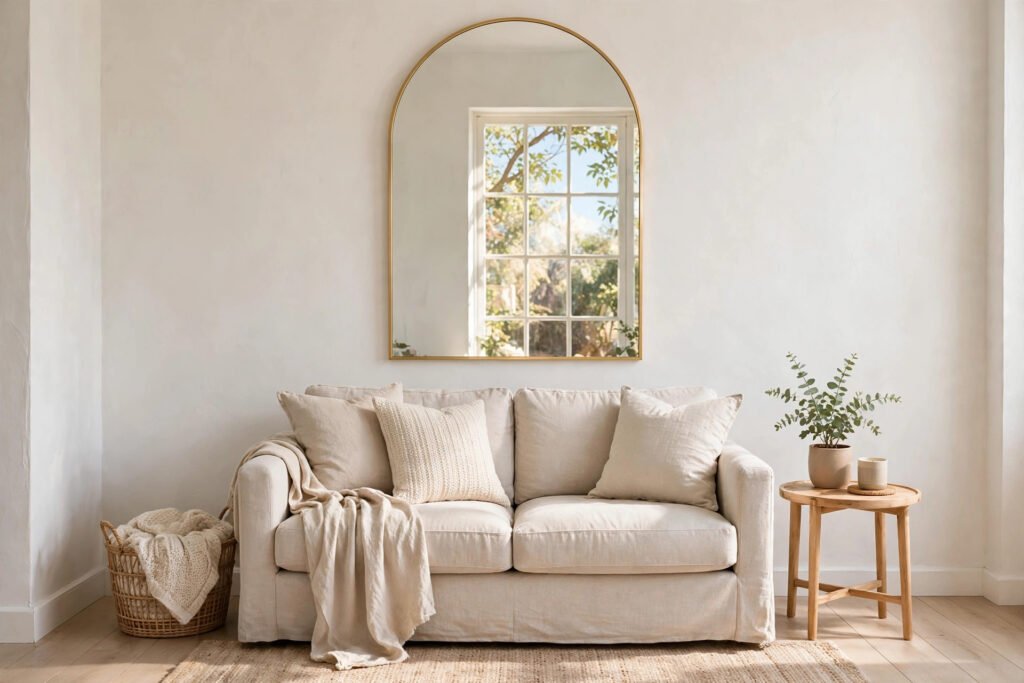
1. Best Overall: Large Arched Wall Mirror
The arched mirror is the budget buy of the moment: the curved top looks designer and the shape suits almost any room. Look for a tall arched mirror in the $50–$100 range with a slim black or gold metal frame.
Pros: Works in living rooms, bedrooms and hallways; adds elegance without a high price; reflects a lot of light.
Cons: Taller sizes are heavy and need solid fixings; the arch reflects less than a full rectangle.
2. Best for the Living Room: Oversized Rectangular Leaning Mirror
A floor-length rectangular mirror leaned against the wall is the fastest way to make a living room feel bigger. It reflects the whole room and bounces window light across the space. A full-length leaning mirror typically falls in the $60–$120 range, with simpler frameless styles at the lower end.
Pros: Maximum visual impact for the money; no drilling required — just lean and secure the top.
Cons: Takes up floor space; must be anchored to the wall for safety, especially with children or pets around. Our small living room ideas guide shows how to fit a large mirror without crowding the room.
3. Best for Small Bedrooms: Round Wall Mirror
A round mirror softens a bedroom full of straight-edged furniture and works beautifully above a dresser or bedside table. A 24–30 inch round mirror usually costs $25–$60.
Pros: Affordable and easy to hang; breaks up boxy furniture; suits almost any bedroom style.
Cons: A round mirror reflects less of the room than a large rectangle; very cheap versions can have thin glass that distorts.
4. Best Budget Set: Decorative Mirror Tiles or Hexagon Set
If one big mirror is out of budget, a set of small decorative mirrors can do the job for $20–$40. Hexagon sets or simple square tiles can be arranged in any pattern, filling a large wall for a fraction of the cost of one big piece.
Pros: The cheapest way to cover a large wall; flexible — rearrange the pattern whenever you like; great for renters, as most sets use adhesive pads — see our guide on how to decorate a rental.
Cons: The joins break up the reflection, so the “bigger room” effect is weaker; adhesive pads can damage paint when removed.
5. Best for the Entryway: Long Narrow Mirror
A long, narrow mirror in a hallway or entryway does double duty: it lets you check your outfit before leaving, and it makes a dark, narrow space feel wider and brighter. Look for a slim full-length mirror in the $30–$70 range.
Pros: Makes narrow hallways feel much wider; practical as a last-look mirror by the door; slim profile fits anywhere.
Cons: A very narrow mirror reflects only a slice of the room; cheaper leaning models can wobble unless anchored.
6. Best for the Bathroom or Vanity: Bevelled Frameless Mirror
A bevelled frameless mirror looks clean, modern and far more expensive than it is — the bevelled edge catches the light and adds a subtle decorative detail without a frame. A good frameless bathroom mirror usually costs $30–$80 depending on size.
Pros: The clean, frameless look suits any bathroom; the bevelled edge adds a high-end detail; easy to clean.
Cons: Frameless mirrors show every water spot and fingerprint; installation needs proper fixings.
7. Best Statement Piece: Sunburst or Gold-Framed Mirror
If you want one mirror to be the star of the room, a sunburst or gold-framed mirror is the budget statement piece — the radiating rays or warm metallic frame add glamour to a plain wall, usually for $35–$90.
Pros: Instant focal point — no other wall decor needed; the gold finish warms up a neutral room.
Cons: The decorative frame means a smaller reflective surface; the sunburst style suits some rooms and clashes with others.
Where to Hang a Mirror for Maximum Effect
Opposite a window. This is the golden rule. A mirror facing a window reflects daylight and the view outside, effectively doubling the light in the room. Avoid hanging a mirror directly opposite a cluttered wall — it will just reflect the mess. A mirror behind a lamp or candle doubles the glow in the evening.
Above furniture, not floating alone. A mirror hung above a console table, dresser or sofa looks intentional and grounded — leave a gap of around 15–25 cm below it. Hanging a mirror too high is one of the common budget home decor mistakes.
Mistakes to Avoid
- Buying too small. Measure the wall and furniture below it before ordering.
- Hanging it too high. A mirror above eye level reflects the ceiling, not the room.
- Reflecting clutter. Check what the mirror will reflect first — it doubles whatever it faces.
- Ignoring the weight. Check the weight, buy the right wall anchors and never hang a heavy mirror from a single hook.
- Mixing too many mirrors. One large mirror makes a room look bigger; five small ones make it look like a funhouse.
The best budget mirrors prove that you do not need a big budget to make a small room feel spacious. Pick a size that suits your wall, hang it opposite a window at eye level, and let it do the work.
FAQs
What size mirror makes a room look bigger?
The bigger, the better — within reason. A mirror roughly two-thirds the width of the furniture beneath it gives the strongest effect.
Where is the best place to hang a mirror in a small living room?
Opposite or beside a window, above the sofa or a console table, at eye level.
Do mirrors really make a small room look bigger?
Yes — they reflect light and the room itself, so your eye reads more space than is actually there. The effect is strongest with large mirrors opposite windows, and weaker with small decorative mirrors.
Are cheap mirrors worth buying?
Yes, if you check the glass quality first. Look for clear, flat glass with no distortion, a sturdy frame and solid hanging hardware.
Can I hang a heavy mirror on a plasterboard wall?
Yes, but not with a normal nail or screw. Use proper plasterboard anchors rated for the mirror’s weight, or fix into a wall stud. If you are renting, a leaning mirror secured at the top avoids drilling altogether.
Related reading: How to Choose the Right Paint Color for a Small Room · Small Living Room Ideas on a Budget · 15 Affordable Home Decor Ideas to Refresh Your Space



Pingback: Budget Entryway Decor: 12 Ideas That Make a Big Impact