
Disclosure: This article contains affiliate links. As an Amazon Associate, we earn from qualifying purchases. If you buy through these links, we may earn a small commission at no extra cost to you.
A nightstand is one of the smallest pieces of furniture in a bedroom — and one of the most used. It holds your phone, your book, a glass of water and the lamp you reach for in the dark. In a small bedroom, though, a nightstand that is too wide, too deep or too tall can crowd the bed and make the whole room feel cramped. The best budget nightstands solve that problem: they are slim enough to fit beside a bed with only a few inches to spare, they still hold the things you actually need, and they cost far less than designer bedside tables.
This guide compares the best budget nightstands for small bedrooms, explains how to measure for the right fit, and gives honest pros and cons for each style. Our picks are based on specifications, features and customer feedback — not hands-on lab testing.
How to Choose a Nightstand for a Small Bedroom
Measure first, shop second
Before you look at a single product, measure the gap beside your bed. Most small bedrooms leave 40–60 cm (16–24 inches) of space, and your nightstand should be at least 5 cm narrower than that gap so you can actually walk past it. Depth matters too: a standard nightstand is around 40 cm deep, but in a tight room a 30–35 cm deep model keeps noticeably more floor space free.
Height is the detail most people get wrong. A nightstand should sit roughly level with the top of your mattress — usually 55–65 cm tall. Too low and you will be reaching down in the dark; too high and it towers over the bed.
Match the room, not just the bed
A nightstand does not have to match your bed frame exactly, but it should share something with it — the same wood tone, the same metal finish, or a similar style. In a small room, a light colour or legs that lift it off the floor make the space feel bigger. Dark, bulky nightstands tend to visually shrink a small bedroom.
The Best Budget Nightstands for Small Bedrooms
Prices below are rough ranges only — check the current price before buying.
1. Best overall: the classic two-drawer nightstand
The classic two-drawer bedside table is the safest pick for most small bedrooms. Typically 40–45 cm wide and 55–60 cm tall, it gives you two proper drawers of storage without taking up much floor space. Look for smooth drawer runners and a solid top that can hold a lamp and a phone charger without wobbling.
Pros: generous hidden storage, timeless look, works with almost any bed style.
Cons: can feel bulky in a very tight space; flat-pack assembly takes 30–45 minutes.
Rough price: usually in the $40–$90 range, depending on the finish and brand.
2. Best for tiny rooms: the slim single-drawer nightstand
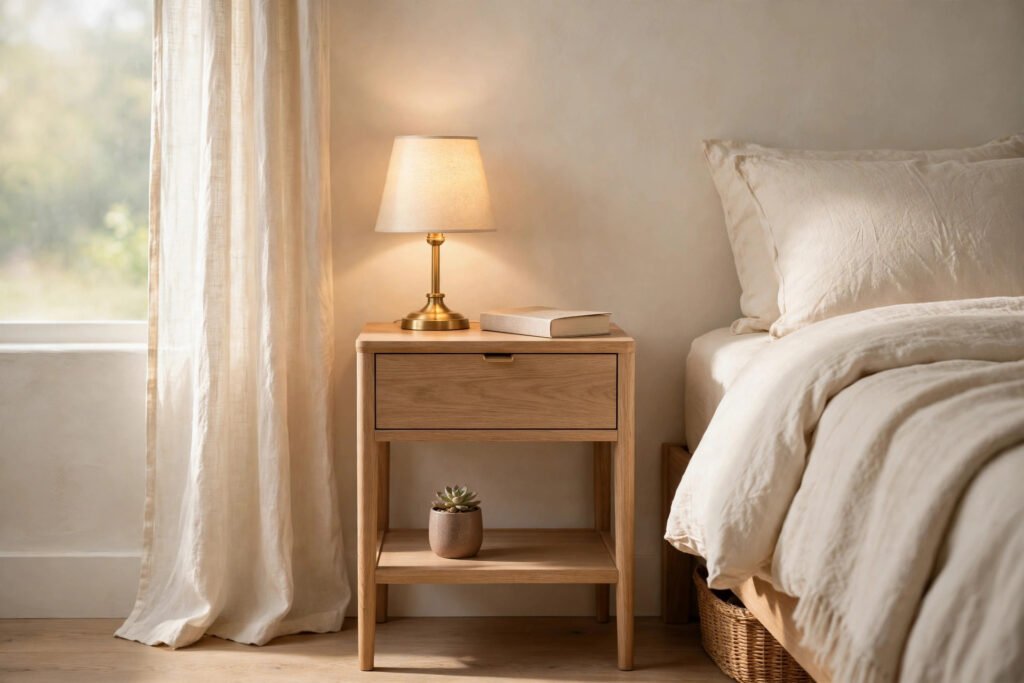
When the gap beside your bed is under 40 cm, a slim single-drawer nightstand is the answer. These are usually 30–35 cm wide with one drawer and an open shelf underneath, so you still get a place for a book and a phone without the bulk.
Pros: fits gaps other nightstands cannot, light and easy to move, often the cheapest option.
Cons: limited storage — one drawer fills up fast; a lamp may take up most of the top.
Rough price: typically $25–$60.
3. Best for storage: the three-drawer nightstand
If your bedroom has no wardrobe space to spare, a three-drawer nightstand doubles as a mini chest of drawers. At around 45–50 cm wide it is the largest option here, so it only works if you have the space — but the extra drawer is genuinely useful for clothes, bedding and the things that have nowhere else to go.
Pros: the most storage of any budget nightstand, doubles as a small dresser.
Cons: the widest option here — measure carefully; heavier and harder to move.
Rough price: roughly $60–$120.
4. Best for renters: the open-shelf nightstand
An open-shelf nightstand — usually a simple frame with one or two shelves and no drawers — is a favourite for renters. It is light, cheap, easy to assemble, and easy to take with you when you move. A small basket on the lower shelf hides the clutter, and the open design keeps a small room feeling airy. If you rent, also see our guide to decorating a rental without losing your deposit.
Pros: very affordable, no heavy assembly, makes small rooms feel bigger.
Cons: no hidden storage, so clutter is always on display; less sturdy than drawer models.
Rough price: usually $20–$50.
5. Best modern look: the floating wall-mounted nightstand
A floating nightstand screws to the wall beside the bed, with no legs and no floor footprint at all. In a small bedroom that is a genuine advantage — the floor stays clear, cleaning is easier, and the room looks bigger. Most budget floating nightstands have one drawer and a small surface, enough for a phone, a book and a small lamp.
Pros: zero floor space used, modern look, makes the room feel larger.
Cons: needs wall fixings and a solid wall — not ideal for every rental; limited weight capacity.
Rough price: roughly $30–$80.
What Size Nightstand Do You Actually Need?
The most common mistake is buying a nightstand that is too big. Use this quick checklist before ordering:
- Width: at least 5 cm less than the gap beside your bed.
- Height: level with the top of your mattress, or up to 5 cm higher.
- Depth: 30–40 cm for a small room; deeper models eat floor space fast.
- Lamp space: your lamp base needs about 20 cm of the top — make sure the surface is wide enough for the lamp plus a phone or a glass of water.
If you only have room on one side of the bed, one nightstand is fine — a mismatched look with a single bedside table is completely normal in small bedrooms. For more ideas on making a small bedroom work harder, see our guide to small bedroom decor ideas on a budget.
Styling Your Nightstand Without the Clutter
A nightstand looks best with three things on it at most: a lamp, one personal item (a book, a small plant or a framed photo), and your phone or a glass of water. A small tray can corral the little things — rings, lip balm, earplugs — into one tidy spot.
For the lamp, a compact table lamp or a wall-mounted light above the nightstand keeps the surface free. A small mirror above the nightstand can also make a tight bedroom feel bigger — see our guide to the best budget mirrors — and a soft wall colour helps too, as we explain in our guide on choosing a paint color for a small room.
FAQs
What is the best budget nightstand for a small bedroom?
The best budget nightstands for a small bedroom are slim single-drawer models around 30–40 cm wide, or open-shelf nightstands if you want the room to feel bigger. Measure your gap first: the nightstand should be at least 5 cm narrower than the space beside your bed.
How tall should a nightstand be?
A nightstand should be roughly level with the top of your mattress — usually 55–65 cm tall. A nightstand that is much lower forces you to reach down in the dark, and one that is much higher looks out of proportion with the bed.
Do I need two nightstands in a small bedroom?
No. One nightstand is completely fine in a small bedroom, especially if you only have space on one side of the bed. A single well-chosen nightstand looks deliberate, not unfinished — the other side can hold a small stool, a wall shelf or nothing at all.
Are cheap nightstands sturdy enough?
Most budget nightstands in the $40–$90 range are sturdy enough for everyday use — a lamp, a book, a phone and a glass of water. Check customer feedback for comments on wobble and drawer runners before buying, and tighten the fixings a week after assembly, as flat-pack furniture often settles.
What is the best nightstand if I have no storage space?
A three-drawer nightstand gives the most storage of any budget option and can double as a mini chest of drawers. If you cannot fit one, add a basket under an open-shelf nightstand or use a wall shelf above the bed for the rest.
The Bottom Line
The best budget nightstands for small bedrooms are not the biggest or the fanciest — they are the ones that fit your space, match your mattress height, and hold what you actually use at night. Start by measuring, decide whether you need drawers or an open shelf, and pick a light-coloured or legged design so the room still feels open.