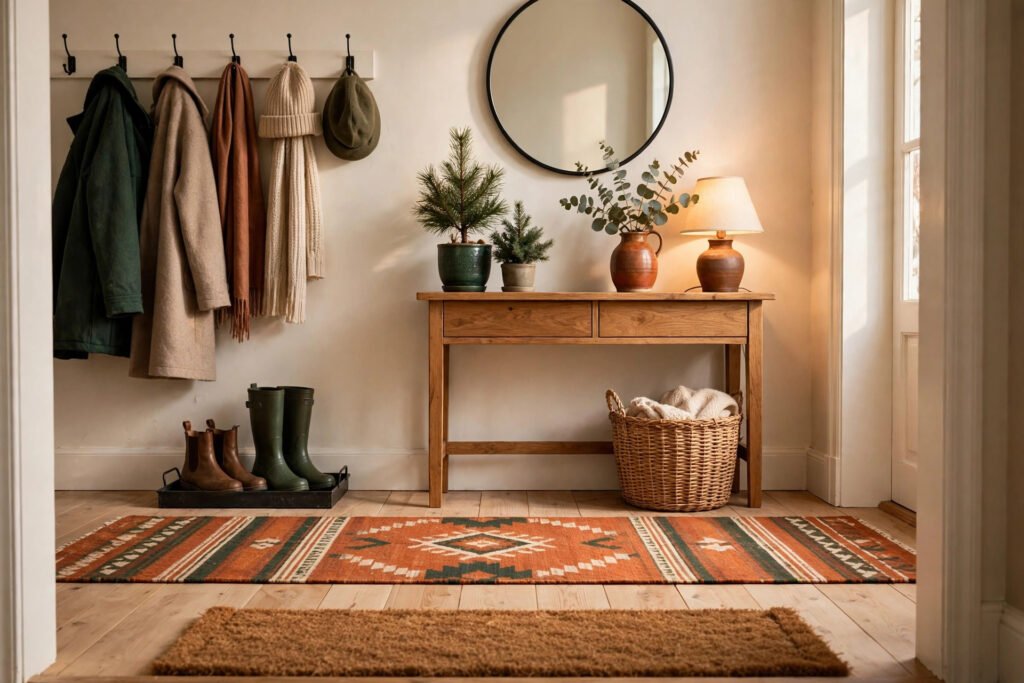

The entryway is the first thing you see when you come in from the cold, and in winter it works harder than any other spot in the house. It catches wet boots, damp coats, scarves, hats and bags — and without a plan, it turns into a muddy pile by the door within a week. The good news is that a winter entryway decor budget does not need to be big to make a real difference. A few practical pieces, some warm texture and a little soft light can turn a cold, cluttered hallway into a welcoming entrance for very little.
1. Start With a Hard-Working Doormat
Everything in a winter entryway starts at the doormat. Snow, rain and grit come in on every pair of shoes, and a thin decorative mat will not cope. Choose a sturdy coir or rubber-backed mat big enough for two feet at once — roughly 45 by 75 centimetres works for most doors — and keep a second, washable mat just inside for the wettest days.
A larger flat-weave rug underneath and a smaller coir mat on top works well too: the mat scrapes, the rug catches the rest, and both shake out easily. A good doormat usually costs roughly £10–£25 — check the current price before buying — and it is the single most useful thing you can buy for a winter entryway.
2. Give Every Coat a Hook
Coats are the biggest source of entryway clutter in winter. With nowhere obvious to hang them, they end up on chairs, over banisters and in a heap by the door. A row of sturdy wall hooks fixes this in an afternoon.
A simple rail with four or five hooks is enough for most households, and a second row of small hooks at child height keeps little coats off the floor too. If you cannot drill into the wall, heavy-duty adhesive hooks will hold a light coat, though a screwed-in rail is far sturdier for heavy winter jackets. One hook per person, plus a spare for guests, and the pile by the door disappears. For more ways to keep a small entrance tidy, see our budget entryway decor ideas (https://somedecor.com/budget-entryway-decor-ideas/).
3. Add a Boot Tray and a Basket for the Bits
Wet boots are the other half of the winter entryway problem. A shallow boot tray by the door catches melting snow and muddy water before it reaches the floor. A rubber or plastic tray with a raised edge is best, and a layer of pebbles inside helps boots dry faster and looks better than bare plastic.
Next to the tray, keep one basket for the small things that get lost in winter: gloves, hats and scarves. One woven basket is enough — the rule is one basket per household, not one per person, or the entryway fills up with storage instead of staying clear. Empty it once a week; anything unused goes back to its proper home.
4. Warm It Up With Texture
A winter entryway feels cold because it usually is: hard floors, bare walls and a draughty door. Texture is the cheapest way to fix that feeling. A small runner rug in a warm colour, a chunky knit throw draped over a bench, or a woven basket all add softness without taking up space.
Choose materials that can handle winter: wool-look rugs, cotton runners and woven baskets cope with damp and dirt far better than pale velvet or silk. Keep the palette warm — cream, rust, deep green or mustard — and use one strong colour rather than five competing ones. A runner in a warm tone, roughly £15–£30 depending on size, changes the whole feel of a hallway for less than a takeaway. Our affordable mudroom decor ideas (https://somedecor.com/affordable-mudroom-decor/) use the same warm, hard-wearing pieces in a slightly bigger space.
5. Hang a Mirror to Bounce the Light
Winter days are short and hallways are often the darkest part of the house. A mirror is the cheapest way to brighten one, because it doubles whatever light comes through the door or the nearest window. A simple round or arched mirror above a small console works in almost any entryway — and gives you a last check before you leave the house.
Hang it at eye level and keep the frame simple: black metal, light wood or rattan all suit a winter entryway and cost very little second-hand. Avoid hanging it opposite a blank wall, where it only reflects darkness; angle it toward the door or a window instead.
6. Bring in Something Green That Survives Winter
A bare entryway looks cold no matter how tidy it is, and a plant is the quickest way to make it feel alive. Not every plant survives a draughty hallway, so choose tough ones: a snake plant, a small pine in a pot, or a sprig of eucalyptus in a vase all cope with low light and cold draughts.
A potted pine on a stool doubles as a winter decoration, and eucalyptus stems in a tall vase need no care at all — just change the water weekly. If your entryway gets almost no natural light, a good faux plant is the honest answer: our best affordable faux plants (https://somedecor.com/best-affordable-faux-plants/) look realistic and need nothing from you.
7. Add Soft Light for Dark Evenings
By four o’clock on a winter afternoon the hallway is dark, and a single harsh ceiling light makes it feel like a corridor. Soft, low light changes that completely. A table lamp on a console, a battery candle in a lantern by the door, or a string of warm fairy lights along a shelf all cost a few pounds and make coming home in the dark feel welcoming.
Choose warm light, around 2700K, and keep it low rather than overhead. A timer plug is worth the small cost: set the lamp to come on before you get home, so you walk into a warm, lit entrance instead of a dark hallway. Our affordable winter bedroom decor ideas (https://somedecor.com/affordable-winter-bedroom-decor/) use the same warm-light trick in the bedroom.
A One-Weekend Winter Entryway Plan
You do not need to do all seven ideas at once, and you should not try. Start on Saturday with the practical pieces: the doormat, the boot tray and the hooks. Those three alone stop the mud and the coat pile, which is most of the problem. On Sunday, add the warm layer — the runner, the mirror and the soft light — and put a plant or a vase of eucalyptus by the door last, as the finishing touch.
Keep it simple and keep it warm. One mat, one rail of hooks, one tray, one basket, one mirror and one source of soft light are enough for almost any entryway.
Frequently Asked Questions
How do I keep a winter entryway tidy?
Give everything a place before winter starts: a doormat and boot tray for shoes, one hook per person for coats, and one basket for gloves, hats and scarves. A tidy entryway is about having a spot for everything, so things land in the right place instead of in a pile by the door.
What is the best doormat for winter?
A coir or rubber-backed mat is best for winter because it scrapes off snow and grit and does not slide around on a hard floor. Choose one big enough for two feet at once, and add a second washable mat just inside the door on the wettest days.
How can I make a small entryway feel warmer in winter?
Add texture and warm light: a runner rug in a warm colour, a woven basket, a chunky throw on a bench and a small lamp or battery candle at low level. Keep the palette to one or two warm colours so the small space does not feel busy.
What plants survive in a cold entryway?
Tough, low-light plants survive best: snake plants, small potted pines and eucalyptus stems in a vase all cope with draughts and little light. If your entryway gets almost no natural light, a good faux plant is a better choice.
How much should I budget for a winter entryway refresh?
A doormat, a boot tray, a rail of hooks and a basket usually come to roughly £30–£60 in total, and a runner rug and a small lamp add another £20–£40. Start with the practical pieces and add the decorative ones over a few weekends — check the current price before buying anything.
A winter entryway does not need a big budget or a renovation to feel warm and welcoming. A hard-working mat, hooks for every coat, a tray for wet boots and a little soft light are the whole job — the pieces that matter most are the cheapest ones, and the ones that cost the most are usually the ones you do not need.