
Disclosure: This article contains affiliate links. As an Amazon Associate, we earn from qualifying purchases. If you buy through these links, we may earn a small commission at no extra cost to you.
The best affordable faux plants do one job well: they make a room feel alive without asking anything of you. No watering schedule, no sunlight, no slow decline on a dark shelf. A good fake plant fills an empty corner, softens a hard shelf and adds the same splash of green a real plant would.
The gap between a convincing fake and an obviously plastic one is wide, and the price difference is often small. The picks below are based on specs, features and customer feedback — how realistic the leaves look and whether buyers still rate them months later. Prices are rough ranges only, so check the current price before buying.
How to Spot a Good Faux Plant
Before you buy, it helps to know what separates a lifelike fake from a cheap-looking one. Four things matter most.
Leaf colour and variation. Real leaves are never one flat shade of green. Look for two or three tones, slightly lighter veins, and variation from leaf to leaf. One uniform green is the biggest giveaway.
Material. Most budget faux plants use plastic or polyester. Polyester and silk-style leaves usually look softer and more natural than stiff, shiny plastic.
Shape and fullness. A plant that arrives flat and sparse will stay flat and sparse. Check the stems and leaves in the listing photos, and read reviews to see whether buyers had to bend and fluff it before it looked right.
The pot it comes in. Many affordable faux plants arrive in a plain black plastic nursery pot. That is fine if you plan to drop it into a decorative pot of your own, but if you want it ready to display, look for one that comes with a finished pot or planter. Our roundup of the best affordable vases has planters that work well for faux stems too.
1. Faux Eucalyptus Stems
Eucalyptus is the easiest faux plant to get right, because the real thing is already quite simple in shape. A bunch of faux eucalyptus stems in a vase gives you greenery on a shelf, a mantel or a dining table for very little — usually in the rough $8 to $15 range for three to five stems.
The best versions have a dusty, silvery-green tone rather than bright plastic green, with thin, slightly matte leaves. They look best in a simple ceramic or glass vase. The downside is that cheap bundles can look sparse, so buy two if you want a full arrangement, and bend the stems gently so they fan out.
2. Faux Fiddle Leaf Fig
The fiddle leaf fig is one of the most popular houseplants, and also one of the hardest to keep alive — which is exactly why the faux version is so popular. A small faux fiddle leaf fig, around 60 to 90 centimetres tall, fills an empty corner or flanks a sofa without any fuss, and usually costs in the rough $25 to $50 range.
Look for large, veined leaves in varied shades of green and a trunk that looks woody, not shiny plastic. The main weakness is that the leaves can look too perfect — real ones have the odd brown edge — so choose one with leaves angled differently rather than all pointing the same way. It pairs well with the styling ideas in our guide to the best budget mirrors, where a tall plant beside a mirror makes a small room feel larger.
3. Faux Monstera
Monstera leaves are instantly recognisable, and a faux monstera in a pot brings a bold, tropical look to a living room or bedroom. Potted versions around 45 to 60 centimetres tall typically cost in the rough $15 to $30 range.
The key detail is the leaf cut-outs: cheap fakes have slits that look stamped on, while better ones have deeper, irregular splits that follow the leaf shape. Read customer feedback about whether the leaves look realistic up close. A faux monstera works best as a single statement plant on a side table — it does not need company, and crowding it can make the display look cluttered.
4. Faux Trailing Pothos
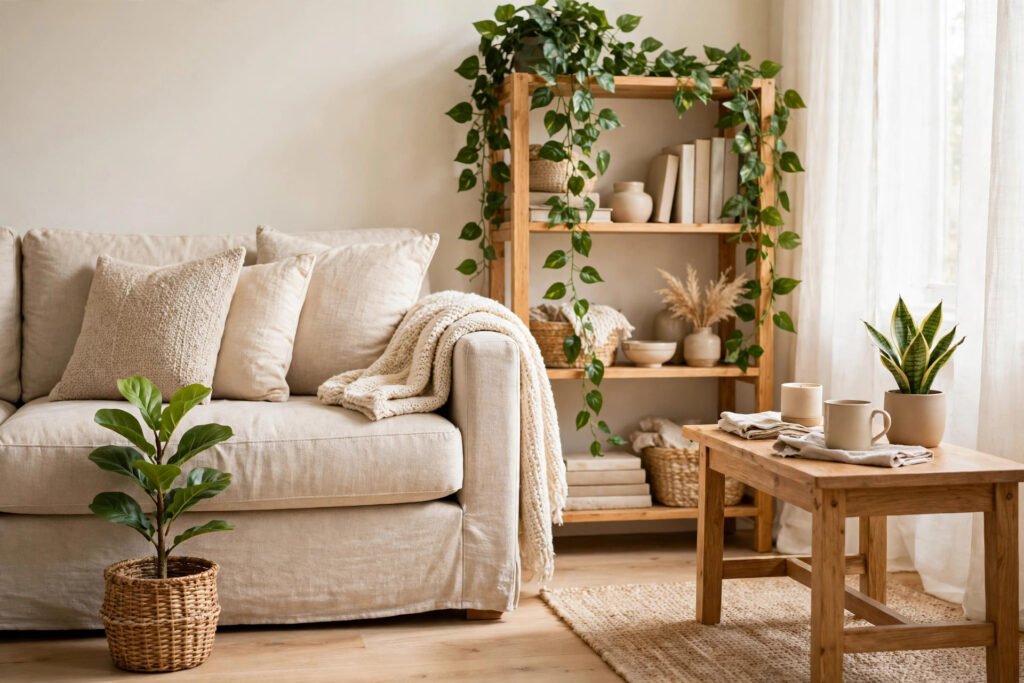
A trailing faux pothos is one of the most useful faux plants you can buy. Drape it over a bookshelf or let it trail down a cabinet, and it softens hard edges in a way few decor pieces can. A single trailing stem usually costs in the rough $10 to $20 range.
Good trailing pothos has leaves that get smaller towards the tip, just like the real thing, and a flexible vine. The main drawback is that long vines can look stringy if the leaves are spaced too far apart, so choose a fuller version with leaves all along the stem. It is a natural fit for open shelving — see our guide on how to style open shelves in the kitchen for ideas on trailing a plant among books and ceramics.
5. Faux Snake Plant
Snake plants are already famously low-maintenance, but a faux one is the only plant that truly cannot be killed. A potted faux snake plant suits bathrooms, bedrooms and offices, and it looks right in a modern, minimal pot. Prices are usually in the rough $12 to $25 range for a plant around 30 to 45 centimetres tall.
The best faux snake plants have upright leaves with the yellow-edged, marbled pattern of the real thing and a slight bend, so they do not all stand perfectly straight. Avoid versions where every leaf is the same height and colour — that is what gives the game away. Snake plants also genuinely suit a bathroom, where humidity and low light make real plants struggle. Our guide to affordable bathroom decor for renters has more ideas for adding greenery to a bathroom without drilling holes.
6. Faux Olive Tree
A faux olive tree is the premium pick on this list, and the one that makes the biggest visual difference in a room. A small olive tree, around 90 to 120 centimetres tall, brings a soft, Mediterranean feel to a living room or dining area, and usually costs in the rough $35 to $60 range.
The fine, silvery-green leaves are what make an olive tree look real, so look for small, narrow leaves with a dusty finish and a trunk with some texture and a gentle bend. The downside is the price, and a tall faux tree needs a heavy pot so it does not topple — factor in a decent planter. Our guide to the best indoor plants for beginners covers real plants too, if you ever want to mix a living plant into your faux collection.
7. Faux Succulents
Faux succulents are the cheapest way to add greenery to a desk, a windowsill or a bathroom shelf. A set of three or four small potted succulents usually costs in the rough $10 to $18 range, and they need no care at all.
The trick is scale: single tiny succulents can look toy-like, so group two or three together in a tray and mix shapes — a rosette, a trailing string of pearls and a spiky aloe-style plant look far more natural together than three identical pots. The best sets use soft-touch plastic that feels slightly rubbery, not hard and shiny. They are also the easiest faux plants to move around, so they are a good first buy if you are not sure where greenery belongs yet.
How to Style Faux Plants So They Look Real
Buying one of the best affordable faux plants is only half the job. Styling it well is what makes people assume it is real.
Mix heights and textures. A tall plant in a corner, a trailing plant on a shelf and a small succulent on a table reads as a collected home, not a display.
Use real soil or moss on top. A thin layer of real potting soil, moss or small pebbles over the base of a potted faux plant hides the plastic and makes it look planted. This one trick does more for realism than anything else.
Put them where real plants would struggle. Bathrooms with no windows, dark hallways, high shelves and desks far from a window are exactly where faux plants earn their keep. A fake plant next to a real one invites comparison; a fake plant in a dark corner just looks like a plant.
Dust them. Faux plants collect dust, and dusty leaves are a dead giveaway. Wipe the leaves with a damp cloth every few weeks, or rinse small ones under the tap. It takes two minutes and keeps them looking fresh.
Do not overdo it. One or two well-chosen faux plants look intentional; ten in every corner feels like a garden centre. Start with one or two, live with them for a week, and add more only where a spot still feels empty.
Frequently Asked Questions
Do faux plants look fake up close?
The best ones do not, at least from a normal distance. Plants with varied leaf colours, matte finishes and natural shapes are hard to tell from real ones across a room. Very cheap plants with shiny, uniform leaves are easier to spot up close, so spend a little more on the plants that sit at eye level.
How do you clean faux plants?
Wipe the leaves with a damp cloth every few weeks, or rinse small plants under a tap and let them air dry. A feather duster works for larger plants, and a soft brush reaches between leaves. Avoid harsh cleaners, which can dull the finish.
Are faux plants safe for homes with pets?
Faux plants are generally safer than many real houseplants, because there is nothing toxic to chew. The main risk is small loose parts or berries on some decorative plants, so check everything is firmly attached if you have a curious pet.
Where should I put faux plants in my home?
Put them where real plants would struggle: dark corners, windowless bathrooms, high shelves and desks far from natural light. They also suit rooms you rarely use, like a guest room, where a real plant would be forgotten and left to dry out.
How long do faux plants last?
A decent faux plant lasts for years if you keep it out of direct sunlight, which can fade the colour, and dust it regularly. Cheaper plants may lose leaves or fade faster, so spend a little more on the plants on display the longest.
Final Thoughts
The best affordable faux plants are the ones you forget are fake. A bunch of eucalyptus stems on a shelf, a trailing pothos over a bookcase, or a small olive tree in a corner all add the same warmth and colour a real plant would, with none of the watering, light or care. Start with one or two picks from this list, style them in a real pot with moss or soil on top, and put them where real plants struggle. If a spot still feels bare after a week, that is where your next plant belongs.