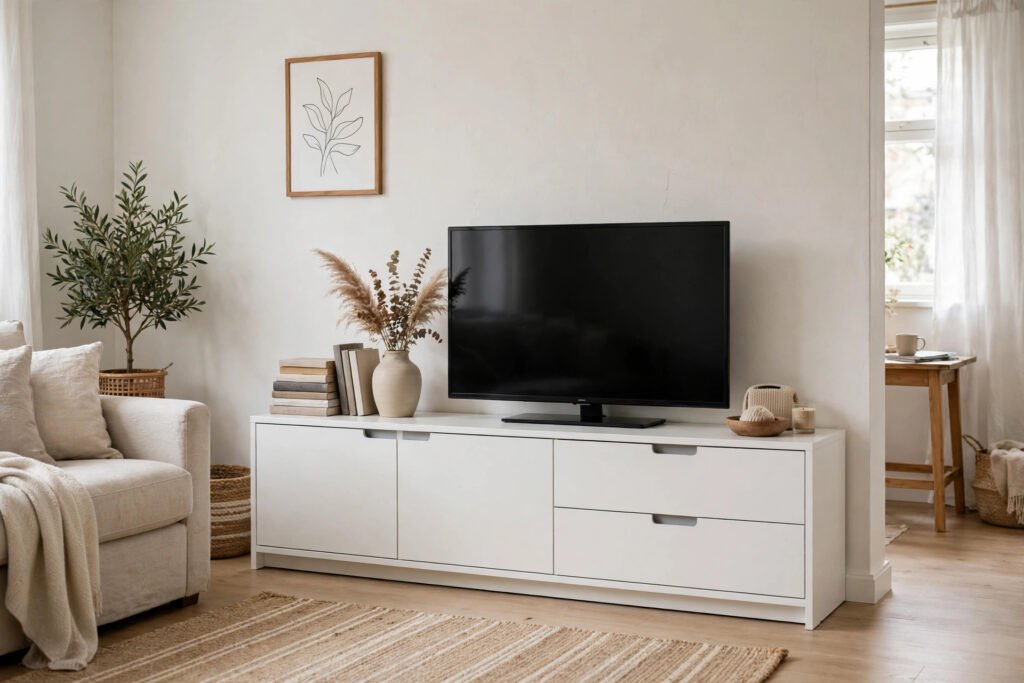

If you want to hide TV cables, games, books, and chargers without spending a fortune, this IKEA BESTÅ review will help. BESTÅ is one of IKEA’s most flexible storage systems. It can be a low TV bench, a tall storage wall, or a floating media unit.
That flexibility can also confuse buyers. There are many frame sizes, doors, legs, and add-ons, and the final price depends on your combination. This IKEA BESTÅ review explains what the system is, how it is built, its pros and cons, who it suits, and what alternatives to consider. It is based on product specs, features, and customer feedback, not on lab tests or hands-on testing we carried out ourselves.
What Is the IKEA BESTÅ System?
BESTÅ is a modular storage system, not one fixed piece of furniture. You start with a frame, then add doors, drawers, shelves, legs, or a wall rail. The parts work together, so you can build a unit for a narrow wall, a wide TV wall, or a small living room.
Most people use BESTÅ as a TV unit or media console. It also works as a sideboard, home-office storage, or low hallway cabinet. Its clean, flat fronts suit modern and Scandinavian rooms well. For renters, the leg option is useful because it needs no drilling. Wall-mounted versions look neater, but need solid fixing and landlord permission, so check your lease first.
Sizes and Configurations
Common frame widths are 47 cm, 60 cm, and 120 cm. Depths are usually 20 cm, 40 cm, or 42 cm, and heights are 38 cm, 64 cm, or 128 cm. The 120 cm frame is a popular TV-unit starting point, while taller frames work as storage cabinets.
A typical setup uses one or two 120 cm frames side by side, with a 40 cm or 42 cm depth for a TV and media boxes. A shallow 20 cm frame suits a hallway, but it will not hold a large games console. Measure your wall, TV, and storage items before ordering, and leave air space around a console or cable box, because closed cabinets trap heat. Solid doors hide clutter; glass doors show display items, but also dust. Drawers suit remotes and cables.
Build Quality and Materials
BESTÅ frames are made mainly from particleboard and fibreboard, with a foil or lacquer finish. This is normal for flat-pack furniture at this price, and it keeps the system affordable. The finish is smooth and easy to wipe clean, and white, black-brown, and oak-effect options blend with most rooms.
Once assembled and levelled, frames feel solid, especially low TV benches. Soft-closing hinges are available on many doors, and shelves are adjustable. Drawers run smoothly when not overloaded.
There are limits. Particleboard dislikes water, so wipe spills quickly and use a tray under a damp plant pot. Edges can chip during a move, and heavy books belong low down. With normal care, most owners say BESTÅ lasts several years, but it is not solid wood that can be sanded and repaired many times. Assembly is a familiar IKEA job: picture instructions, a screwdriver, and ideally a second person for wide frames. Build it in its final room, as a wide unit is awkward to move through a doorway.
Pros of the IKEA BESTÅ
- Flexible: start with one frame and add matching units later.
- Clean look: flat fronts and simple finishes suit most modern rooms.
- Good storage: a low 120 cm unit can hide a console, cable box, books, and chargers.
- Affordable: even a larger TV wall usually costs less than a similar solid-wood sideboard.
- Adjustable: shelves can move, and doors or legs can change later.
Cons of the IKEA BESTÅ
- Particleboard: scratches and chips are hard to hide, unlike solid wood.
- Assembly: wide units are heavy once built, and wall mounting needs secure fixing.
- Cost creep: doors, drawers, legs, and lighting add up fast.
- Moisture: the finish needs quick wipe-ups and care near plants or drinks.
- Adjustments: doors and drawers may need a small tweak after a few weeks on uneven floors.
How Much Does IKEA BESTÅ Cost?
Prices vary because BESTÅ is sold as separate parts. As a rough guide, a single low frame can start in the region of $60 to $120, depending on size and finish. A typical two-door TV unit often lands in the region of $150 to $350, while a larger media wall can reach $500 to $800 or more.
These are rough price ranges only. Check the current price before buying, and add up the full combination, including hinges, legs, and any wall rail. Delivery and assembly, if you pay for them, are extra. If you only need to hide a console and cables, one low frame may be enough.
Who Should Buy BESTÅ, and Who Should Skip It?
BESTÅ suits renters, first-apartment owners, and anyone who wants tidy, modern storage without a high price tag. It fits if you like clean lines, want to hide clutter, and are happy to assemble flat-pack furniture. It also suits people who may move in a year or two, as units can be taken apart and rebuilt, though repeated moves raise the risk of damage.
It suits you less if you want solid wood, a traditional look, or furniture that will survive many moves without wear. That flexibility is still why this IKEA BESTÅ review rates it highly for small rented spaces. If you store very heavy items, keep them low down. In a damp room, use trays under plants and coasters under drinks to protect the finish.
Alternatives Worth Considering
The IKEA LACK TV unit is cheaper and simpler, but offers far less closed storage. The IKEA HEMNES TV bench looks more traditional, but is less modular and usually costs more for the same width. Other budget retailers sell similar low TV units, but you lose the option to add matching frames later, and quality varies, so read customer feedback first. You can also mix a low BESTÅ unit with one or two open shelves above the TV for plants and books, which looks more relaxed than a full wall of closed doors.
Frequently Asked Questions
Is IKEA BESTÅ good quality for the price?
Yes, for the price it is generally good value. Frames are stable once assembled, the finish is easy to clean, and the modular design gives plenty of storage. It is particleboard and fibreboard, not solid wood, so it will not feel as heavy or repairable, but most owners find it holds up well with normal care.
Can IKEA BESTÅ hold a large TV?
Yes, if you choose a unit wider than the TV and rated for its weight. A low 120 cm or 180 cm unit is a common choice for a medium to large TV. Keep it level, place the TV centrally, and follow IKEA’s weight guidance. For a very large TV, wall-mounting it separately is often safer.
Is BESTÅ easy to assemble?
Assembly is straightforward if you follow the picture instructions, but it is not a five-minute job. One low frame is manageable alone, while wider or wall-mounted units are much easier with two people. Build it in its final room and check it is level before adding doors.
Can you wall-mount IKEA BESTÅ in a rental?
You can, if the wall is suitable and you have permission, but many renters choose legs instead. Legs avoid drilling and make the unit easier to move. If you wall-mount, use the correct fixings, fix into studs where possible, and ask your landlord first.
Is IKEA BESTÅ worth it in 2026?
For many homes, yes, especially if you want flexible, closed storage at a budget-friendly price. It is easy to expand and suits most modern rooms. It is less worth it if you want solid wood, dislike flat-pack assembly, or need a unit that will survive many moves without wear.
Conclusion
This IKEA BESTÅ review comes down to a simple trade-off: flexible, tidy, affordable storage, versus the weight and repairability of solid wood. For a first apartment, a rented living room, or a family room needing more closed storage, that trade-off usually makes sense. Measure before you order, add up the full cost, and check the current price before buying.