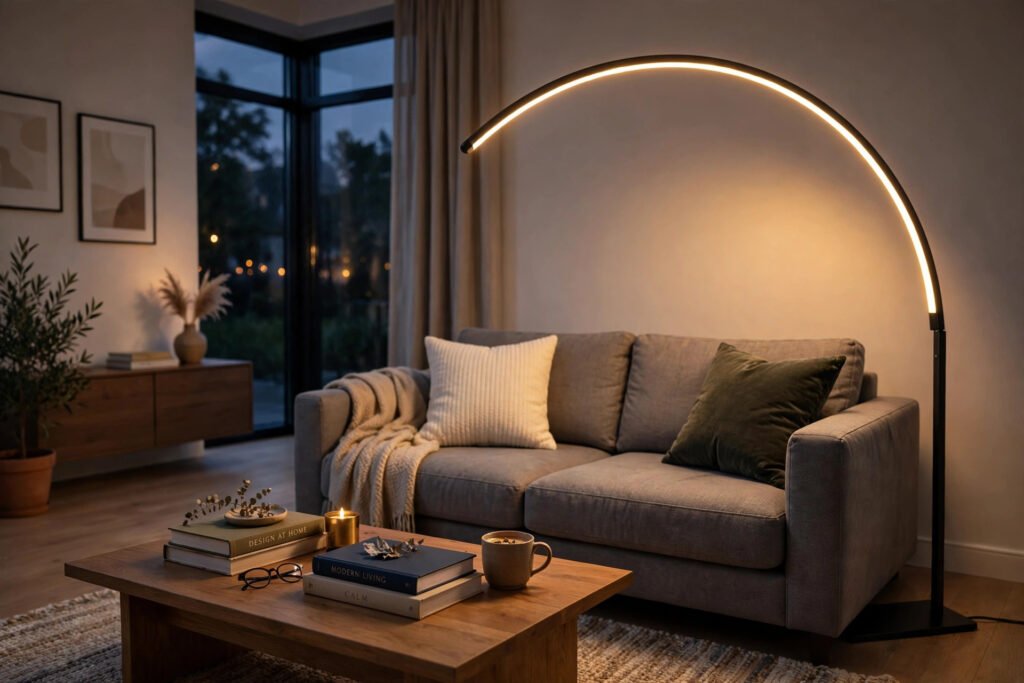

If your living room feels dim or hard to relax in after dark, the problem is often your lighting, not your furniture. Finding the best LED floor lamp living room owners actually love is one of the easiest, most renter-friendly upgrades: no wiring and no electrician. Plug it in, place it well, and the room feels warmer.
We compared and reviewed the most popular LED floor lamp types based on specs, features, and customer feedback — not a lab test — looking at brightness, colour temperature, dimming, size, and rough price range.
How We Compared These Lamps
We did not run lab tests or claim hands-on testing. We compared manufacturer specs, features, and what buyers mention in reviews: brightness, warmth, controls, and stability. Brightness (lumens): higher means more light; a main lamp is often 1,500 lumens or more. Colour temperature (Kelvin): warm white, around 2700K, feels cosy; neutral white, around 3500K to 4000K, feels clean; daylight, around 5000K, can feel cold. Dimmable: a dimmer lets you turn the lamp down for films and up for reading.
At a Glance: 5 Types Compared
| Type | Brightness | Colour | Rough Price | Best Use |
|---|---|---|---|---|
| Arc | 1,500–2,500 lumens | 2700K–4000K | $80–$250 | Over a sofa or chair |
| Torchiere | 1,500–3,000 lumens | 2700K–4000K | $40–$150 | General ambient light |
| Tripod | 800–1,800 lumens | 2700K–3500K | $50–$180 | Styled corners, small rooms |
| Reading | 800–1,500 lumens | 2700K–4000K | $40–$130 | Books and crafts |
| Smart dimmable | 1,000–2,500 lumens | 2700K–5000K | $60–$200 | TV, work, and relaxing |
Prices vary by brand and retailer — check the current price before buying.
1. Arc Floor Lamp
An arc lamp has a tall, curved arm that reaches over your sofa or armchair, with the light hanging down from above. Place the base behind or beside the sofa, so the shade hangs over your seating area.
- Best use: Over a sofa, sectional, or large reading chair.
- Pros: Big visual impact and great light where you sit.
- Cons: Needs floor space and can feel bulky in a small room.
Choose an arc lamp for a designed look, if you have room for the curve.
2. Torchiere Floor Lamp
A torchiere is the classic tall lamp with an upward-facing bowl at the top. It bounces light off the ceiling, spreading it softly around the whole room. If your living room has a dark corner and no overhead light, a torchiere is often the fastest fix.
- Best use: General light in a dark corner or beside a TV unit.
- Pros: Bright, affordable, simple, and great with no ceiling light.
- Cons: Upward light alone can feel flat and is poor for reading.
Choose a torchiere for maximum brightness with minimum fuss.
3. Tripod Floor Lamp
A tripod lamp stands on three legs with a fabric or linen shade. It is the most decorative option here and suits modern, boho, farmhouse, and Scandinavian rooms well. It spreads light sideways, creating a warm pool of light — lovely for evenings, but weak as your only light in a large, dark room.
- Best use: A styled corner or a small living room.
- Pros: Stylish, sculptural, and stable on three legs.
- Cons: Less bright than a torchiere or arc lamp.
Choose a tripod lamp if the look matters as much as the light.
4. Reading Lamp with Adjustable Arm
A reading lamp is slimmer, with an adjustable arm or gooseneck and a small, directed shade. Point it at your book, laptop, or craft project while the rest of the room stays soft. Choose a dimmable model with adjustable colour temperature: warm, dim light is easier on the eyes at night, while brighter, neutral light helps for work or crafts.
- Best use: Beside an armchair or the end of a sofa.
- Pros: Precise, adjustable light in a compact footprint.
- Cons: It lights a small area only, not a whole room.
Choose a reading lamp for a favourite chair.
5. Smart Dimmable Floor Lamp
A smart dimmable lamp is usually a slim, modern pole or tower with built-in LEDs. Control brightness and colour from a remote, touch panel, or phone app. Set bright, neutral light for cleaning, a warm glow for dinner, and very low light for a film.
- Best use: Multi-use living rooms, for work, TV, and relaxing.
- Pros: Adjustable brightness and colour, with remote or app control.
- Cons: More features can mean more to go wrong, and some apps feel fiddly.
Choose a smart lamp if you want flexibility.
How to Choose the Right Lamp
Start with how you use the room, not the lamp you like in a photo.
- Dark room, no ceiling light: Start with a bright torchiere or smart lamp, then add a reading lamp.
- Reading every evening: Choose an adjustable-arm reading lamp or an arc lamp, with warm, dimmable light.
- Small living room: Pick a slim torchiere or compact tripod lamp, and avoid a wide arc lamp.
- Large room: You may need two lamps — one for general light, one for seating.
- TV watching: Use warm, dimmable light to the side of the TV to avoid glare.
- Renters: Look for a stable base, a standard plug, and no installation.
Before you buy, measure your sofa and the base space, check cord length and the nearest outlet, and check whether a built-in LED can be replaced. Read recent reviews for stability, dimmer quality, and colour, and try the lamp in two or three spots first.
Our guide to rug size shows how the right rug can make your seating area — and your lamp — look balanced. Before buying on a budget, read these common home decor mistakes too.
Pros and Cons of LED Floor Lamps
LED floor lamps are popular for good reasons, but they are not perfect for every home.
Pros:
- Energy-efficient and long-lasting compared with older bulb types
- Many are dimmable, with adjustable colour temperature
- No wiring or installation, ideal for renters
- Easy to move when you rearrange or move home
Cons:
- Built-in LEDs in some models cannot be replaced
- Very cheap models can feel unstable or have a poor dimmer
- One lamp rarely lights a large room evenly
- Smart models depend on a remote or app
In short, choose the right type and check build quality first.
Frequently Asked Questions
How bright should an LED floor lamp be for a living room?
For general light, look for around 1,500 lumens or more. For reading, 800 to 1,500 lumens is usually enough, because the light is focused. Large or very dark rooms may need two lamps.
What colour temperature is best for a living room?
Warm white, around 2700K to 3000K, is best for relaxing in the evening. Neutral white, around 3500K to 4000K, is better for daytime tasks. Adjustable colour temperature gives you both.
Are LED floor lamps good for reading?
Yes, if you choose the right type. An adjustable-arm reading lamp or an arc lamp over your chair gives focused, glare-free light. A torchiere alone is too diffuse for small print.
Do LED floor lamps use a lot of electricity?
No. LEDs use much less electricity than older halogen or incandescent lamps for the same brightness.
Can I use a floor lamp if my living room has no ceiling light?
Yes. A bright torchiere or smart dimmable lamp can be the main light for the room, with a second lamp near your seating for reading. This is a common setup in rentals.
Final Checklist Before You Buy
- Decide the lamp’s main job: light, reading, or style
- Measure your space, base, and sofa height
- Check brightness in lumens and colour temperature in Kelvin
- Choose dimmable, adjustable colour for flexibility
- Check cord length and the nearest outlet
- Check whether the built-in LED can be replaced
- Read recent reviews for stability and dimmer quality
- Compare rough price ranges and check the current price before buying
- Test the lamp in two or three spots first
The best lamp is not the brightest or most expensive — it is the one that fits your room, habits, and budget.