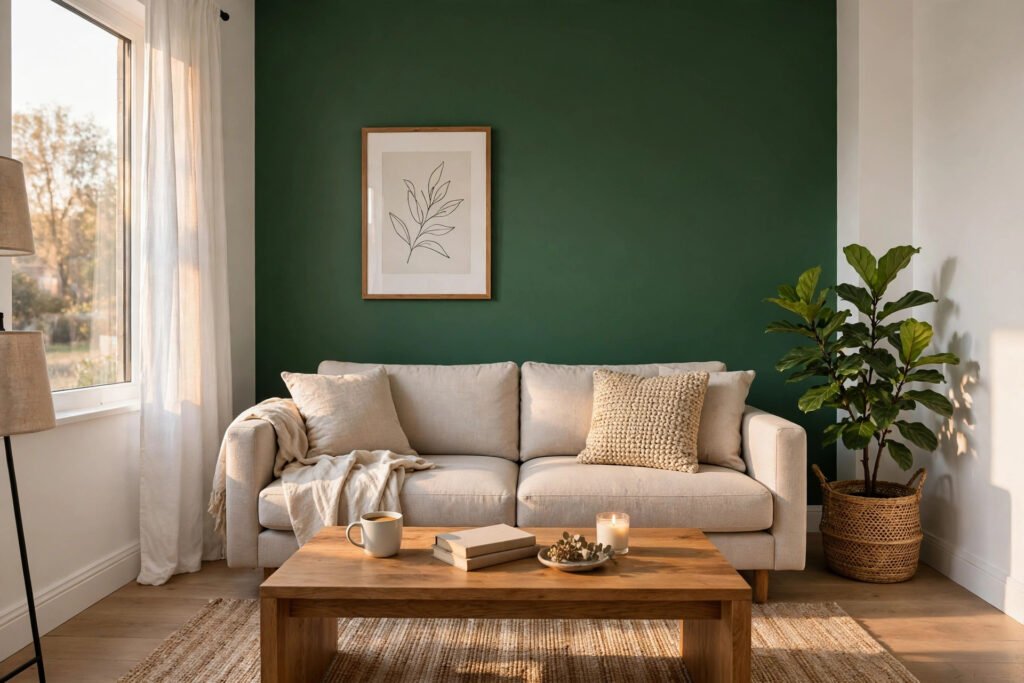

An accent wall is the fastest way to give a room personality without redecorating the whole space, and affordable accent wall ideas prove you do not need a big budget or a contractor to pull it off. One painted wall, a roll of peel-and-stick wallpaper, or a few slim wood battens can turn a plain room into one that feels designed. Most ideas here cost under $50. Prices below are rough ranges only — check the current price before buying, as prices vary by shop and region.
What Makes a Good Accent Wall?
An accent wall gives the eye one clear focal point: one wall with colour, pattern, or texture, while the rest of the room quietly supports it. That contrast is what makes a space feel finished rather than flat. The trick is restraint: one strong wall beats two competing ones, and a bold choice works best when the rest of the room stays calm.
1. Paint One Wall a Bold Colour
Paint is still the cheapest accent wall of all. A single litre of good wall paint usually costs in the rough range of $10 to $25, and one wall rarely needs more than that. Deep green, navy, terracotta, or a warm charcoal all look far more expensive than they cost, especially against white or pale grey walls.
Before you commit, paint a test patch and live with it for a day — colours look very different in morning and evening light. If you are nervous about going dark, try the wall behind the bed or the sofa first, where furniture softens the effect.
2. Peel-and-Stick Wallpaper
Peel-and-stick wallpaper has become the renter’s best friend. A roll usually costs in the rough range of $15 to $40, and one or two rolls cover a feature wall in a small room. It goes up without paste and peels off without damage.
Measure carefully before ordering, and buy one extra roll if the pattern needs matching. Start at the top and smooth downwards, working out air bubbles as you go. If the pattern is busy, keep the rest of the room simple so the wall can do the talking.
3. Wood Slats or Battens
Thin wood slats give a wall instant texture and a warm, crafted feel. Ready-cut pine battens cost roughly $1 to $3 per strip, so a full wall often costs in the rough range of $20 to $50 depending on spacing. Paint them the same colour as the wall for a subtle, tonal look, or stain them for contrast.
Use a small offcut of wood as a spacer to keep the gaps even — it is much faster than measuring each one. Vertical slats make a ceiling feel taller, while horizontal slats can make a narrow room feel wider.
4. A Gallery Wall
A gallery wall is an accent wall made from things you already own, which makes it one of the cheapest options. Mix framed prints, photos, small mirrors, and even a woven basket or two, and arrange them as one big composition on a single wall. The wall becomes the feature, not any single frame.
Plan the layout on the floor first, take a photo of it, and only then pick up a hammer. Keep the gaps roughly equal — about 5 to 8 centimetres — and anchor the arrangement around one larger piece at eye level. Our roundup of the best budget picture frames will help you keep the cost down.
5. Fabric, Tapestry, or a Large Textile
A large piece of fabric hung on the wall adds colour, pattern, and softness in minutes, and it is one of the easiest accent walls to change with the seasons. A tapestry or a length of bold fabric usually costs in the rough range of $15 to $40, and you only need a curtain rod, a wooden dowel, or a few hooks to hang it.
It works especially well in bedrooms, where fabric softens the room and absorbs sound. Hang it behind the bed as a makeshift headboard, or let a long tapestry run almost to the floor for a relaxed feel. If you like texture, a woven wall hanging or macrame piece works the same way — see our roundup of the best affordable macrame wall hangings.
6. Picture-Frame Moulding
Picture-frame moulding — thin strips of trim arranged in rectangles on the wall — looks like expensive panelling but costs very little. A few lengths of lightweight trim, some adhesive or small nails, and a coat of paint are all you need, and a wall usually comes in at roughly $20 to $45 in materials.
Measure and mark the rectangles with a pencil and a spirit level first; crooked moulding is the one thing that gives this trick away. Paint the moulding the same colour as the wall for a quiet, classic look.
7. Oversized Art, Mirrors, or a Statement Piece
Sometimes one big thing on a wall is all the accent you need. A single oversized print, a large mirror, or a cluster of three matching mirrors creates a focal point without any building work. Large prints usually cost in the rough range of $20 to $50, and budget mirrors are often cheaper than people expect.
Scale matters most: a small picture on a big empty wall looks lost, so go larger than you think — the art should cover roughly two-thirds of the width of the furniture below it. If you are styling a bedroom, our roundup of the best budget wall art for bedrooms has prints that work at this scale.
How to Choose the Right Wall
Pick the wall your eye lands on first when you walk in: behind the sofa or television in a living room, behind the bed in a bedroom, or the longest uninterrupted wall in a dining room. Avoid walls broken up by doors, windows, or large radiators — the accent gets lost when it competes with too many interruptions. Also consider the light: a dark wall can feel oppressive in a dim room, so choose a textured or patterned accent instead.
Mistakes to Avoid
The most common mistake is accenting more than one wall. Two bold walls stop being an accent and start being a theme, and the room loses its focal point. Another is choosing a colour you love in isolation that clashes with your sofa, rug, or curtains — hold a sample against your largest piece of furniture first. If you are renting, check your tenancy agreement first — peel-and-stick products and removable hooks are the safer bet. For more renter-friendly ideas, see our guide to decorating a rental and our affordable home office wall decor ideas.
Frequently Asked Questions
What is the cheapest accent wall idea?
Paint is the cheapest accent wall idea for most rooms. One wall usually needs a single litre, in the rough range of $10 to $25, plus a brush and roller if you do not own them. A gallery wall made from frames and prints you already own can cost even less.
Can I do an accent wall in a rental?
Yes, if you choose a removable option. Peel-and-stick wallpaper, fabric hung from hooks, a gallery wall, and a large mirror leaned against the wall all come down cleanly. Paint is possible too if your landlord agrees and you repaint before moving out.
Which wall should be the accent wall?
Choose the wall you notice first when you enter — behind the bed in a bedroom, or behind the sofa in a living room. Pick a wall with as few doors and windows as possible so the accent reads as one clear feature.
Do accent walls make a room look smaller?
A dark accent wall can make a small room feel cosier, but it rarely makes it look smaller if the other walls stay light. It often makes a room feel larger by giving the eye a clear focal point and a sense of depth. If you are worried, choose a mid-tone colour or a textured finish rather than a very dark shade.
How much does an accent wall cost?
Most affordable accent wall ideas cost between $10 and $50 in materials. Paint is the cheapest option, while wood slats, peel-and-stick wallpaper, and large art sit at the higher end. Doing the work yourself keeps the cost down; hiring someone can easily double the total.
Final Thoughts
An accent wall is one of the few decorating projects where a small budget is genuinely no disadvantage. Paint, wallpaper, fabric, and a few lengths of trim can all create a wall that looks considered and expensive, and none of them needs a renovation or a professional. Pick one idea, start with the wall you see first when you walk in, and let the rest of the room stay calm.