
Disclosure: This article contains affiliate links. As an Amazon Associate, we earn from qualifying purchases. If you buy through these links, we may earn a small commission at no extra cost to you.
Affordable Home Gym Corner Ideas on a Budget
A home gym corner ideas budget plan starts with a truth most people miss: you do not need a spare room, a garage, or hundreds of dollars to work out at home. One corner — the dead space beside the sofa, the awkward nook in the bedroom, the end of a hallway — is enough for a mat, a pair of dumbbells, and a routine you will actually stick to. The trick is treating it like a real room in miniature: clear floor, a few versatile pieces, tidy storage, and a look that fits your home. Prices below are rough ranges — check the current price before buying.
1. Pick the Right Corner
Not every corner works equally well, so choose before you buy anything. Look for a spot with at least 6 by 4 feet of clear floor — enough to lie down on a mat with your arms out — and a ceiling high enough to raise your arms overhead without touching a light fitting. A corner near a window is ideal: natural light makes the space feel bigger, and fresh air matters when you are working up a sweat.
Avoid corners that double as a walkway. If you have to move the mat every time someone walks past, you will stop using it. A bedroom corner or the far end of a living room usually works better than the middle of a busy room. Measure the space and write the numbers down; every piece of equipment you buy after this should fit inside those measurements. If you are short on space elsewhere too, our guide to small living room ideas on a budget shows how to carve out zones in tight rooms.
2. Start With a Good Mat
The mat is the single most important purchase, because it defines the workout zone and protects both your floor and your joints. A thick exercise mat — around 6mm or more — gives enough cushion for floor work, yoga and stretching without sliding around. A basic one usually costs roughly $20–$40 — check the current price before buying.
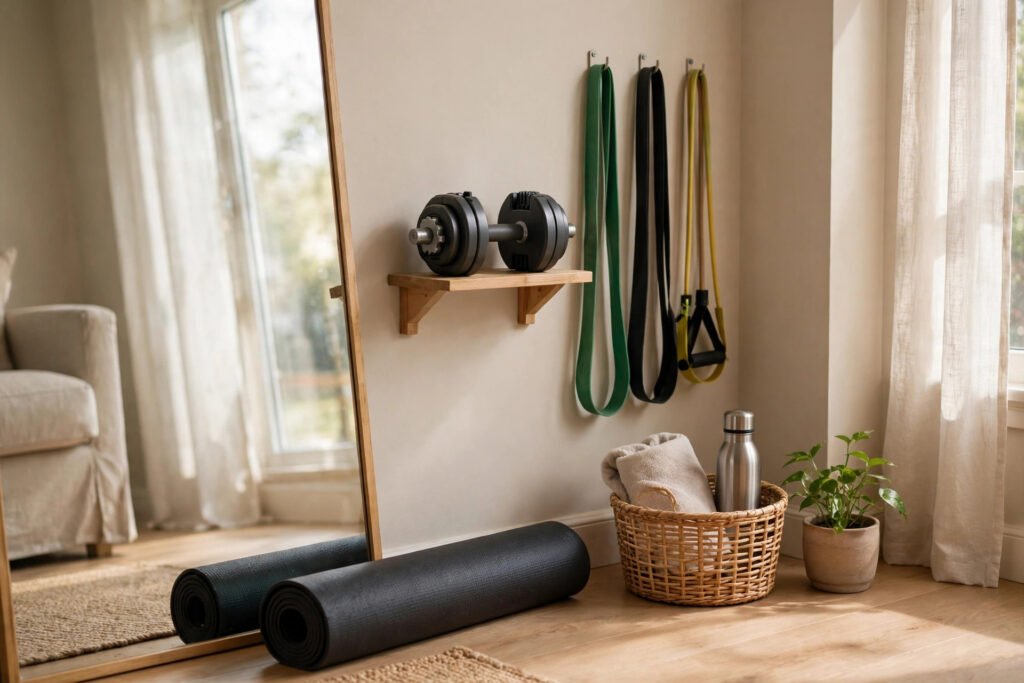
Roll the mat out to mark the corner as yours. When it is down, the space reads as a gym corner; when it is rolled up and tucked behind a door, the room goes back to normal. Choose a plain, dark colour — charcoal, navy or forest green — so it blends with your furniture instead of shouting “gym equipment”. Avoid very cheap, thin mats: they bunch up under your feet and wear through in a few months.
3. Choose Versatile Equipment Over a Lot of Equipment
A home gym corner fails when it fills up with single-purpose gadgets. Three versatile pieces cover almost everything: adjustable dumbbells, resistance bands, and a stability ball. Adjustable dumbbells replace a whole rack of fixed weights and usually cost roughly $40–$90 for a pair — check the current price before buying. Resistance bands cost roughly $10–$25 for a set and cover pulling, pressing and leg work while weighing almost nothing. A stability ball, roughly $15–$30, doubles as a bench and a core trainer.
Skip the big machines entirely. A treadmill or a bench press station will eat the whole corner and most of your budget, and a corner gym that takes over the room is one you will resent. Buy the three versatile pieces first, use them for a month, and only then decide if you are missing anything. If the corner sits in a bedroom, our budget bedroom makeover ideas under $100 show how to fit a workout zone into a room that still has to feel restful.
4. Use the Wall for Storage
Floor space is the scarcest thing in a gym corner, so get equipment off the floor and onto the wall. A couple of sturdy wall hooks hold resistance bands and a jump rope, and a small wall-mounted shelf keeps a water bottle, a towel and your phone within reach. A pegboard panel — roughly $20–$40 — turns a blank wall into a tidy rack for bands, straps and gloves, and it looks intentional rather than improvised.
Keep it simple and check the fixings. Wall hooks and shelves need proper wall plugs, not just a nail, because dumbbells and bands pull downward with real weight. If you rent and cannot drill, a tall, narrow shelving unit or a freestanding coat rack does the same job without holes in the wall. For more ideas that work in tight spaces, see our guide to affordable wall shelves for small spaces.
5. Add a Mirror to Open the Space
A mirror is the cheapest way to make a small corner feel twice as big, and it is genuinely useful — it lets you check your form during squats, lunges and stretches, which is how you avoid injury. A large leaning mirror, roughly $30–$60, propped against the wall behind the mat, does the job and can be moved when you need the space. Stick-on mirror tiles are even cheaper, roughly $15–$25, though the joins are visible.
Place the mirror so it catches the window light and reflects it back into the room. Do not put it where it reflects a television or a cluttered shelf — you want a calm view while you work out. If the mirror is heavy, secure the top to the wall with a strap or bracket, especially if children or pets use the room. Light matters too: most spare corners are the darkest part of a room, so add a small floor lamp with a warm bulb (roughly $20–$40) if the corner has no window. Our roundup of the best budget mirrors to make a room look bigger covers the sizes and styles that work best in small corners.
6. Keep It Tidy With a Small Storage System
A gym corner only survives if it stays tidy. One basket or storage cube — roughly $10–$20 — holds the bands, gloves, towel and water bottle when the workout is over, and the mat rolls up behind it. Give everything a home and the corner never turns into a pile of equipment in the middle of the room.
Build a two-minute reset into your routine: mat rolled, bands hung, dumbbells on the shelf, bottle in the sink. Two minutes is all it takes, and it is the difference between a corner you love and a corner that becomes a dumping ground. If the corner shares a room with a desk or a wardrobe, our budget home office organization ideas show how to keep shared zones tidy.
A Simple Home Gym Corner Checklist
Start with the measurements, then buy in this order: mat first, then the three versatile pieces, then wall storage, then the mirror and the light. Set it all up in one afternoon and try a full workout the same day — if something gets in the way, move it now, while the corner is still new. A home gym corner ideas budget works best when you spend on the mat and the dumbbells, save on storage and lighting with simple solutions, and leave the big machines out entirely.
FAQs
How much space do I need for a home gym corner?
About 6 by 4 feet of clear floor is enough for a mat, dumbbells and most bodyweight exercises. You also need enough ceiling height to raise your arms overhead. Measure before buying anything — equipment that does not fit the corner is money wasted.
What is the cheapest way to set up a home gym corner?
A thick mat (roughly $20–$40), resistance bands (roughly $10–$25) and adjustable dumbbells (roughly $40–$90) — roughly $70–$155 in total. Add pieces later only if you actually miss them.
Can I build a home gym in a rental?
Yes — choose equipment that needs no drilling. Use a freestanding shelf or coat rack instead of wall hooks, a leaning mirror instead of a mounted one, and a rolled mat that tucks away. Everything in this guide works without a single hole in the wall.
How do I keep a home gym corner from looking messy?
Give every item a home: wall hooks or a basket for bands, a shelf for the bottle and towel, and a spot to roll the mat. A two-minute tidy-up after each workout keeps the corner looking like part of the room instead of a pile of equipment.
Do I need a mirror in my home gym corner?
Yes — a leaning mirror lets you check your form, which lowers injury risk, and makes a small corner feel twice as big by bouncing light around the room. One usually costs roughly $30–$60.
You do not need a spare room or a big budget to work out at home. One measured corner, a good mat, three versatile pieces and a little wall storage is a gym you will actually use.