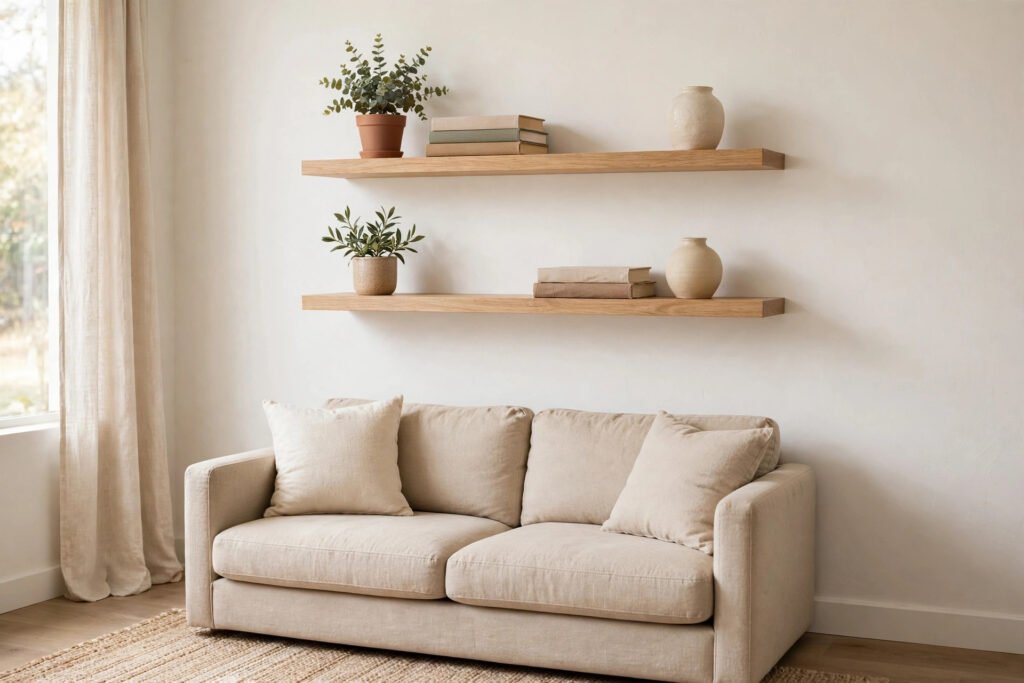

When floor space is scarce, the walls are the most underused storage you own. Affordable wall shelves small spaces rely on are not a luxury — a single well-placed shelf can hold books, plants and everyday essentials without taking up a single centimetre of floor. The trick is choosing the right style for the right wall, fixing it properly, and styling it so it looks intentional rather than cluttered. Here are seven budget-friendly styles, what they cost, and how to hang them.
Why Wall Shelves Work So Well in Small Rooms
Shelves move storage up to eye level, where it doubles as decoration. They cost far less than a new cabinet or bookcase, and most install in under an hour with basic tools.
Use the vertical space in spots that are already wasted: above a desk, over a door, beside a window, or in the narrow strip of wall next to a bed. One shelf in the right place beats three shelves in the wrong one.
1. Floating Shelves: The Clean, Modern Classic
Floating shelves have no visible brackets, so they look like a slim ledge growing straight out of the wall.
A pair of 60 cm wooden floating shelves typically costs roughly $15–$30, and a set of three in different lengths runs roughly $25–$45. Check the current price before buying. Most budget floating shelves hold 5–10 kg each when fixed into a wall stud or with proper wall plugs — enough for books, small plants and framed photos, but not for a full row of heavy hardbacks. Our step-by-step guide to DIY floating shelves on a budget walks through installation in detail.
2. Ledge Shelves: Picture Rails That Double as Storage
Ledge shelves — also called picture ledges — are shallow shelves with a small lip at the front. They were made for leaning framed prints and art, but they are just as good for small plants, candles and spice jars.
A 60 cm ledge shelf costs roughly $10–$20, so a row of three along one wall is one of the cheapest upgrades you can make. They hold less weight than a deep floating shelf, usually 3–5 kg, so keep heavy items off them.
3. Corner Shelves: Storage for Wasted Corners
Corners are the most wasted space in a small room, and corner shelves turn them into useful storage. A triangular or L-shaped shelf fits neatly where two walls meet and holds plants, books or bathroom essentials without sticking out into the room.
A single corner shelf costs roughly $12–$25, and a set of three stacked in a corner runs roughly $25–$40. Check the current price before buying.
4. Cube Shelves: Flexible Boxes You Can Rearrange
Cube shelves are open boxes you mount on the wall in any arrangement — a row, a staircase pattern, or a scattered cluster.
A set of three cubes costs roughly $20–$35, and larger sets of five or six run roughly $35–$55. Check the current price before buying. Cubes hold more than ledges because the box shape supports weight from below, usually 5–8 kg per cube.
5. Bracket Shelves: The Strongest Budget Option
If you need shelves that actually hold weight — cookbooks, a row of plants, or a small library — bracket shelves are the answer. A simple wooden board on two metal brackets is the strongest shelf style per pound spent.
A 90 cm board with two brackets costs roughly $15–$30, depending on the wood and bracket style. Properly fixed into studs, a bracket shelf can hold 15–20 kg or more, far beyond any floating shelf at the same price.
6. Ladder Shelves: Lean, Don’t Drill
Ladder shelves lean against the wall, so they need no drilling at all — perfect for renters or anyone who does not want holes in the wall.
A small leaning ladder shelf costs roughly $30–$60, more than a single wall shelf but far less than a bookcase. Check the current price before buying. They hold a surprising amount because the floor takes most of the weight, but always anchor the top to the wall if you have children or pets.
7. Over-the-Door and Above-Door Shelves
The wall above a door is almost always empty, and it is the perfect spot for a shelf holding items you use rarely — spare bedding, seasonal decor, or books you have already read. An above-door shelf costs roughly $15–$25 and installs in minutes.
Over-the-door hanging shelves, which hook over the top of the door with no drilling at all, cost roughly $10–$20 and suit renters perfectly. They hold lighter items, usually 3–5 kg, so keep them for shoes, scarves or cleaning supplies rather than books.
How to Hang Wall Shelves So They Stay Up
Get the fixings right — a shelf that falls off the wall is worse than no shelf at all.
Find the studs. In plasterboard walls, screws driven into a wooden stud hold far more weight than any plug. A cheap stud finder, or simply tapping the wall and listening for the solid sound, tells you where the studs are.
Use the right plugs. If there is no stud where you need one, use the correct wall plug for your wall type — toggle bolts for plasterboard, masonry plugs for brick. The small plastic plugs supplied with budget shelves are often the weakest part of the kit, so upgrading them is money well spent.
Check with a level. A shelf that is even slightly crooked is obvious the moment you put a plant on it. Use a spirit level, mark your holes with a pencil, and drill once. Our guide on how to style open shelves in the kitchen covers the same fixing basics for heavier kitchen loads.
Styling Wall Shelves Without Clutter
A shelf full of random objects makes a small room feel smaller; a styled shelf feels curated. The difference is restraint.
Follow the rule of three. Group objects in threes — a plant, a book stack and a candle, for example — and leave gaps between groups. Empty space is part of the design, not wasted space.
Vary the heights. A tall vase next to a low stack of books looks intentional; five objects all the same height look like a shop display. Mix tall, medium and low pieces on each shelf.
Keep a colour thread. Pick two or three colours and repeat them across the shelf. Neutral wood, white and one accent colour works in almost any room and keeps the display calm.
Mistakes to Avoid
The most common mistake is hanging shelves too high. A shelf you cannot reach without a step ladder becomes dead storage — you will never use what is on it. Keep everyday shelves between shoulder and eye height, and reserve high shelves for items you rarely need.
Another mistake is buying the cheapest shelf without checking its weight rating. A shelf that sags under a row of books looks bad and can fail. Spend a few pounds more on a shelf rated for the weight you actually plan to put on it.
Finally, do not fill every wall. One styled shelf wall is a feature; shelves on every wall make a small room feel like a warehouse. Pick the best wall, style it well, and leave the rest of the room to breathe. If you are short on storage elsewhere too, our how to organize a small closet on a budget guide uses the same edit-first approach, and our roundup of the best budget picture frames for a gallery wall pairs frames with your shelves.
FAQs
How much weight can affordable wall shelves hold?
It depends on the style and the fixings. Floating shelves usually hold 5–10 kg, ledge shelves 3–5 kg, and bracket shelves fixed into studs 15–20 kg or more. Always check the manufacturer’s rating and use the right wall plugs for your wall type.
Can I put wall shelves up in a rental?
Yes. Ledge shelves use only two small screw holes that are easy to fill, and leaning ladder shelves or over-the-door shelves need no drilling at all. Check your tenancy agreement first.
What is the best shelf depth for a small room?
A depth of 15–20 cm suits most small rooms — deep enough for books, plants and framed photos, but shallow enough that the shelf does not jut into the walkway. Go deeper, 25–30 cm, only above a desk or in a kitchen where you need room for plates and jars.
How high should I hang wall shelves?
Everyday shelves work best between shoulder and eye height, roughly 140–160 cm from the floor. Shelves above a desk should sit 45–60 cm above the desktop so you can reach them from your chair. Reserve shelves above 180 cm for items you rarely need.
Are floating shelves or bracket shelves better for small spaces?
Floating shelves look cleaner and suit light decor, while bracket shelves hold more weight and cost less for the same length. For books or heavy items, choose brackets; for mostly decorative shelves, floating shelves give the tidier look.