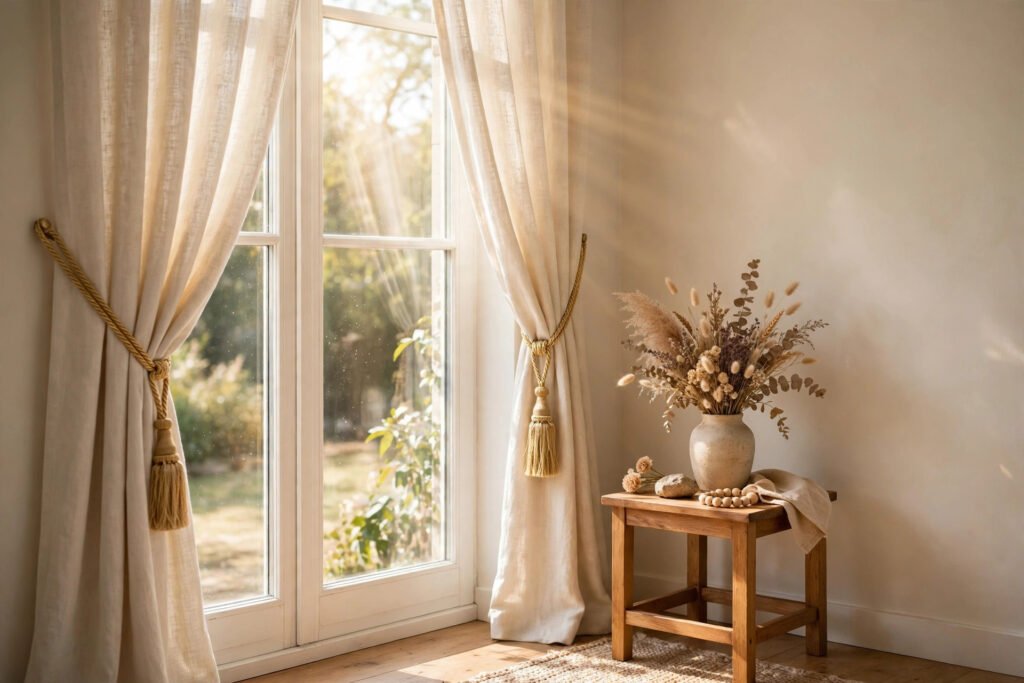

Best Budget Curtain Tiebacks and Holdbacks
Disclosure: This article contains affiliate links. As an Amazon Associate, we earn from qualifying purchases. If you buy through these links, we may earn a small commission at no extra cost to you.
The best budget curtain tiebacks are the cheapest way to make a window look finished. Curtains left hanging straight can look flat and heavy, but pull them back with a tieback and the same window suddenly has shape and light. A good set usually costs less than a takeaway dinner, yet the right one can make budget curtains look far more expensive.
This roundup is based on specs, features and customer feedback rather than lab testing. We have compared the most popular budget styles — rope, magnetic, tassel, beaded, fabric and hook holdbacks — and noted the honest pros and cons of each.
1. Classic Rope Tiebacks
Rope tiebacks are the simplest option and often the cheapest. A twisted or braided cord with a tassel at each end loops around the gathered curtain and hooks onto a small wall hook. They suit almost every curtain style, from sheer voile to heavier blackout panels, and you can slide the rope up or down to change the coverage.
Pros: very affordable, adjustable, gentle on fabric.
Cons: can look dated in a very modern room; tassels collect dust.
2. Magnetic Tiebacks
Magnetic tiebacks are two small decorative pieces joined by a magnet, with the curtain sandwiched between them. There is nothing to screw into the wall, which makes them ideal for renters, and they are the easiest style to adjust: just slide them up or down until the drape looks right.
They work best on light to medium-weight curtains. On very heavy blackout curtains, a single magnet may struggle to hold the fabric, so check the weight rating and read customer feedback before buying. For sheer or lightweight panels, they are close to perfect. If you are dressing a window with sheers, our roundup of the best budget sheer curtains has more ideas for a light, airy finish.
Pros: no drilling, renter-friendly, quick to adjust.
Cons: may slip on heavy curtains; weaker magnets can lose grip over time.
3. Tassel Tiebacks
Tassel tiebacks are the traditional choice, and they still earn their place in a classic or cosy room. A thick cord ends in a full tassel that hangs below the gathered curtain, adding a decorative touch that plain rope cannot match. They pair especially well with velvet and lined curtains, where the weight of the tassel helps the fabric fall in a graceful curve.
Budget sets come in neutral colours such as cream, grey and taupe, as well as richer tones like burgundy and forest green. If your curtains are already patterned, choose a plain tassel in one of the colours from the pattern.
Pros: decorative and classic, good for heavy fabrics.
Cons: tassels need dusting; can look too formal in a minimalist room.
4. Beaded Tiebacks
Beaded tiebacks use a string of wooden, glass or acrylic beads instead of a cord, and they bring a touch of sparkle to a plain window. Wooden beads suit a boho or Scandinavian room; crystal-style beads suit a more glamorous look. They are a good choice when the curtains are plain, because the tieback becomes the decoration.
Beaded tiebacks are less flexible than rope, so they work best when the curtain is gathered into a fairly tight bunch. Most budget sets include the fixings — check before you order.
Pros: decorative, suits plain curtains, many styles available.
Cons: less flexible than rope; beads can chip if knocked against the wall.
5. Fabric Tiebacks
Fabric tiebacks are a band of the same — or a matching — fabric as the curtain, and many curtain sets include them in the pack. If yours did not, you can make a pair from a spare length of fabric in about twenty minutes with a sewing machine, or buy ready-made bands.
The band blends into the curtain rather than standing out, which makes it a good choice for patterned curtains, where a rope or tassel might clash. The downside is that a plain band can look unfinished if the edges are not hemmed neatly, so check the stitching when your order arrives.
Pros: blends with the curtain, great for patterns, easy to make yourself.
Cons: plain bands can look unfinished; limited colours in ready-made sets.
6. Metal Hook Holdbacks
Metal holdbacks are fixed to the wall rather than tied around the curtain. A small curved hook, usually in brass, black or chrome, holds the gathered fabric in a neat loop. They give the most polished look of any option here, and they are the best choice for heavy curtains because the wall fixing takes the weight rather than the tieback.
Installation needs two small screws per holdback, so they are not ideal for renters — although some brands now sell adhesive versions for light curtains. If you are replacing your curtain hardware at the same time, our roundup of the best budget curtain rods covers affordable rods and finials to match.
Pros: most polished look, best for heavy curtains, durable.
Cons: needs drilling (unless adhesive); harder to adjust once fitted.
7. Wooden Bead and Macramé Tiebacks
Macramé and wooden-bead tiebacks are the boho option: they add texture and a handmade feel for very little money. A macramé tieback is usually a braided cord with a fringe or a wooden bead accent, and it pairs well with linen, cotton and other natural fabrics.
They suit relaxed rooms — bedrooms, reading corners and cottage-style living rooms — better than formal spaces. Keep the rest of the window simple so the tieback does not compete with a patterned curtain.
Pros: textured and handmade look, very affordable, suits natural fabrics.
Cons: fringe can tangle; less suited to formal or very modern rooms.
How to Choose the Right Tieback
Start with the weight of your curtains. Light sheers work with almost anything, but magnetic and fabric tiebacks are the easiest. Medium-weight cotton and linen suit rope, tassel and beaded styles. Heavy velvet or lined blackout curtains need a metal holdback or a strong rope tieback, because anything weaker will slip or sag.
Next, match the style to the room. A classic living room suits tassel or rope; a modern room suits magnetic or metal; a boho bedroom suits macramé or wooden beads. If you are unsure, a plain rope tieback in a neutral colour is the safest choice.
Finally, check the length. If your panels are very wide or thick, a short tieback will not close around the gathered fabric. Measure the bunch you plan to gather, and choose a tieback a few centimetres longer.
How to Position Tiebacks
Place the tieback about two-thirds of the way down the window, or roughly at sill height. That gives the curtain a gentle S-curve and lets the maximum light in while keeping the fabric neatly out of the way.
For a more relaxed look, lower it to about three-quarters of the way down; for a more formal look, raise it slightly. Keep both sides level — a tieback even a couple of centimetres higher on one side is noticeable. Mark the wall with a pencil before you fix any hooks, and step back to check the drape before you tighten the screws. Our guide to how to hang curtains the right way covers the full hanging process.
Mistakes to Avoid
The most common mistake is pulling the curtains back too tightly. A tieback should gather the fabric, not strangle it — leave the bunch loose enough that the folds fall naturally.
Another mistake is choosing a tieback that is too short. If you have to force the ends together, it will slip off or pull the curtain out of shape. Measure first, and if you are between sizes, choose the longer one.
FAQs
What are the best budget curtain tiebacks for renters?
Magnetic tiebacks are the best choice because they need no drilling and no wall fixings. Fabric and rope tiebacks also work if you use an adhesive hook instead of a screw-in one.
Do magnetic curtain tiebacks work on blackout curtains?
It depends on the weight. Most magnetic tiebacks hold light and medium-weight curtains well, but very heavy lined blackout curtains may need a stronger magnet or a metal holdback.
Where should curtain tiebacks be placed?
About two-thirds of the way down the window, or roughly at sill height, gives the most flattering drape. Lower the tieback for a relaxed look, or raise it slightly for a more formal one — just keep both sides level.
How do I stop tiebacks from slipping down?
Make sure the tieback is long enough to close comfortably around the gathered fabric, and that the hook or holder is fixed securely. For rope and tassel tiebacks, a small loop of thread stitched to the back of the curtain can stop the cord sliding.
Can I use tiebacks on sheer curtains?
Yes. Magnetic tiebacks are the neatest option for sheers because they grip without crushing the fabric. Choose a light, slim tieback so it does not overwhelm the delicate material.