
Disclosure: This article contains affiliate links. As an Amazon Associate, we earn from qualifying purchases. If you buy through these links, we may earn a small commission at no extra cost to you.
These budget bathroom mirror ideas prove that you do not need a renovation — or a big spend — to change how your bathroom feels. A mirror is one of the hardest-working pieces in the room: it bounces light around, makes a small space feel larger, and sets the style of the vanity wall. Swap a plain builder-grade mirror for something with a little character, and the room looks different the same afternoon. The seven ideas below all cost roughly $20–$100, and each one is based on specs, features and customer feedback rather than lab testing. Prices change often, so check the current price before buying.
1. Hang an Arched Mirror
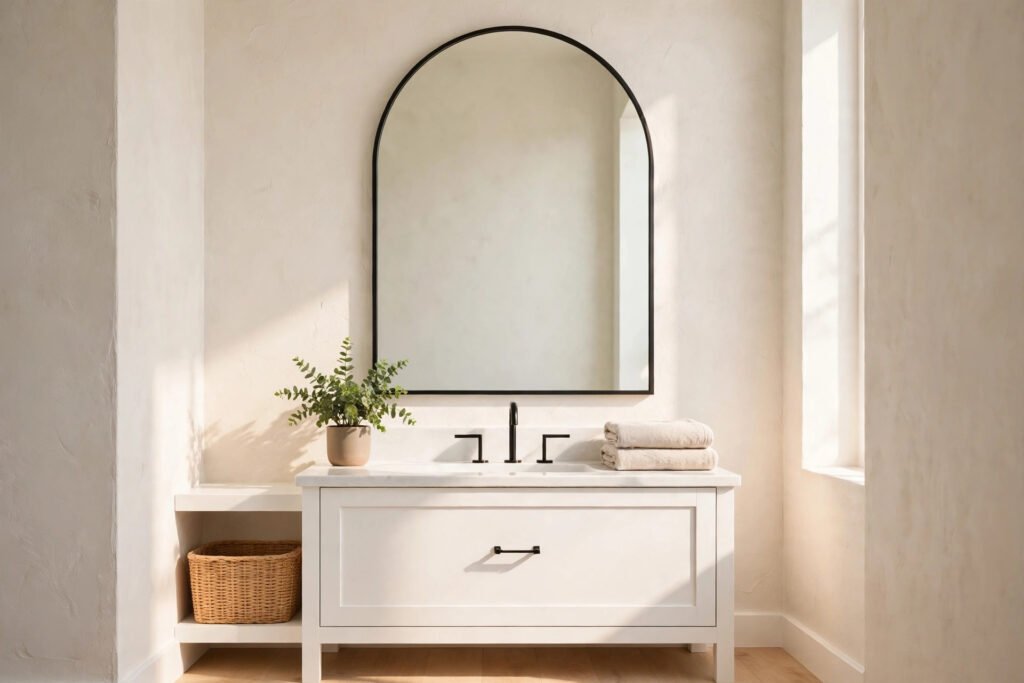
An arched mirror is the quickest way to make a basic bathroom look considered. The soft curve breaks up all the straight lines of tiles, vanity and cabinets, and it suits almost every style, from modern to farmhouse. A 20 x 30 inch arch fits a standard single vanity, while a 24 x 36 inch version suits a wider unit.
Look for a thin metal frame in black, brass or brushed nickel — the frame colour should match your taps and hardware so the whole wall feels intentional. Frameless arches are cheaper, roughly $25–$50, and look clean in a minimalist bathroom.
Hang it so the centre of the mirror sits at eye level, about 60 inches from the floor, and leave a few inches between the bottom of the mirror and the splashback.
2. Go Oversized With One Big Mirror
One large mirror does more for a small bathroom than two small ones. It reflects the whole room, doubles the light from the window or fittings, and makes the wall feel taller. Measure your vanity first: the mirror should be a few inches narrower than the vanity itself, never wider, or it will look top-heavy.
A frameless mirror cut to size is often the cheapest option — roughly $30–$60 for a single-vanity size — and a glass shop can cut it to your exact measurements. A simple wood or metal frame in a large size usually costs roughly $50–$100. Hang it with proper wall fixings, not adhesive strips, because a large mirror is heavy and a bathroom wall gets damp.
If your bathroom feels cramped, this is the idea to try first. Our guide on how to make a small bathroom look bigger has more tricks that work alongside a bigger mirror.
3. Frame a Plain Builder-Grade Mirror
If your bathroom has a flat, frameless mirror glued to the wall, you do not need to remove it. A DIY frame transforms it for roughly $15–$40 in materials. Thin wood trim, cut to size and mitred at the corners, sticks straight onto the mirror glass with construction adhesive, and a coat of paint or stain finishes the job in an afternoon.
Painted black trim looks smart in a modern bathroom; natural oak or pine suits a warmer, farmhouse feel. Measure twice before cutting, and use a level when you stick the trim on — a frame that is even slightly crooked is obvious in a mirror.
This is one of the best budget bathroom mirror ideas for renters too, because nothing is drilled into the wall. For more renter-friendly changes, see our affordable bathroom decor ideas for renters.
4. Use a Pair of Matching Mirrors
A double vanity looks unfinished with a single small mirror in the middle. Two matching mirrors — one over each basin — instantly make the room feel balanced and a little more luxurious, and the pair costs less than one large designer mirror. Round or arched mirrors work best in pairs because their soft shapes keep the wall from looking like a grid. Keep each mirror roughly the same width as its basin, hang them at exactly the same height, and leave a gap of about 6–8 inches between them.
5. Try a Round Mirror
A round mirror is a safe, stylish choice for almost any bathroom, and it is often the cheapest framed option — roughly $20–$60 for a 24-inch size. The circle softens a room full of rectangles, and it works just as well over a pedestal sink as over a full vanity. In a very small bathroom, a round mirror leaves wall space free on either side for a sconce or a small shelf.
Choose a diameter about two-thirds the width of your vanity. A mirror that is too small looks lost, while one that is too large crowds the wall. A thin metal frame in black or gold reads modern; a chunky wood frame leans farmhouse. Our roundup of the best budget mirrors includes round options at several price points.
6. Pick a Mirror With a Shelf or Storage
In a small bathroom, a mirror that does two jobs is worth more than a pretty one. A mirror with a small shelf underneath gives you a spot for a toothbrush holder or a plant, and it keeps the vanity top clear. A mirrored cabinet does the same job with hidden storage behind the glass, which is ideal when counter space is tight.
Surface-mounted cabinets hang like a normal mirror and cost roughly $50–$100 for a basic single-door version. Check the depth before buying: anything deeper than about 5 inches will stick out awkwardly over a narrow vanity. If storage is your main problem, our affordable bathroom storage ideas cover more options that actually work.
7. Add Light Around the Mirror
A mirror only works as well as the light in front of it. Two small sconces at eye level on either side of the mirror give even, flattering light with no shadows, and they cost far less than a new light fitting — roughly $25–$60 a pair for simple plug-in or battery options. If wiring is not an option, a backlit LED mirror does the same job in one piece and usually costs roughly $60–$100.
How to Choose the Right Size
Size matters more than style. A mirror that is too small makes the vanity look oversized; one that is too large overwhelms the wall. As a rule, the mirror should be 70–80% of the width of your vanity, and its bottom edge should sit 5–10 inches above the splashback. For height, aim for the centre of the mirror at eye level, roughly 57–65 inches from the floor.
In a bathroom with low ceilings, a tall mirror draws the eye upward and makes the room feel taller. Measure the wall, mark the outline with painter’s tape, and live with the shape for a day before you buy — it is much easier to move tape than to rehang a mirror. If you are also refreshing the vanity area, our budget bathroom vanity decor ideas pair well with a mirror upgrade.
Frequently Asked Questions
What size mirror should I choose for a small bathroom?
Choose a mirror about 70–80% as wide as your vanity, with its centre at eye level (roughly 57–65 inches from the floor). A larger mirror reflects more light and makes a small bathroom feel bigger.
Can I hang a mirror in a bathroom without drilling?
Yes, for lightweight mirrors under about 5 kg, heavy-duty adhesive strips can work on a smooth, dry wall. For anything heavier, use screws and wall anchors — steam weakens adhesives over time, and a falling mirror is dangerous.
How do I stop a bathroom mirror from fogging up?
A thin layer of shaving foam wiped over the glass, or a small anti-fog film, keeps the mirror clear for a few weeks at a time. A heated mirror pad behind the glass is a longer-term fix and costs roughly $20–$40, but it needs a power source.
Are arched mirrors still in style?
Yes — arched mirrors have stayed popular for several years because the soft curve suits modern, farmhouse and traditional bathrooms alike. They are a safe choice if you want a mirror that will not look dated quickly.
What is the cheapest way to upgrade a bathroom mirror?
Framing a plain builder-grade mirror with wood trim costs roughly $15–$40 and takes an afternoon. If you would rather replace the mirror, a frameless mirror cut to size or a simple round mirror is usually the cheapest ready-made option.
Final Thoughts
A bathroom mirror is a small change with an outsized effect. Whether you hang an arch, frame the mirror you already have, or add light around it, the right choice makes the room brighter, bigger and more finished — all for the price of a takeaway or two. Start with the size, match the frame to your taps, and hang it at eye level.