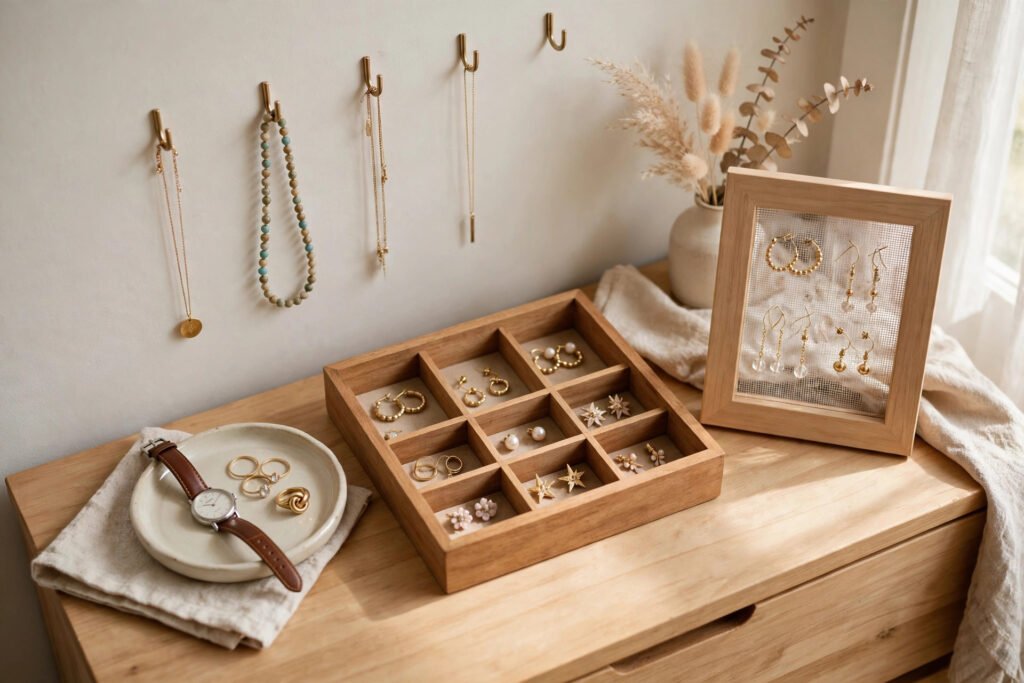

A tangled necklace, a missing earring, a ring buried at the bottom of a drawer — most of us own more jewelry than we ever wear, because we cannot find it. The good news is that an organize jewelry budget plan does not need fancy organizers or a specialist shop. With a few cheap trays, hooks and small boxes, plus an hour of sorting, you can turn a messy drawer into a tidy display where every piece is visible and easy to reach.
The secret is not buying more storage. It is matching the storage to the way you actually wear your jewelry. A necklace you wear every day needs a hook, not a box lid. A pair of studs you wear twice a year can wait in a small compartment. Work through the seven ideas below and pick the ones that fit your space.
1. Sort Everything Before You Buy Anything
Start by laying every piece of jewelry you own on a clean towel. Seeing it all at once shows what you really have — most people find duplicates, broken clasps, and pieces they forgot they owned.
Sort the pile into four groups: pieces you wear weekly, pieces for special occasions, pieces to repair, and pieces to let go of. The weekly group is small, and that is the point: it is the only group that needs prime storage space. The occasional group can live in a box on a shelf, broken pieces go in a small bag to fix or recycle, and anything you have not worn in a year and do not love can be passed on. Once the sorting is done, you will know exactly how much storage you need — usually far less than you expected.
2. Hang Necklaces So They Stop Tangling
Necklaces are the worst offenders in any jewelry drawer. Chains slide, knots form, and a delicate chain can take ten minutes to untangle. The fix is simple: hang them.
A row of small adhesive hooks inside a wardrobe door costs very little and keeps every chain separate. If you would rather see your necklaces, use a decorative hook rail or a small wall-mounted rack near your mirror. Give each necklace its own hook, with a little space between them, and keep the longest chains at the ends. For ideas on displaying pieces on the wall, see our affordable wall shelves for small spaces.
If wall space is tight, a necklace stand on a dresser works just as well. Simple stands in wood or metal cost roughly $8–$20 depending on size and material — check the current price before buying.
3. Use a Tray for the Pieces You Wear Every Day
Everyday jewelry needs a home that is faster than a drawer. A small tray on your bedside table or dresser is the answer. Your watch, your everyday ring, and the earrings you reach for each morning all land in one place, and nothing rolls away.
A ceramic dish, a small wooden tray, or even a pretty saucer from the kitchen will do the job. The trick is to keep the tray small: if it fits only your daily pieces, it stays tidy on its own. A tray that is too big becomes a dumping ground for hair ties, coins, and anything else in your pockets. For more ways to make your bedside work harder, see our best budget nightstands for small bedrooms.
4. Repurpose Small Boxes for Rings and Earrings
Rings and stud earrings are small, and they vanish in big compartments. The cheapest fix is to repurpose things you already own. An ice cube tray, a pill organizer, or a small box divided with cardboard strips gives every pair of studs and every ring its own slot.
Velvet-lined ring rolls are another good option. They cost very little — roughly $5–$15 for a simple one — and they keep rings upright and separate, which protects the stones and makes it easy to see what you have. Check the current price before buying, and pick a roll that fits inside the drawer or box where it will live.
For earrings, a small box with a lid works best — it stops pairs from separating. Keep each pair together in the same compartment.
5. Turn a Frame Into an Earring Display
If you own a lot of dangling earrings, a drawer will never work — they tangle, snag, and hide. A display is better, and you can make one from an old picture frame in about ten minutes.
Remove the glass, stretch a piece of mesh, lace, or fine netting across the back of the frame, and hang it on the wall near your mirror. Earrings hook straight through the mesh, so you can see every pair at a glance. A frame from a charity shop costs very little, and the finished display doubles as wall decor. For more affordable ways to decorate the wall around your display, see our best budget picture frames for a gallery wall.
6. Use a Pegboard or Shelf for a Mini Jewelry Station
If your collection is large, give it a dedicated station. A small pegboard on the bedroom wall, fitted with a few hooks and a tiny shelf, holds necklaces, bracelets, and a few rings in one place. It costs far less than a purpose-built jewelry cabinet, and it grows with your collection: add hooks when you need them, move them when you rearrange.
Keep the station near a mirror so you can try pieces on without walking across the room, and add a small shelf underneath for the tray of everyday pieces from idea three. If a pegboard feels too much like a workshop, a narrow floating shelf with hooks underneath does the same job more quietly. For a simple shelf project, see our DIY floating shelves on a budget.
7. Keep a Travel Roll Ready for Trips
A good home system falls apart the moment you travel, so keep a small travel roll or pouch ready to go. A fabric roll with pockets and a tie, or a small zip pouch with compartments, keeps necklaces separate and earrings paired on a weekend away.
The budget version costs almost nothing: wrap each necklace in tissue paper or thread it through a drinking straw to stop it tangling, then roll everything in a soft cloth.
Tips That Keep the System Working
A jewelry system only works if it is easy to keep up. Put pieces back in the same place every time you take them off — that single habit matters more than any organizer you buy. Do a quick tidy once a month: check for tangles, return stray pieces home, and move anything unworn for weeks out of the prime spots.
Clean your jewelry gently and regularly. A soft cloth after wearing removes the oils and creams that dull metal and stones over time. Avoid storing jewelry in a damp bathroom if you can; humidity tarnishes silver and loosens glue, so a bedroom drawer or a dry shelf is a better home. For more storage ideas that work in small rooms, see our affordable bathroom storage ideas and our budget bedroom makeover ideas under $100.
FAQs
How do I organize jewelry on a budget?
Start by sorting everything into pieces you wear weekly, pieces for special occasions, and pieces to let go of. Then use cheap solutions you already own — a tray for everyday pieces, small boxes or an ice cube tray for rings and studs, and hooks inside a wardrobe door for necklaces.
How do I stop necklaces from tangling?
Hang each necklace on its own hook so the chains never touch. Adhesive hooks inside a wardrobe door, a hook rail, or a necklace stand all work. For travel, thread each chain through a drinking straw.
What is the best way to store earrings?
Stud earrings belong in a small lidded box with separate compartments, one pair per slot. Dangling earrings are better displayed: hook them through mesh stretched across an old picture frame.
Where should I keep my everyday jewelry?
Keep it on a small tray on your bedside table or dresser, close to where you get dressed. A tray that holds only your daily watch, ring, and earrings stays tidy on its own.
Should I store jewelry in the bathroom?
It is better not to. Bathrooms are humid, and humidity tarnishes silver, dulls stones, and weakens glue on costume pieces. Store jewelry in a dry bedroom drawer or on a shelf away from steam.
Final Thoughts
An organize jewelry budget project is less about shopping and more about seeing what you own. Sort it, hang the necklaces, tray the daily pieces, and give the small things small compartments. Once every piece has a visible home, you will wear more of what you own — and stop buying duplicates of things you already had.