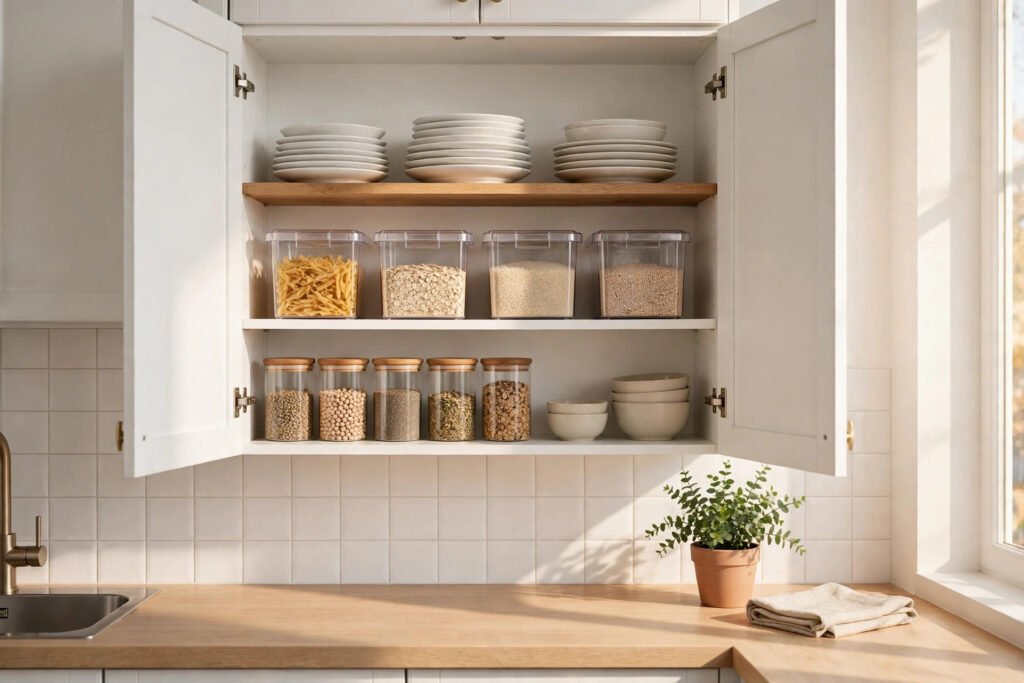

Learning how to organize kitchen cabinets budget will change the way your kitchen feels every single day. When every cabinet has a clear job and everything inside has a home, cooking stops being a hunt through crowded shelves and starts feeling calm and easy. You do not need a full renovation, a custom storage system or a big spend to get there. The seven ideas below use cheap bins, simple habits and a bit of honest decluttering, and most of them cost less than a weekly shop.
1. Empty Every Cabinet Before You Organize Anything
The biggest mistake people make is buying organizers first and sorting second. Start the other way round. Take everything out of one cabinet at a time, wipe the shelf clean, and look at what you actually own. Most kitchens hide duplicates: three spatulas, two half-empty boxes of the same spice, a stack of plastic lids with no matching containers.
Sort everything into three piles: keep, donate, and bin. Keep only what you use at least a few times a year and what is still in good condition. Broken lids, chipped mugs and expired food go straight out. Be honest with yourself — if you have not used a gadget in a year, you are not going to start now.
This step costs nothing and it is the one that makes everything else work. An organized cabinet is not a cabinet full of pretty boxes; it is a cabinet that holds less, so there is room to find what matters. Our guide to affordable kitchen storage ideas has more ways to cut the clutter before you spend a penny on storage.
2. Give Every Cabinet a Zone
A kitchen works best when things live where they are used. This is called zoning, and it is free. Put plates, bowls and glasses in the cabinet nearest the dishwasher or the sink, so putting things away takes seconds. Keep pots, pans and cooking oils close to the hob. Store baking trays, mixing bowls and measuring cups together in one spot, near the counter where you bake.
Write the zones down on a scrap of paper before you start putting things back. It only takes five minutes, and it stops you from sliding back into the old habit of putting things wherever there happens to be a gap. A simple plan also helps everyone else in the house put things back in the right place, which is half the battle.
3. Use Shelf Risers to Double Your Space
Shelf risers are the cheapest way to organize kitchen cabinets budget, because they turn one shelf into two. A small metal or bamboo riser lifts a row of mugs or bowls and creates a second layer underneath for smaller items. A riser usually costs roughly $8–$15 — check the current price before buying — and one riser can hold an entire shelf’s worth of bowls that used to be stacked in a wobbly tower.
Risers work best for plates, bowls and mugs, the items that get stacked and then topple when you pull one out from the bottom. Measure your shelf height before you buy: a riser needs enough clearance for the items underneath as well as the ones on top, so check the tallest mug or bowl that will sit below it. Our guide to organize a pantry on a budget shows how the same riser trick works for food storage.
4. Add Cheap Bins and Baskets Inside the Cabinets
Loose items are the enemy of an organized cabinet. Small bins and baskets group them into tidy units you can pull out, use and put back as one piece. Use one bin for spice packets, one for baking supplies, one for sandwich bags and cling film, and one for the odds and ends that never seem to have a home.
Plastic bins usually cost roughly $3–$8 each, and small woven baskets roughly $5–$12 — check the current price before buying. You do not need matching sets or expensive brands; a few plain bins from a discount shop do the job just as well. Clear bins are the most practical because you can see what is inside without pulling them out.
5. Hang Lids, Hooks and Racks on the Inside of Doors
The inside of a cabinet door is free storage space that most people never use. A simple rack screwed or stuck to the inside of a door holds pan lids, chopping boards or cling film rolls, and it keeps the most awkward items out of the main shelves. Lid racks usually cost roughly $6–$12 — check the current price before buying.
Adhesive hooks are just as useful and even cheaper. Stick two or three inside a cabinet door to hang measuring cups, small strainers or tea towels. Inside the cabinet under the sink, hooks hold rubber gloves and cleaning cloths so they stop sliding around at the bottom of the cupboard. Only use adhesive hooks on smooth, clean surfaces, and check the weight rating before you hang anything heavy.
6. Stack Plates Vertically and Use Dividers
Plates stacked flat in a tall pile are hard to use: you lift five to reach the one you want, and the whole stack slides. Stand plates, baking trays and chopping boards upright instead, using a simple vertical divider or a plate rack. A plate organizer usually costs roughly $8–$15 — check the current price before buying — and it turns a messy stack into a neat row you can flick through like books.
The same trick works for baking trays, muffin tins and chopping boards, which are almost always stored flat and forgotten at the bottom of a pile. Stood upright in a divider, they take up less space and you can see them all at once. Tension rods also work as cheap dividers: fit one or two upright inside a deep cabinet to create slots for trays and boards.
If you have deep lower cabinets, consider a pull-out drawer insert or a simple sliding tray. These usually cost roughly $20–$40 — check the current price before buying — and they stop the familiar problem of items disappearing into the dark back corner of a deep cabinet.
7. Keep It Organized with a Five-Minute Weekly Reset
An organized cabinet stays organized only if you maintain it, and maintenance does not need to be a big job. Pick one evening a week and spend five minutes on a quick reset: put stray items back where they belong, toss anything that has expired, and wipe one shelf. That is all it takes to stop the slow slide back into chaos.
Set a simple rule for the whole household: one item in, one item out. When a new mug, gadget or container comes into the kitchen, an old one leaves. This single rule prevents the gradual build-up that fills cabinets again within a few months.
Every few months, do a proper check of one cabinet and ask the same question as on day one: do I still use this? Kitchens change, and the cabinet should change with you. Our guide to small kitchen decor ideas on a budget has matching ideas for keeping the rest of the kitchen calm and clutter-free once the cabinets are sorted.
FAQs
How do I organize kitchen cabinets on a tight budget?
Start by emptying and decluttering every cabinet, then zone items by where they are used. Add cheap shelf risers, bins and door hooks — an organize kitchen cabinets budget plan can usually be done for roughly $30–$60 in total, and much of the work costs nothing at all.
What is the cheapest way to add storage inside cabinets?
Shelf risers and small plastic bins give you the most extra space for the least money. Door hooks and lid racks use space that is otherwise wasted, and tension rods make cheap dividers for trays and chopping boards.
How should I arrange items inside kitchen cabinets?
Put everyday items between waist and shoulder height, near where they are used: plates near the dishwasher, pots near the hob, baking things near your prep counter. Rarely used items go on the top shelf or in the hardest-to-reach cabinet.
Should I label the bins inside my kitchen cabinets?
Yes. A strip of masking tape and a marker pen works perfectly and costs almost nothing. Labels matter most in shared kitchens, where one person’s system is another person’s mystery — when every bin has a name, putting things away becomes automatic.
How do I keep my kitchen cabinets organized long-term?
Do a five-minute reset once a week, follow a one-in, one-out rule for new items, and re-check one cabinet every few months. Small, regular habits keep the system working far better than one big annual tidy-up.