
Disclosure: This article contains affiliate links. As an Amazon Associate, we earn from qualifying purchases. If you buy through these links, we may earn a small commission at no extra cost to you.
Learning how to organize a pantry budget style is mostly about working with what you already own. You do not need a wall of matching glass jars or a full set of labelled bins to have a pantry that works. What you need is a clear system: everything grouped by use, the things you reach for most kept at eye level, and containers that stop food from sliding to the back and being forgotten. The eight ideas below use cheap, everyday supplies, and most of them cost nothing at all. Prices are rough ranges only – check the current price before buying.
1. Empty the Pantry Completely First
Every good pantry reset starts with an empty shelf. Take everything out, wipe the shelves down, and sort items into three piles: keep, donate, and throw away. Check expiry dates as you go — most families find at least a few tins and packets that expired months ago. This step feels like the most work, but it is also the most valuable: you cannot organize what you cannot see, and a pantry half full of things nobody eats will never stay tidy.
While the shelves are bare, measure them. Note the depth, the height between shelves, and the width of the narrowest gap. Cheap containers only work when they actually fit, and a basket that is two centimetres too tall for a shelf is money wasted.
2. Group Food by How You Use It
Forget sorting by colour or by brand. The system that lasts is grouping by use. Put breakfast foods together — cereal, oats, honey, peanut butter — so the morning routine takes one reach instead of five. Keep baking supplies in one spot, snacks in another, and dinner ingredients like pasta, rice and tinned tomatoes in a third. Our guide to affordable kitchen storage ideas uses the same zone approach for the rest of the kitchen, and it works just as well inside a pantry.
3. Put Everyday Items at Eye Level
The middle shelves are the most valuable real estate in any pantry, so reserve them for the things you use daily: coffee, tea, cereal, cooking oil, and the snacks the kids reach for. Heavy items like big bags of flour and rice belong low, where they are easy to lift and cannot fall on anyone. Light, rarely used items — the Christmas baking tray, the spare slow cooker — go on the top shelf.
This one change fixes the most common pantry problem: the good stuff hiding at the back. If an item lives at eye level and you can see it, you will use it before it expires.
4. Use Cheap Containers You Already Own
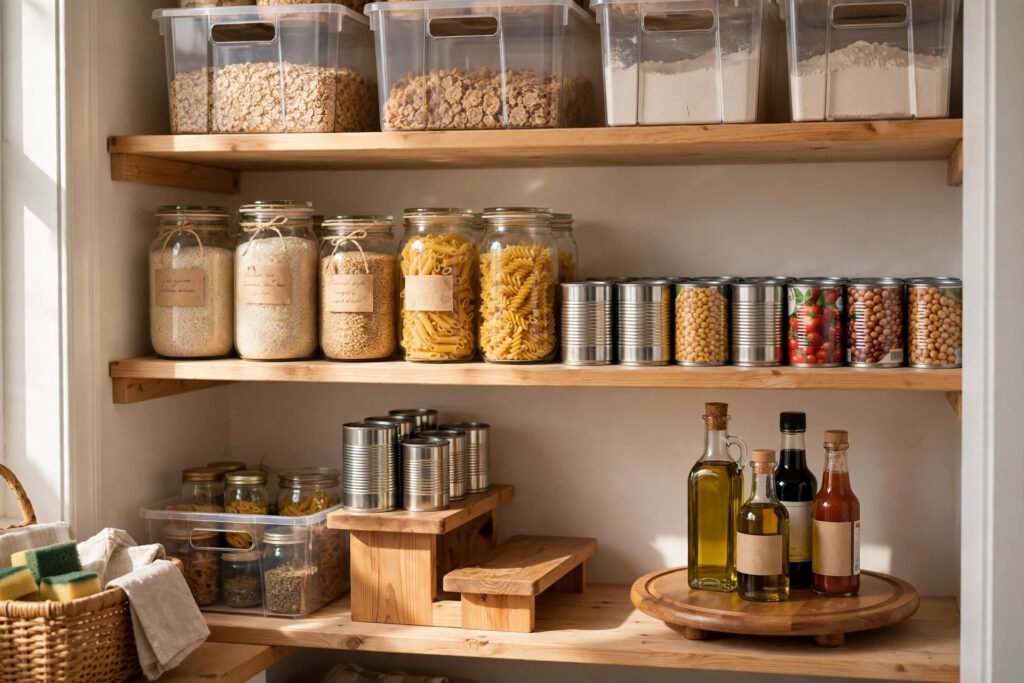
Matching storage sets look lovely in photos, but they are not a requirement. Before buying anything, look around your home. Shoe boxes make excellent shelf dividers. Large yoghurt tubs hold small packets. An old magazine holder turned on its side becomes a rack for tinned food, with the labels facing out so you can read them at a glance. A lazy Susan from a pound shop or discount store — usually around $5–$10 — stops bottles and jars from disappearing into the back corner.
When you do buy containers, start with just two types: clear bins for loose packets and airtight jars for open dry goods like rice, pasta and flour. Clear bins are the priority, because seeing the contents is what keeps the system working. Square and rectangular containers waste far less space than round ones on a shelf.
5. Decant Only What Makes Sense
Decanting everything into matching jars is satisfying but expensive, and it takes hours. Decant only the foods that actually benefit: dry goods that go stale in open bags, like flour, rice, oats and sugar. Keep everything else in its original packaging. A bag clip, which costs pennies, keeps cereal fresh just as well as a jar does, and the packet already tells you the expiry date and cooking instructions.
If you do decant, keep a strip of masking tape and a marker nearby and label each jar with the contents and the date you opened it. It takes ten seconds and saves the guesswork later. The same labelling habit is one of the best tricks in our guide to how to organize a small closet on a budget.
6. Add a Shelf Riser or Two
Most pantry shelves are far taller than the food on them, which wastes the top half of every shelf. A small shelf riser — a simple wire or bamboo platform that costs $8–$15 — doubles the usable surface by giving tins and jars a second level. Put shorter items underneath and taller items on top, and nothing gets buried.
If a riser is still too much spend, a sturdy box or an upside-down storage tub does the same job for free. Just make sure it is stable and that you can still reach everything easily.
7. Label Everything in Plain Words
Labels do not need to be pretty to work. A roll of masking tape and a thick marker is the cheapest labelling system there is, and it beats fancy printed labels because you can change it in seconds when the system changes. Label the front of every bin and basket with what goes inside it — “Snacks”, “Baking”, “Pasta” — in words everyone in the house understands.
This matters most for shared pantries. When every person in the house knows where things live, they put things back in the right place without being asked. That is the difference between a pantry that stays tidy for a week and one that stays tidy for months.
8. Do a Five-Minute Weekly Reset
No organization system survives without maintenance, but maintenance does not need to be a project. Pick one day a week — the day before your regular shop is ideal — and spend five minutes on the pantry. Pull anything expired, move items that have drifted to the wrong shelf, and note what needs buying. That is all.
A weekly reset also stops duplicate buying. How many times have you bought a second bag of rice because you could not see the first one? A tidy, visible pantry saves real money over a year, which is the whole point of organizing on a budget. For more small-space ideas, see our small kitchen decor ideas on a budget.
Frequently Asked Questions
How much does it cost to organize a pantry on a budget?
Most pantries can be organized for $0–$30. The free version uses boxes, tubs and jars you already own, plus masking tape labels. If you buy a few clear bins, a lazy Susan and a shelf riser, expect roughly $20–$30 in total. Prices are rough ranges only — check the current price before buying.
What is the best way to organize a small pantry?
Use zones and go vertical. Group food by use, keep daily items at eye level, and add a shelf riser to use the height of each shelf. Small pantries benefit most from clear containers, because you can see everything without pulling it all out.
Should I decant everything into matching jars?
No. Decant only dry goods that go stale in open bags, like flour, rice and oats. Keep everything else in its original packaging with a bag clip, and label jars with the contents and the date opened.
How do I keep a pantry organized with kids in the house?
Give snacks their own low, reachable bin and label it clearly. When kids know exactly where their snacks live — and can reach them — they stop pulling everything off the shelves.
What containers work best for a budget pantry?
Clear, rectangular bins with straight sides waste the least space and let you see the contents. Add one lazy Susan for deep corners and airtight jars only for open dry goods. Shoe boxes, magazine holders and yoghurt tubs work just as well as bought containers for most items.
Final Thoughts
A well-organized pantry is not about spending money — it is about making a simple decision for every item: what it is, where it lives, and how often you use it. Start by emptying the shelves, group food by use, keep daily items at eye level, and use containers you already own. Add a shelf riser, label everything in plain words, and give the pantry five minutes a week. That is the whole system, and it costs almost nothing. If you are refreshing the wider kitchen too, our affordable kitchen backsplash ideas for renters and budget home office organization ideas use the same low-cost approach in other rooms.