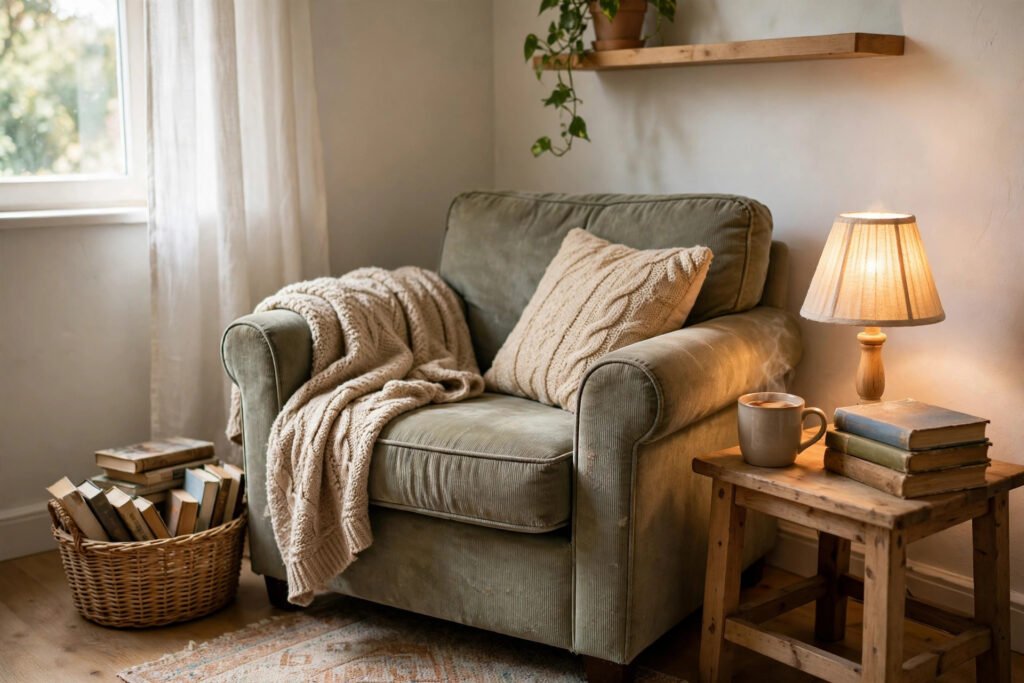

A reading nook does not need a window seat, a built-in bench or a designer budget. It needs three things: somewhere comfortable to sit, light you can actually read by, and a spot that feels separate from the rest of the room. Get those three right and even a forgotten corner can become the place everyone in the house quietly fights over.
These reading nook ideas budget readers ask for most are built around pieces you probably already own, plus a few cheap additions. Most of the corners below cost under $50 in new purchases, and several cost nothing at all if you shop your own home first. Prices mentioned are rough ranges only — check the current price before buying.
1. Start With the Chair You Already Own
The single biggest mistake in a reading nook is buying a new chair first. Look around your home before you spend anything. An armchair from the living room, a dining chair with a cushion, or even a sturdy wooden chair can work — comfort comes from what you add, not from the chair itself.
Test any chair by sitting in it for twenty minutes with a book. If your back aches, add a firm cushion behind you rather than replacing the chair. If the seat is too low, a folded blanket underneath raises it. Our guide to budget bedroom makeover ideas under $100 uses the same principle: rearrange first, buy second.
If you do need a chair, second-hand is the budget move. Charity shops, marketplace listings and end-of-line sales often turn up solid armchairs for roughly $20 to $40. Check the frame for wobble and sit in it before you pay — a throw and a cushion can hide almost any dated fabric.
2. Claim a Corner, Not a Room
A nook works because it feels enclosed. A corner does that for free — two walls already wrap around you, and the rest of the room fades away. Look for the spots you currently ignore: the corner beside a window, the end of a hallway, the space next to a wardrobe, or the awkward gap beside a fireplace.
Place the chair at a slight angle, facing into the room rather than flat against the wall. That small turn makes the corner feel intentional instead of like a chair that got pushed aside. A small rug underneath anchors the spot and tells your brain this is a separate place, even in an open-plan room — the same trick that makes small living rooms feel larger.
3. Light It Like You Mean It
Bad light kills a reading nook faster than an uncomfortable chair. Overhead ceiling lights create glare on pages and shadows on your face, so a nook needs its own light source at shoulder height, coming from behind or beside you.
A small table lamp on a side table is the classic answer, and it does not need to cost much — basic lamps start at roughly $10 to $20, and a warm-white bulb (around 2700K) is easier on the eyes than harsh daylight bulbs for evening reading. Our roundup of the best budget table lamps for living rooms covers the styles that work best in small corners.
4. Layer One Throw and One Cushion
A reading nook should feel like a blanket fort for adults. One soft throw and one supportive cushion are enough — more than that and the chair becomes a storage pile you have to clear before you can sit down.
Choose a throw you actually like touching, because you will use it every day. Fleece and knitted throws are usually the cheapest, roughly $10 to $20, and they wash well. Drape it over one arm of the chair rather than folding it neatly; a nook should look inviting, not staged. Our picks for the best throw blankets for a cozy living room work just as well in a nook.
The cushion goes behind your lower back, not behind your head. A firm cushion supports your spine during a long chapter; a soft one just flattens. If you read with a tablet or e-reader, a small cushion on your lap doubles as a rest for your arms.
5. Add a Surface for Tea and Books
Every reader needs somewhere to put a mug down. Without a surface, the book ends up on the floor, the tea goes cold on a windowsill, and the nook slowly stops being used.
A small side table is ideal, but a stool, a stack of books, or a wooden crate all do the job. The surface only needs to hold a mug and your current book, so anything roughly 12 inches across is enough. Our roundup of the best budget side tables for small living rooms has several options under $30 that fit a tight corner.
6. Store Books Within Arm’s Reach
A reading nook without books nearby is just a chair. You do not need a full bookcase — a small stack on the floor, a wall shelf, or a basket beside the chair is enough. The rule is simple: the next book should be reachable without standing up.
A basket is the cheapest option and the most forgiving. It holds five or six books, hides the mess, and can be moved when you need the floor space. Small floating shelves cost roughly $10 to $15 each and use wall space that would otherwise be empty. Our DIY floating shelves on a budget guide shows how to put one up in under an hour.
7. Make It Yours With One Personal Touch
A nook needs one thing that makes it yours — a framed photo, a plant, a candle, or a piece of art you love. One personal item is enough. Five turns it into a display shelf, and display shelves are not comfortable.
A small plant is the easiest choice. It adds life to a corner, costs little, and survives neglect better than most people expect — a pothos or snake plant in a plain pot is roughly $5 to $10 and nearly impossible to kill. A candle adds scent and a reason to sit down in the evening, but keep it on a stable surface away from the throw.
Frequently Asked Questions
How much does a reading nook cost to set up?
Most reading nooks cost under $50 if you reuse a chair you already own. A lamp (roughly $10 to $20), a throw (roughly $10 to $20) and a small shelf or basket (roughly $5 to $15) are usually the only new purchases. A brand-new chair is the one expense that pushes the total up, which is why second-hand chairs are the best budget option.
Where is the best place for a reading nook?
A corner near a window is ideal because it gives you natural light during the day and a sense of enclosure from the two walls. If no window corner is free, any quiet corner works — the end of a bedroom, a landing, or the space beside a fireplace. The best spot is the one you will actually sit in every day.
How do I make a reading nook in a small apartment?
Use a corner you already have and keep it small. One chair, one lamp, one throw and a small surface are enough. A rug marks the spot without taking up floor space, and a wall shelf holds books without needing a bookcase.
What lighting is best for a reading nook?
A warm-white lamp at shoulder height, placed beside or slightly behind the chair, is best for evening reading. It avoids the glare that overhead lights cause on pages. During the day, natural light from a nearby window is free and ideal — just avoid sitting with your back to the window so your shadow does not fall on the page.
Can I make a reading nook without buying a new chair?
Yes — most people already own a chair that works. Test it by sitting with a book for twenty minutes, then fix comfort problems with a cushion behind your back or a folded blanket on the seat.
Final Thoughts
A cozy reading nook is one of the cheapest rooms to build in your home, because it is not really a room at all. It is a chair, a light, a throw and a corner that belongs to you. Start with what you own, add light before you add decoration, and keep the books within reach. The best reading nook ideas budget decorators rely on all share the same secret: the nook works when it is comfortable enough to use every day, not when it is pretty enough to photograph.