
Disclosure: This article contains affiliate links. As an Amazon Associate, we earn from qualifying purchases. If you buy through these links, we may earn a small commission at no extra cost to you.
Entryway mirror ideas budget shoppers will love start with a simple truth: a mirror is the hardest-working piece in a hallway. It bounces light into a dark corner, makes a narrow entry feel twice as wide, and gives you a last look before you leave the house — all for the price of one small purchase. You do not need a designer mirror or a big renovation to get that effect. A well-chosen budget mirror, hung at the right height and styled with one or two simple pieces, can make a plain entryway look finished. Most ideas below cost roughly $15–$60, so check the current price before buying, as mirrors go on sale often.
1. A Round Mirror Above a Small Console
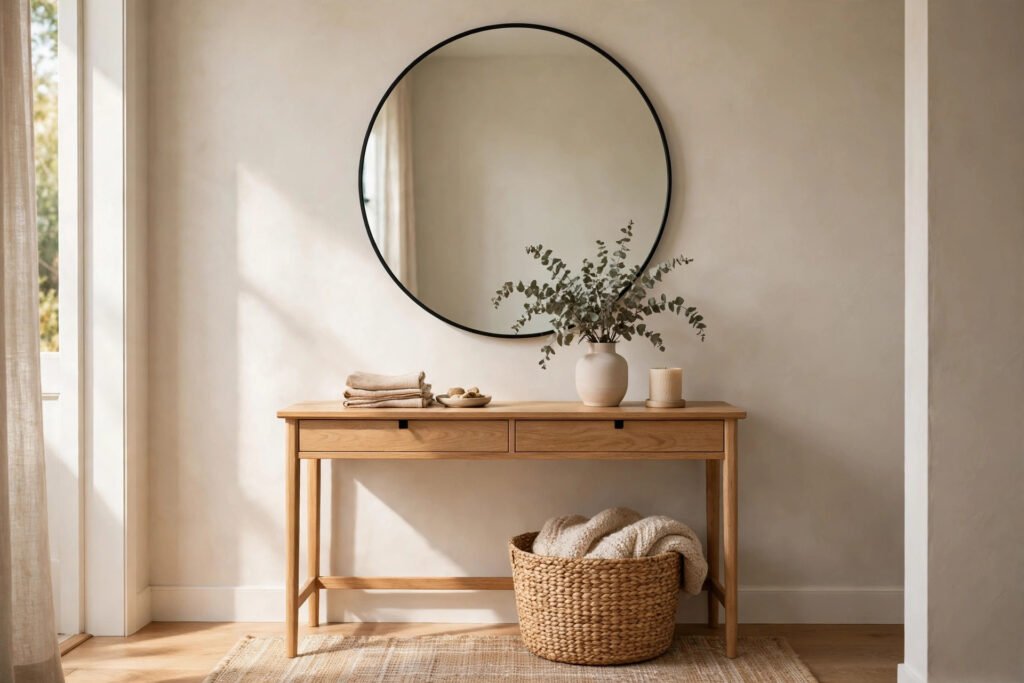
A round mirror is the safest first choice for an entryway, because its soft shape breaks up all the straight lines of a door frame, a bench, and a rug. It suits almost every style, from modern to farmhouse, and is widely available in budget sizes of 24–30 inches. Plain black or thin gold frames cost roughly $20–$45 and look far more expensive than they are.
Hang it above a slim console table with a small tray for keys and a candle, and the entryway is done. Keep the wall around it bare so the mirror stays the star. If your hallway is very narrow, a 24-inch round mirror is plenty; a 36-inch one can feel too big in a tight space.
2. A Full-Length Mirror Leaned Against the Wall
A full-length mirror does not have to live in a bedroom. Leaned against the wall beside the front door, it gives you a head-to-toe check before leaving, and its tall, narrow shape makes a small entryway feel much larger. Leaning is also renter-friendly, since it needs no holes in the wall — just a secure lean against a stable surface and, for safety, a small anti-tip strap or a rubber pad behind the frame.
Look for a simple frame in black, natural wood, or white, in the 50–60 inch range. Prices vary widely, but plain full-length mirrors cost roughly $25–$55. For more mirror options across the home, see our roundup of the best budget mirrors. Keep the floor in front of it clear so the reflection stays clean and the mirror can do its work.
3. A Mirror Over a Floating Shelf
If your entryway is too narrow for a console table, a mirror over a small floating shelf gives you the same look in half the depth. The shelf holds keys, sunglasses, and mail, while the mirror above it adds light and a focal point. A shelf of 18–24 inches wide is enough; anything longer crowds a narrow wall.
Choose a rectangular or oval mirror that is slightly wider than the shelf, and leave some empty space on the shelf so it reads as styling rather than storage. A small plant or a framed photo is all it needs. Floating shelves cost roughly $10–$25, so the whole setup often comes in under $50. For more on styling the space around it, see our budget entryway decor ideas.
4. A Gallery of Small Mirrors
One big mirror is not the only option. Three or four small mirrors in matching or mixed frames, hung as a cluster, create a gallery-wall effect that costs less than a single large statement piece. Small mirrors in the 8–12 inch range cost roughly $5–$15 each, and you can mix round, square, and arched shapes as long as the frames share a colour or finish.
Plan the layout on the floor first, then hang the largest mirror at the centre and build outward, keeping gaps even at about two inches. This works especially well on a wide, blank entry wall where one mirror would look lonely. For help arranging a cluster, see our budget-friendly gallery wall ideas.
5. A Thrifted or Vintage Mirror, Refinished
The cheapest way to get a mirror that looks expensive is to buy it second hand. Charity shops, flea markets, and online marketplaces are full of solid mirrors with dated frames, often for $5–$20. A coat of matte black or gold spray paint, a light sanding, and new hanging hardware can turn a tired frame into something that looks bought new.
Check the glass carefully before buying: small chips at the edge can be hidden by the frame, but large scratches or cloudy spots cannot be fixed cheaply. If the mirror is heavy, use proper wall anchors rather than a single nail, and never hang a large mirror with adhesive strips alone.
6. A Mirror with Built-In Hooks or a Shelf
For a truly small entryway, a mirror with hooks or a small shelf built in solves two problems at once. You get the light and depth of a mirror plus a place for coats, dog leads, and bags, without buying two separate pieces. These combination pieces are widely available in the $30–$60 range and suit renters, since they need only one set of fixings.
Hang it where the hooks are easy to reach — about 60 inches for the mirror centre, with hooks just below it — and do not overload it. Two or three light items keep it tidy; a wall of coats hides the mirror entirely and defeats the purpose. For the hallway beyond the entry, our affordable hallway decor ideas show how to carry the look through.
Hanging Heights and Placement That Actually Work
Getting the height right matters more than the mirror you choose. Hang the mirror so its centre sits at about 57–60 inches from the floor, which is eye level for most adults. If it hangs above a console table, leave 4–6 inches of gap between the top of the table and the bottom of the mirror. Too much gap makes the two pieces look unrelated; too little looks cramped.
If your mirror faces a window or a light source, it will reflect that light and brighten the hallway noticeably. If it faces a blank wall, angle it slightly or choose a spot where it catches something worth reflecting — a plant, a window, or a piece of art. In a dark hallway, pair the mirror with a warm lamp or a candle so there is something to reflect.
What to Avoid
A few common mistakes can undo a good mirror. Avoid hanging a mirror opposite the front door at full height if it startles you every time you walk in — a smaller mirror or one hung slightly off-centre solves this. Avoid ornate, heavy frames in a tiny hallway, where they compete with the door and the light switch for attention. And avoid placing a mirror where it reflects clutter: a mirror doubles whatever it faces, so a tidy entryway looks twice as tidy, and a messy one looks twice as messy.
Finally, do not buy a mirror just because it is cheap. A warped, cloudy, or badly framed mirror will look cheap in your hallway every day. The best entryway mirror ideas budget shoppers find all share one thing: clear glass, a solid frame, and the right spot on the wall. Spend a little more on those three things, and buy it once.
Frequently Asked Questions
What size mirror is best for an entryway?
A mirror about two-thirds as wide as the console table or bench beneath it usually looks best — for most entryways, a round mirror of 24–30 inches, or a rectangular mirror around 20 x 30 inches. In a very narrow hallway, go smaller rather than larger.
How high should I hang an entryway mirror?
Hang it with its centre at about 57–60 inches from the floor, which is eye level for most adults. If it sits above a console table, leave a 4–6 inch gap between the table and the bottom of the mirror.
Can a mirror make a small entryway look bigger?
Yes, if it is placed well. A mirror reflects light and creates the illusion of depth, so a narrow hallway feels wider and brighter. It works best when it reflects a window, a lamp, or a plant rather than a blank wall or clutter.
What is the cheapest way to get a stylish entryway mirror?
Buy a plain round or rectangular mirror in the $20–$45 range, or thrift a second-hand mirror for $5–$20 and refinish the frame with spray paint. A simple frame in black, gold, or natural wood usually looks more expensive than an ornate one.
Is a leaning full-length mirror safe in an entryway?
Yes, if it is secured. Lean it at a slight angle against a stable wall, add a rubber pad behind the frame, and use an anti-tip strap or furniture anchor, especially in homes with children or pets. Never rely on leaning alone for a very heavy mirror.