
Disclosure: This article contains affiliate links. As an Amazon Associate, we earn from qualifying purchases. If you buy through these links, we may earn a small commission at no extra cost to you.
The best budget drawer organizers kitchen owners actually keep using are the ones that fit the drawer, not the ones that look good in a photo. A kitchen drawer without an organizer becomes a tangle of cutlery, spatulas and mystery gadgets within a week, and every time you open it you waste a minute digging. The seven picks below are based on specs, features and customer feedback, not hands-on testing, and each one costs little enough that you can sort a whole kitchen for roughly the price of one takeaway.
1. Bamboo Expandable Cutlery Tray
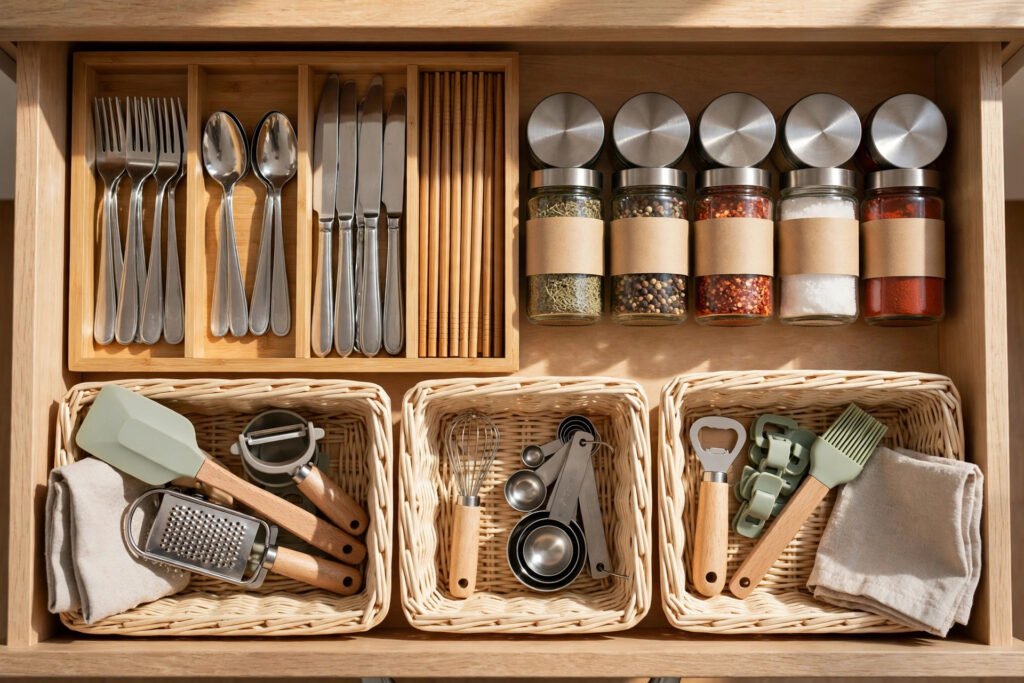
The classic first buy, and still the best one for most kitchens. A bamboo tray with expandable sides stretches to fit drawers of different widths, so you do not need to measure to the millimetre before ordering. The compartments are sized for forks, knives, spoons and a row of larger serving pieces, and bamboo is naturally resistant to moisture, which matters in a kitchen drawer.
A standard bamboo cutlery tray usually costs roughly $15–$30 — check the current price before buying. Pick one with rubber feet so it does not slide every time you open the drawer.
Pros: looks warm and natural, expands to fit, easy to wipe clean. Cons: bamboo can stain if a wet utensil sits on it for days, and the fixed compartments do not suit very wide serving spoons.
2. Adjustable Spring-Loaded Drawer Dividers
If your problem is not cutlery but the deep drawer full of cooking utensils, dividers are the answer. Spring-loaded dividers press against the drawer walls and split the space into lanes, so tongs, ladles and whisks each have their own channel instead of piling up in a heap.
A set of four dividers usually costs roughly $10–$20 — check the current price before buying. Bamboo versions look nicer; plastic ones are easier to wash. Measure your drawer’s depth first — a tall divider in a shallow drawer will stop it closing.
Pros: fits almost any drawer, no cutting or fixing, easy to rearrange. Cons: they can slip if the drawer walls are not perfectly straight, and they do nothing for very small items like measuring spoons.
3. Deep Utensil Organizer Tray
Cutlery trays are shallow by design, which is no good for the drawer that holds spatulas, peelers and rolling pins. A deep utensil tray is the same idea with taller walls and longer compartments, built for the tools you actually cook with.
Expect to pay roughly $15–$25 for a good one — check the current price before buying. Choose one with a long compartment for spatulas and tongs, and square ones for peelers and graters. Silicone or soft-touch liners inside the compartments stop metal tools rattling every time the drawer moves.
Pros: finally gives long tools a proper home, sturdy enough for heavy items. Cons: takes up the whole drawer, so it suits one dedicated utensil drawer rather than a shared one.
4. In-Drawer Spice Jar Organizer
Spices are the drawer that defeats most people. Jars roll around, labels face the wrong way, and you end up buying a third jar of cumin because you could not see the two you already had. An in-drawer spice organizer holds jars flat at a slight angle, labels up, so you can read every one at a glance.
A two-tier angled insert usually costs roughly $12–$25 — check the current price before buying. Check your jar sizes first — tall jars may not fit, and the insert needs a drawer at least 10 cm deep.
Pros: ends the spice hunt, uses a drawer you already have. Cons: only fits standard jar sizes, and it uses a whole drawer for spices alone.
5. In-Drawer Knife Block
A knife block on the worktop eats counter space; a knife block in the drawer eats none. An in-drawer knife tray holds blades flat in slots, protected and out of reach of small hands, and it frees up the worktop for cooking.
A bamboo or beech knife tray usually costs roughly $20–$35 — check the current price before buying. Check the slot widths against your knives: wide chef’s knives need wider slots than a standard set provides.
Pros: safer than a loose knife drawer, frees the worktop, keeps blades sharper. Cons: the most expensive pick on this list, and it only fits knives, so it needs a drawer of its own.
6. Stackable Small Bins for the Gadget Drawer
Every kitchen has one: the drawer with the batteries, the spare light bulbs, the tape measure, the chopsticks and the thing you cannot identify. Small stackable bins turn that drawer from a junk pile into a set of labelled zones without any measuring or fitting.
A set of six to eight small bins usually costs roughly $10–$18 — check the current price before buying. Clear plastic bins are the practical choice because you can see what is inside. Put the things you use weekly in the front bins and the rarely-used items at the back.
Pros: cheapest way to sort a messy drawer, easy to lift out and clean. Cons: bins can slide around in a wide drawer unless you pack them tightly, and they do nothing for long items.
7. Pegboard Drawer Organizer
The most flexible option on this list. A pegboard base sits in the drawer and wooden pegs slot into the holes, so you build compartments exactly around the plates, bowls and pans you own. When your collection changes, you move the pegs instead of buying a new organizer.
A pegboard set usually costs roughly $20–$30 — check the current price before buying. It works best in deep drawers holding plates and bowls, where normal dividers are useless. Most sets can be trimmed to fit a non-standard drawer.
Pros: fully customisable, excellent for plates and pans, grows with your kitchen. Cons: needs some assembly and measuring, and the pegs can work loose if the board is cut too short.
How to Choose the Right Organizer for Your Drawers
Start by measuring. Open each drawer and note the width, depth and height in centimetres — most organizer problems come from guessing. Standard kitchen drawers are usually 45–60 cm wide, but older kitchens vary.
Then sort before you buy. Empty the drawer, throw away the broken tools and the duplicates, and group what is left: cutlery, cooking tools, spices, gadgets. Buy the organizer for the group that lives in that drawer, not for a tidy photo. Our guide on how to organise kitchen cabinets on a budget uses the same sort-first rule for the cupboards above, and our affordable kitchen storage ideas have more small-kitchen fixes that pair well with drawer organizers.
Finally, think about cleaning. Kitchen drawers get crumbs and spills, so pick materials you can wipe or wash — bamboo, plastic and silicone all clean easily, while fabric liners do not.
For the rest of the kitchen, our guide to how to organise a pantry on a budget applies the same one-home-for-everything idea to food storage, and our best budget storage baskets are useful for the items that do not belong in a drawer at all.
Frequently Asked Questions
What size drawer organizer do I need?
Measure the inside of your drawer — width, depth and height — before ordering. Most kitchen drawers are 45–60 cm wide, and expandable trays or adjustable dividers cover that range. A tray that is even 2 cm too wide will not fit, so measure twice.
Are bamboo drawer organizers better than plastic?
Bamboo looks warmer and suits most kitchens, but it can stain if wet utensils sit on it. Plastic is cheaper, easier to wash and better for damp items. Either works — choose bamboo for the cutlery drawer you see every day, plastic for the drawer that holds wet or greasy tools.
How do I stop drawer organizers sliding around?
Use organizers with rubber feet or a non-slip base, and fill the drawer properly — an organizer slides when there is empty space around it. A strip of non-slip shelf liner underneath the tray also works, and it costs very little.
Can I use drawer organizers in a rental kitchen?
Yes. Every organizer on this list sits inside the drawer with no screws, glue or drilling, so you can take them all with you when you move. Expandable trays and spring-loaded dividers are the most renter-friendly because they adapt to different drawer sizes.
How much should I spend on kitchen drawer organizers?
A single drawer usually costs roughly $10–$35 to organize, depending on the type. Sorting a whole kitchen typically costs roughly $50–$100 in total. Start with the drawer that annoys you most, then add the rest one at a time.