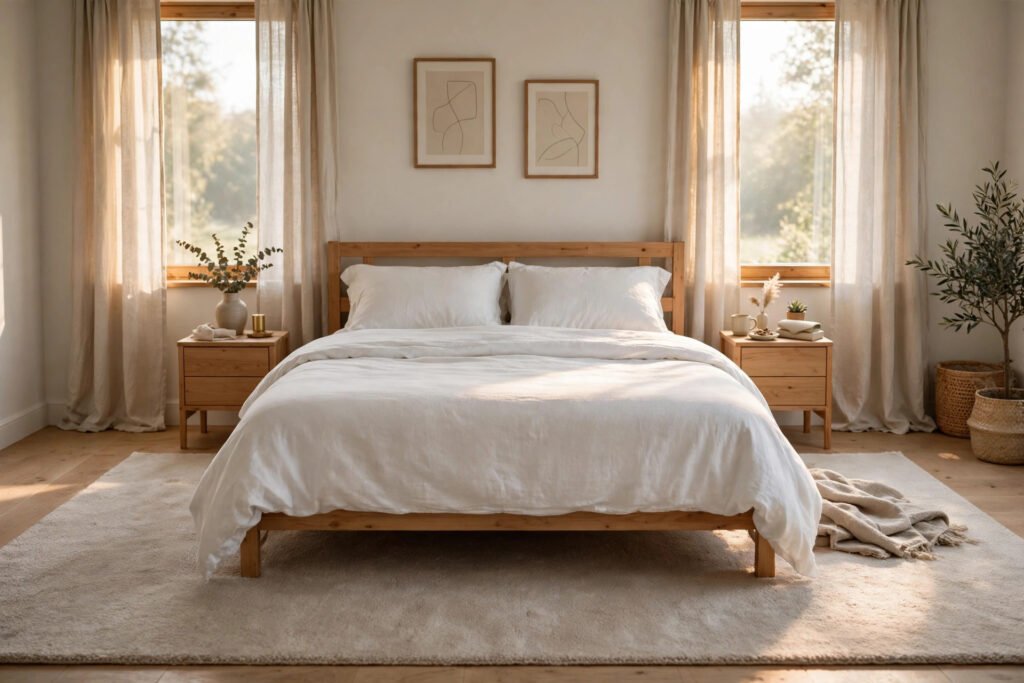

Choosing the right rug size for bedroom floors is one of those small decisions that changes how the whole room feels. Too small looks lost; too big swallows the room. Get it right, and the bedroom feels warmer and finished. Here are the standard sizes for every bed, how far a rug should extend, and the mistakes to avoid.
Why Rug Size Matters More Than Pattern
Most people shop by colour and pattern, then pick whatever size is on sale. That is backwards: in a bedroom the rug is mostly hidden under the bed, so size and placement matter far more than design. A well-sized rug frames the bed; a wrong-sized one chops the floor into awkward pieces.
The Quick Rule: Measure the Bed, Then Add Space
Start with the bed and add at least 45 to 60 centimetres (about 18 to 24 inches) of rug on each exposed side. That gives you a generous border of softness beside the bed and at the foot — your feet land on rug, not cold floor, even when you step out at an angle.
Always measure before ordering: tape the outline of the size you are considering on the floor and live with it for a day. It costs nothing and stops the most common regret. Leave 20 to 30 centimetres of bare floor between the rug edge and the wall.
Rug Size by Bed Size
Twin and Single Beds
For a twin or single bed, a 4 x 6 ft rug (about 120 x 180 cm) works beside the bed, or a 5 x 7 ft rug (about 150 x 210 cm) partly underneath. In a child’s or small guest room, a bedside runner of roughly 2.5 x 8 ft is a cheaper option.
Full and Double Beds
A full or double bed pairs well with a 5 x 7 ft rug or, better, a 6 x 9 ft rug (about 180 x 270 cm), which extends past both sides and well past the foot. If the room is tight, the 5 x 7 ft size still works under the lower two-thirds of the bed.
Queen Beds
For a queen bed, the standard recommendation is an 8 x 10 ft rug (about 240 x 300 cm), reaching past both sides with a wide border at the foot. A 9 x 12 ft rug (about 270 x 360 cm) suits larger bedrooms and can sit under the nightstands too. Avoid a 5 x 7 ft rug under a queen bed; it barely peeks out.
King Beds
For a king bed, start at 9 x 12 ft; a 10 x 14 ft rug (about 300 x 420 cm) is ideal in a spacious master bedroom. The rug should extend at least 60 centimetres beyond each side so the scale matches the mattress — anything smaller looks two sizes too small.
Three Placement Options That Work
Under the Bed (the Classic)
Slide the rug under the lower two-thirds of the bed, starting in front of the nightstands and extending well past the foot. The top sits hidden under the mattress, so you can buy a slightly smaller rug. It is the most forgiving option on a budget, since less of the rug is visible. Our guide to choosing the right rug size for a dining room uses the same idea of sizing to the furniture, not the room.
Beside the Bed (the Budget Option)
If a large rug is out of budget, two runners — one on each side — give you the soft landing for a fraction of the price. Runners roughly 2.5 ft wide and 7 to 8 ft long suit a queen or king bed, and they are easy to move and wash, which makes them practical for households with kids or pets.
At the Foot of the Bed
A smaller rug across the foot of the bed works where a full rug would crowd the space, anchoring the bed visually and giving your feet something soft. Choose one at least as wide as the bed — a narrow rug at the foot of a wide bed looks like a mistake.
Rug Size for a Small Bedroom
Small bedrooms are where sizing goes wrong most often — the temptation is to buy a tiny rug to match the tiny room. Do the opposite: a too-small rug breaks the floor into pieces and shrinks the room, while one reaching under the bed and out to the sides makes it feel larger.
A 5 x 7 ft or 6 x 9 ft rug under the lower two-thirds of the bed works best. If even that is too big, a single runner on the side you get out of bed on beats a small square rug floating mid-room. For more ideas, see our guide to making a small bedroom feel cosy on a budget.
Choosing a Rug Material on a Budget
Size and material together decide the price. Low-pile rugs and flatweaves are the cheapest and easiest to clean — good picks for bedrooms that double as playrooms or pet zones. Wool costs more, usually in the rough range of $100 to $300 for a bedroom size, but lasts for years. Cotton is soft and washable, though it shows wear faster. Synthetic rugs, such as polypropylene, are the budget-friendly middle ground: stain-resistant, available in every pattern, and a good 8 x 10 ft option often costs in the rough range of $80 to $200. Prices vary by shop and region, so check the current price before buying.
For value, see our roundup of the best budget area rugs for bedrooms and the best affordable rugs under $50 for smaller sizes and runners.
Common Rug Size Mistakes to Avoid
The most common mistake is buying a rug that is too small — in bedrooms, too small is almost always worse than slightly too big. The second is placing the rug so it starts at the foot of the bed rather than under it. The third is ignoring the nightstands, leaving an awkward strip of bare floor between furniture pieces. The fourth is choosing a rug before measuring, and the fifth is buying a high-pile rug the bedroom door cannot swing over.
Frequently Asked Questions
What size rug should I put under a queen bed?
An 8 x 10 ft rug is the standard rug size for bedroom layouts with a queen bed, extending about 60 centimetres past each side and well beyond the foot. If your room is large, a 9 x 12 ft rug works even better and can sit under the nightstands too.
Should a bedroom rug go under the nightstands?
It can, but it does not have to. A rug under the nightstands looks more polished and makes the sleeping area feel like one zone, but it needs a larger rug and a bigger budget. The classic placement — starting just in front of the nightstands and extending past the foot — looks just as good and costs less.
How far should a rug extend past the bed?
Aim for at least 45 to 60 centimetres (18 to 24 inches) beyond each side of the bed and at the foot. Less looks skimpy, and your feet will miss the rug when you get up. More is fine if the room is large enough.
Can a rug be too big for a bedroom?
Yes, if it runs wall to wall or blocks doors and drawers. Leave 20 to 30 centimetres of bare floor between the rug edge and the wall, and make sure doors can swing over it. Slightly too big is still better than too small, as long as it does not crowd the room.
What is the cheapest way to get the right rug size for a bedroom?
Buy a flatweave or synthetic rug one size up from what you think you need, or use two runners beside the bed instead of one large rug. Runners give you the soft landing for a fraction of the price, and a good 8 x 10 ft synthetic rug often costs in the rough range of $80 to $200. Check the current price before buying.
Final Thoughts
It comes down to one habit: measure the bed, add space on every exposed side, and tape the outline on the floor before you spend anything. An 8 x 10 ft rug suits most queen beds, a 9 x 12 ft rug suits king beds, and a 5 x 7 ft or 6 x 9 ft rug covers a full bed — but your room is the final judge. If you are refreshing the whole room on a budget, our budget bedroom makeover ideas under $100 pair well with a new rug. Get the size right first, and the pattern almost takes care of itself.