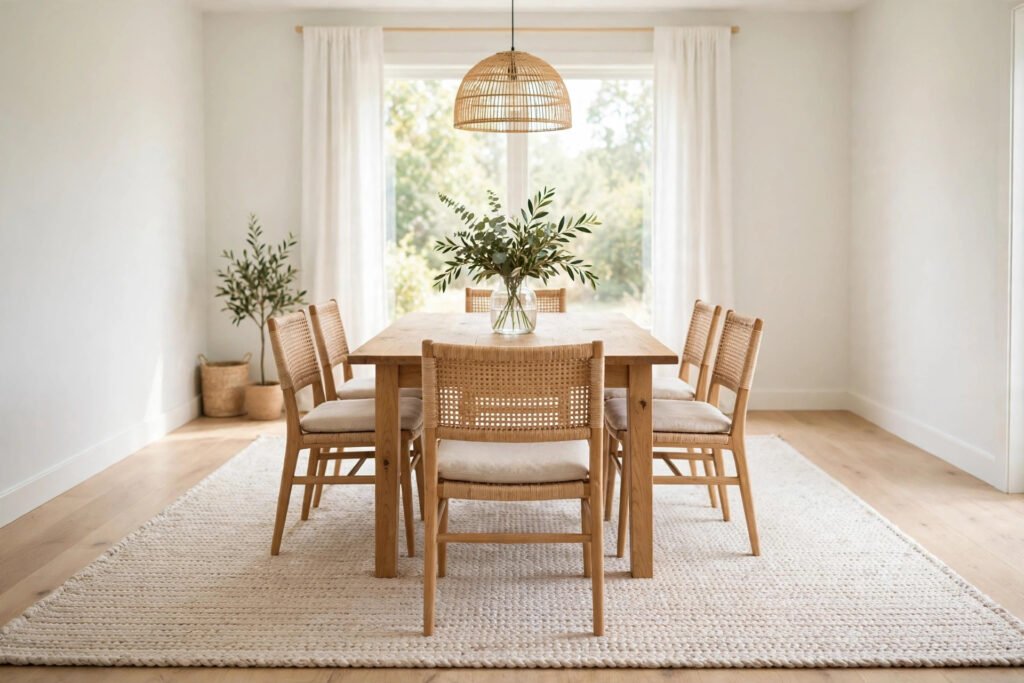

Getting the rug size for dining room tables right matters more than the rug itself. A beautiful rug in the wrong size makes the whole room feel off — chairs catch on the edge, the table looks stranded, and the floor seems smaller than it is. A rug that fits properly does the opposite: it anchors the table, softens the room and makes even a plain dining set look intentional.
The good news is that choosing the right size is not guesswork. There is one simple rule, a few standard sizes, and a handful of common mistakes to avoid. Prices mentioned are rough ranges only — check the current price before buying.
The One Rule That Matters
The rug must be large enough that every chair stays fully on it, even when pulled out. That is the whole rule. When someone sits down and pulls their chair out to stand up, the back legs should still be on the rug. If the chair legs slip off the edge, the chair wobbles, the rug bunches up, and the floor gets scratched.
In practice, that means the rug should extend at least 24 inches (about 60 cm) beyond the table on every side. Some guides say 18 inches is enough, but 24 inches is the safe number for real dining chairs, which slide back further than most people expect. Measure your table, add 48 inches to both the length and the width, and that is your minimum rug size.
Our rug size guide covers the same rule for living rooms and bedrooms, but the dining room is where it matters most, because chairs move every single day.
Rectangular Tables: The Most Common Setup
A 6-seater rectangular table — 72 inches long by 36 inches wide — needs a rug of about 9 by 12 feet. A smaller 4-seater table, around 60 by 36 inches, works well with an 8 by 10 foot rug.
If your table has a leaf or extension, measure it with the leaf in. A rug bought for the closed table will be too small the first time you host a dinner party and extend it.
Leave a gap of at least 18 inches between the rug edge and the wall if you can. A rug pushed right up against the skirting board looks cramped, while a small strip of bare floor around the rug frames it nicely.
Round Tables: Go Bigger Than You Think
Round tables trip people up because the rug needs to be round too, or at least wide enough in every direction. A round rug that matches the table shape looks best — a square rug under a round table can work, but the corners often stick out awkwardly into the walkway.
A 48-inch round table seats four comfortably and needs a rug of at least 8 feet in diameter. A 60-inch round table, which seats six, needs a 9 or 10 foot round rug. That sounds enormous, and it is — but anything smaller leaves the chairs half on and half off, which is exactly the wobble problem the 24-inch rule exists to prevent.
Square Tables: Keep the Shape
A square table deserves a square rug. A 42-inch square table, which seats four, needs a rug of about 8 by 8 feet. A 60-inch square table, which seats eight, needs a 9 or 10 foot square rug. The same 24-inch rule applies, and it matters even more here, because the corners of the rug are where chairs tend to catch and the edge curls up within a week.
What If Your Room Is Too Small?
Sometimes the right rug simply does not fit the room. A small dining area might not have space for a 9 by 12 foot rug with 18 inches of bare floor around it. In that case you have three honest options.
First, go one size down and accept the compromise. An 8 by 10 foot rug under a 6-seater table will leave the chairs slightly over the edge when pulled out, but it is far better than a 6 by 9 rug that leaves the chairs mostly off it. Our roundup of affordable area rugs under $100 can help keep the cost of the bigger size down.
Second, choose a low-pile, flatweave rug. Chairs slide more easily on flat rugs, and the legs are less likely to catch on the edge, so a slightly small flatweave rug is more forgiving than a thick, plush one.
Third, skip the rug entirely. A bare floor with a beautiful table and good lighting can look better than a rug that is clearly too small. Our guide to affordable dining room decor ideas has plenty of ways to warm up a dining room without a rug at all.
Choosing the Right Material
Dining room rugs take more punishment than any other rug in the house. Food drops, drinks spill, and chairs scrape across them every day. That rules out a few popular materials.
Wool is the classic choice — it is durable, naturally stain-resistant, and easy to clean if you blot spills quickly. Wool rugs cost more, roughly $150 to $400 for an 8 by 10 foot size, but they last for years.
Indoor-outdoor rugs made from polypropylene are the budget-friendly option. They cost roughly $50 to $150 for the same size, they can be hosed down or scrubbed, and they handle red wine and tomato sauce far better than natural fibres. The trade-off is that they feel thinner underfoot and look less luxurious.
Avoid high-pile and shag rugs in the dining room. Food gets trapped in the fibres, chairs sink into the pile, and cleaning them properly means dragging the whole rug outside.
Whatever material you choose, add a rug pad underneath. A pad stops the rug sliding when chairs move, protects the floor, and adds a little cushioning. A pad for an 8 by 10 foot rug costs roughly $20 to $40 and is worth every penny.
The Mistakes That Make a Room Look Wrong
The most common mistake is buying a rug that is too small. People measure the table, not the table plus the chairs, and end up with a rug that looks like a placemat under the table. If you are torn between two sizes, always go bigger.
The second mistake is choosing a rug with a busy pattern that fights with the table. A dining table is already a large, solid block in the middle of the room, so a loud pattern underneath it makes the room feel busy. Solid colours, subtle borders and quiet geometric patterns work best.
The third mistake is forgetting the lighting. A dark rug under a table can make the whole room feel dim, so if your dining room has little natural light, choose a lighter rug and pair it with a pendant light over the table — our roundup of the best budget pendant lights for dining rooms covers options that work well here.
Measuring Before You Buy
Do it with painter’s tape, not a tape measure alone. Lay out the rug’s dimensions on the floor with tape, put the table and chairs in place, then sit down and pull each chair out as if you were leaving the table. If any chair leg crosses the tape line, the rug is too small. This five-minute test saves you the cost and hassle of returning a rug, and it works for every table shape.
Frequently Asked Questions
What size rug do I need for a 6-seater dining table?
A 6-seater rectangular table (about 72 by 36 inches) needs a rug of roughly 9 by 12 feet. The rule is to add 24 inches to each side of the table so the chairs stay fully on the rug when pulled out.
Should a dining room rug be round or rectangular?
Match the rug shape to the table shape. Rectangular tables take rectangular rugs, round tables take round rugs, and square tables take square rugs. A square rug can work under a round table if it is large enough, but a round rug under a rectangular table almost never works.
Can a dining room rug be too big?
Yes, but it is a much rarer problem than too small. A rug that runs right up to the walls makes the room feel cramped and leaves no bare floor to frame it. Leave at least 18 inches of floor showing between the rug edge and the wall where possible.
What is the best rug material for a dining room?
Low-pile wool is the best all-round choice for durability and stain resistance, while indoor-outdoor polypropylene is the best budget option because spills can be scrubbed off it. Avoid high-pile and shag rugs, which trap food and make chairs hard to move.
How do I stop my dining chairs catching on the rug?
Make sure the rug extends at least 24 inches beyond the table on every side, choose a low-pile rug, and use a rug pad underneath to stop the rug sliding. If chairs still catch, the rug is probably too small and going one size up will fix it.
Final Thoughts
Choosing the rug size for dining room tables comes down to one rule: the chairs must stay on the rug when they are pulled out. Measure the table, add 24 inches on every side, match the rug shape to the table shape, and test the size with painter’s tape before you buy. Get the size right first, and the colour and pattern become the easy part.