
How to Decorate a Home Office for Two on a Budget
Disclosure: This article contains affiliate links. As an Amazon Associate, we earn from qualifying purchases. If you buy through these links, we may earn a small commission at no extra cost to you.
A home office for two budget setup is one of the trickiest small-space puzzles in home decor: two people, two work styles, one room, and a budget that has to stretch twice as far. Sharing an office need not double the cost: the right layout, clever furniture, and honest rules about noise and clutter let two people work side by side without a renovation. The eight ideas below cover layouts, desks, storage, lighting, and the touches that stop a shared office feeling crowded. Prices are rough ranges only — check the current price before buying.
1. Pick a Layout That Fits How You Actually Work
Before buying anything, watch how you both work for a few days. Do you take video calls at the same time? Does one of you need silence while the other likes music? The answers decide the layout.
Side by side along one wall is the simplest and cheapest arrangement, because one long desktop serves both people. Back to back works well in a square room and gives each person a wall to face, cutting down on distraction. Face to face suits couples who collaborate often, but feels exposed on video calls. An L-shape in a corner gives each person a defined zone and uses dead corner space well. Leave at least 60 cm of desk width per person and a 75 cm walkway behind the chairs — our guide to decorating a home office on a budget (https://somedecor.com/home-office-decor-budget/) has more ideas for tight corners.
2. Share One Long Desk Instead of Buying Two
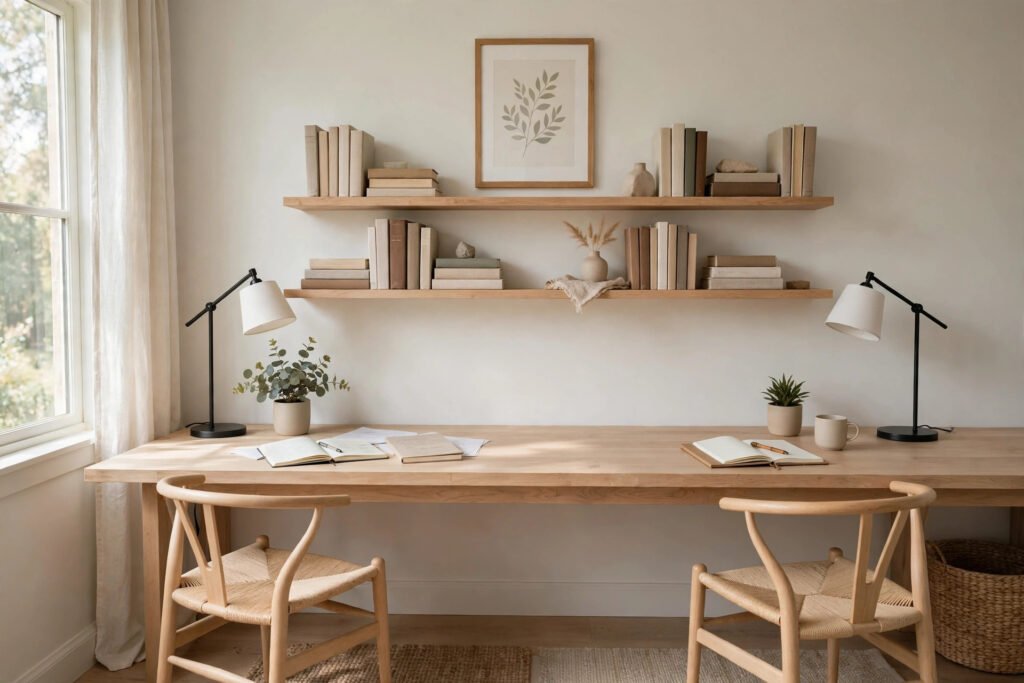
Two separate desks cost more, take up more floor, and leave an awkward gap between them. One long desktop — a kitchen worktop, a reclaimed door on trestle legs, or two budget desk frames joined together — gives both people room to spread out for roughly the price of one mid-range desk. A home office for two budget desk like this is the single biggest saving in the whole room. A 180 cm desktop fits two laptop setups with room for a shared lamp, and trestle legs from a hardware store keep the project under the cost of two branded desks. Give each person a defined half — a desk mat or a different colour tray marks the boundary.
3. Give Each Person Their Own Storage Zone
Shared offices fall apart when storage is shared too, so give each side its own drawer unit, shelf, or basket — one person’s neat stack becomes the other person’s clutter within a week.
A three-drawer rolling unit under each side of the desk keeps chargers, notebooks, and headphones out of sight. Wall shelves above each workspace hold books and plants without eating floor space. Matching baskets in different colours make it obvious whose things are whose.
For more storage ideas, see our roundup of budget home office organisation ideas (https://somedecor.com/budget-home-office-organization-ideas/) — many of the cheapest solutions there work twice as well in a shared room.
4. Light Both Sides Properly
Bad lighting is the fastest way to make a shared office feel gloomy: one ceiling light rarely reaches both desks evenly, and a single lamp leaves one side in shadow.
Place the shared desk perpendicular to the window if you can, so daylight falls across both workspaces instead of shining into one person’s screen. Then add one small desk lamp per person rather than one big shared lamp — matching lamps look tidy, and each person can angle theirs to suit their own screen.
Warm white bulbs (around 2700–3000K) feel cosy in the evening, while a cooler bulb aids concentration. Our guide to the best budget desk lamps for home offices (https://somedecor.com/best-budget-desk-lamps-home-office/) compares affordable options that work well in pairs.
5. Manage Noise and Privacy Without Building Walls
Two people on calls at the same time is the biggest friction point in a shared office, but a little sound control goes a long way.
A tall bookshelf or fabric divider between the desks blocks sightlines, absorbs some sound, and doubles as storage. A rug, curtains, and a couple of cushions all reduce echo too. Noise-cancelling headphones are worth it if you both take calls regularly — even a budget pair makes a shared room feel much calmer.
Agree on a simple signal for calls — a small “on a call” sign, a coloured desk flag, or just headphones on means do not interrupt. It sounds formal, but it prevents far more frustration than it causes.
6. Keep Cables Under Control From Day One
Two laptops, two monitors, two chargers, and a lamp or two tangle fast — one afternoon on cable management keeps the desk tidy for months.
A cable tray or basket screwed under the desktop hides power strips and excess cable. Velcro ties are cheaper than clips and easier to adjust, and labelling each charger with tape stops anyone unplugging the wrong one.
Run cables along the back edge of the desk, not across the floor, where they trip people up. Put a shared printer or speaker in the middle, where either person can reach it.
7. Personalise Each Side — Cheaply
A shared office should not look like a call centre — each person needs a small corner that feels like theirs.
Let each person pick one wall item — a framed print, a pinboard, a photo — for their side. Keep the palette consistent so the two halves still look like one room: same frame colour, similar sizes, one shared accent colour. A plant each is another cheap touch that softens the hard edges of monitors and desks. Our best budget desk organisers roundup (https://somedecor.com/best-budget-desk-organizers/) includes small trays and holders that keep personal items tidy. Two very different styles side by side look chaotic, but two small personal touches inside one calm colour scheme look deliberate and welcoming.
8. Set a Shared Budget — and a Shared Tidy-Up Rule
The cheapest shared office is the one you only buy once. Before shopping, agree on a total budget and split it between shared items (desk, rug, lighting) and personal ones (chair, lamp, storage).
A realistic starting point is roughly $200–$400 for the shared desk setup, $40–$100 for lighting, and $30–$80 for storage, with chairs bought separately to suit each person’s height and back. Buying secondhand — office clearances, thrift shops, local selling groups — can halve those figures, and office furniture is easy to find used in good condition.
Then agree on the tidy-up rule: five minutes at the end of each workday, both desks clear. A five-minute habit is easier to keep than a weekend deep clean.
What a Shared Office Really Needs
A home office for two budget plan works when the layout respects both people, the storage is clearly divided, and the lighting and noise are handled honestly. You do not need matching designer furniture or a big room. A long shared desk, two good chairs, one lamp each, and a few storage boxes cover most of it. Spend on chairs and lighting, and save on shelves and baskets. Start with the layout, add storage second, and let the personal touches come last.
FAQs
How much desk space does each person need in a shared home office?
Each person needs at least 60 cm of desk width for a laptop and notebook, and 80–100 cm is more comfortable with an external monitor. A 180 cm shared desktop fits two laptop setups with room to spare, while 200 cm or more suits two monitors.
What is the best layout for a home office for two?
Side by side along one wall is the simplest and cheapest layout, suiting most couples and roommates. Back to back works better in square rooms and gives each person more privacy, while an L-shape suits small rooms needing two clearly defined zones.
How do two people take video calls in the same room?
Use noise-cancelling headphones, agree on an “on a call” signal, and stagger important calls where possible. A bookshelf or fabric divider between the desks, plus a rug and curtains to soften echo, makes a real difference. If calls clash constantly, one person can use another room for the busiest hour.
Can you set up a home office for two in a small bedroom?
Yes. A long desk along one wall, wall-mounted shelves instead of floor storage, and slim chairs that tuck fully under the desk make it possible in a room as small as 3 by 3 metres. Keep colours light and furniture slim so the room does not feel cramped.
What should two people share in a home office, and what should stay separate?
Share the desk surface, lighting, printer, and large storage like a bookshelf. Keep personal items separate: each person should have their own drawer unit, charger, headphones, and desk lamp. Clear ownership prevents most arguments about clutter.