
Disclosure: This article contains affiliate links. As an Amazon Associate, we earn from qualifying purchases. If you buy through these links, we may earn a small commission at no extra cost to you.
Budget-Friendly Dining Room Wall Decor Ideas
A dining room wall decor budget does not need to be big to make the room feel finished. A bare wall above a sideboard or behind the table is the first thing guests notice, yet it is also one of the cheapest walls in the house to decorate well. The eight ideas below use affordable frames, second-hand finds and simple DIY touches — all far cheaper than a full redecoration.
1. A Gallery Wall of Framed Prints
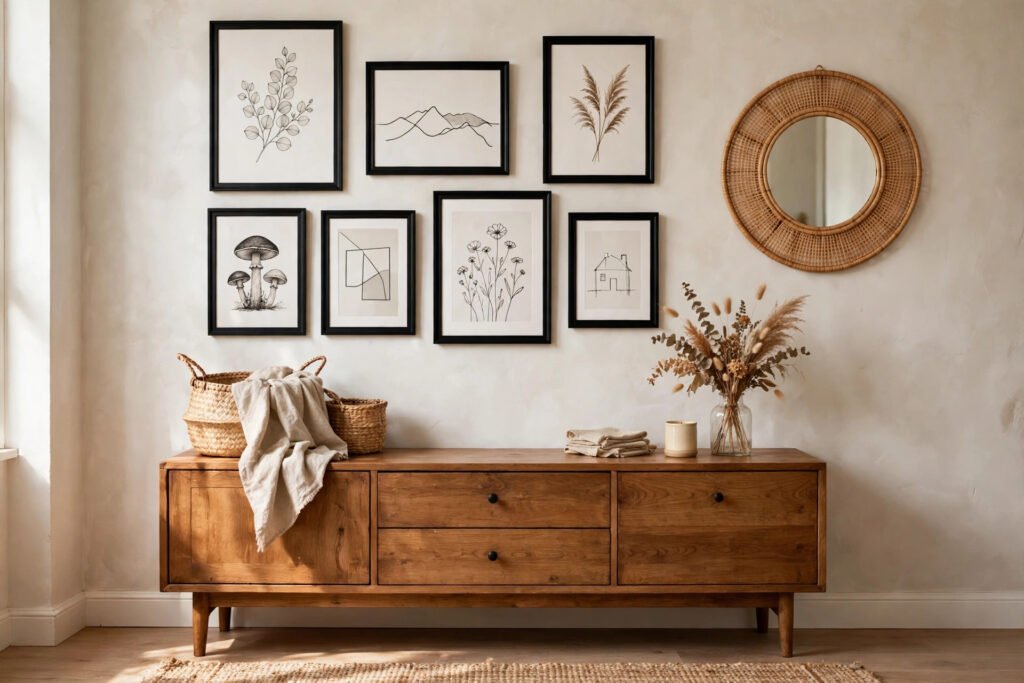
A gallery wall is the easiest way to fill a large dining room wall on a small budget. Start with three to five frames in one colour — black, white or natural wood — and fill them with free printable art, pages from old books or your own photos. Matching frames make mixed pictures look deliberate instead of random.
Hang the largest frame at eye level in the centre, then build outwards, leaving roughly 5–8 cm between frames. Keep the arrangement about two-thirds the width of the table or sideboard below it, so it feels connected to the furniture. Our guide to budget-friendly gallery wall ideas shows more layouts that work in small rooms too.
2. A Plate Wall
A plate wall is classic dining room decor, and it costs almost nothing if you shop second-hand. Mismatched plates from charity shops, car boot sales or your own cupboard look charming together when they share a colour family — all blues, all creams, or all patterned. Plate hangers cost very little and hold each plate securely.
Arrange the plates on the floor first, then transfer the layout to the wall. An odd number of plates — five, seven or nine — looks more relaxed than a neat even grid, and a single larger plate in the middle anchors the whole display.
3. One Big Mirror
A mirror is the hardest-working piece of dining room wall decor, because it does two jobs at once: it fills the wall and it bounces light around the room, making the space feel bigger. A large round or arched mirror above a sideboard is a classic choice, and second-hand mirrors are easy to find cheaply.
Hang the mirror so it reflects something worth seeing — a window, a pendant light or a plant — rather than a blank wall opposite. If a big mirror is out of budget, group three small mirrors in a row or a triangle for a similar effect at a fraction of the price.
4. Floating Shelves with Small Decor
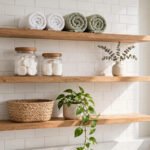
Floating shelves turn a bare wall into a display without the commitment of a gallery wall. One or two slim shelves above a sideboard hold small vases, a trailing plant, a stack of cookbooks and a candle, and you can rearrange them whenever the mood changes. Shelves cost roughly $15–$30 each — check the current price before buying — and a pair is usually enough for a dining room wall.
Keep the shelves shallow, about 15 cm deep, so they do not crowd the table. Style them with a mix of heights — a tall vase, a medium plant and a low candle — and leave some empty space, because a shelf packed edge to edge looks cluttered rather than curated.
5. Woven Baskets and Textured Wall Hangings
Woven baskets, a macramé hanging or a simple textile bring warmth that flat prints cannot. Flat baskets in different sizes hung in a loose cluster make a relaxed, boho-style feature wall, and they are light enough to hang with a single nail each. Charity shops and discount stores often sell baskets for a few dollars each.
A single large woven wall hanging works just as well above a sideboard, especially in a dining room with wooden furniture. The texture softens hard walls and echoes the natural materials of the table below. If you like this look, our affordable dining room decor ideas include more ways to warm up the room on a budget.
6. DIY Framed Fabric or Wallpaper Panels
Fabric and wallpaper offcuts make striking wall art for very little money. Stretch a bold fabric over a cheap canvas frame, or frame a single sheet of patterned wallpaper, and you have a large piece of art for the price of a remnant. This works especially well with botanical prints, stripes or a subtle geometric pattern.
Make two or three panels in the same fabric, or mix one patterned panel with plain ones in a matching colour. The result looks far more expensive than it is, and you can swap the fabric when you fancy a change. Remnant bins in fabric shops are the best place to look — a half-metre is usually enough for one panel.
7. A Chalkboard or Letter Board
A chalkboard or letter board adds personality to a dining room wall and costs very little. Use it for a weekly menu, a favourite quote, a seasonal greeting or a simple drawing — and change it whenever you like. A framed chalkboard above a sideboard looks intentional, while a small letter board on a shelf adds a playful touch.
Chalkboards suit a farmhouse or rustic dining room best, while a felt letter board in a neutral colour works in almost any style. Keep the message short and change it often; a board that never changes becomes part of the wallpaper.
8. Painted Wall Panelling or a Colour Block
If your dining room wall is very plain, paint can be the decor. A single painted rectangle behind the table, a half-height colour block or simple batten panelling painted the same colour as the wall adds shape and depth for the cost of a small tin of paint and a few lengths of wood.
Choose a colour one or two shades deeper than the rest of the room for a subtle effect, or go bold with a deep green or navy on one wall only. Painted panelling also gives framed art something to sit against, so it pairs well with any of the ideas above. Before you start, read our guide to how to choose wall art size — the same sizing rules apply whether the art hangs on paint or on plain plaster.
How to Plan Dining Room Wall Decor on a Budget
A dining room wall decor budget goes further when you start by measuring the wall and the furniture below it. Art should be about two-thirds the width of the table or sideboard it hangs above, and its centre should sit at eye level, roughly 145–150 cm from the floor. Our dining table decor ideas show how the table and the wall can work together, and our affordable dining room lighting ideas cover the pendant lights that complete the look.
Set a budget before you shop, then spend it on one good piece rather than five small ones. A single large mirror or a set of matching frames will always look better than a scatter of tiny pictures. Finally, live with the wall for a week before adding more — a dining room that feels finished usually needs less on its walls than you think.
FAQs
What is the cheapest way to decorate a dining room wall?
The cheapest way to decorate a dining room wall is a gallery wall of framed prints using free printable art, or a plate wall made from second-hand plates. Both can cost under $30 if you already own the frames or plates, and both fill a large wall well.
How big should wall art be above a dining table?
Wall art above a dining table should be about two-thirds the width of the table, with its centre at eye level, roughly 145–150 cm from the floor. A single large piece or a gallery wall of the same total width both work — what matters is the proportion, not the number of frames.
Can I mix different styles of wall decor in a dining room?
Yes, you can mix styles of wall decor in a dining room as long as one thing ties them together — the same frame colour, a shared colour palette or a repeated material such as wood or brass. Without that link, mixed pieces can look accidental rather than collected.
How do I hang heavy mirrors or plates safely?
Hang heavy mirrors with proper wall fixings rated for the weight, and use a stud finder to anchor into solid wood where possible. Plates should hang on spring-style plate hangers sized to each plate, and both should be checked every few months to make sure they are still secure.
What wall decor works best in a small dining room?
A large mirror works best in a small dining room, because it reflects light and makes the room feel bigger. A slim floating shelf or a gallery of three frames also works — avoid deep shelves, which crowd a tight space.