
Affordable entryway storage ideas are the difference between a front door you trip over and one that quietly works for you. The entryway is the hardest-working corner of most homes: shoes pile up, coats slide off chairs, keys vanish, and post lands wherever it lands. The seven ideas below cost very little and can be set up in a single afternoon.
1. Give Every Shoe a Home — Even a Small One
Shoes are the first thing that makes an entryway look messy, and they are the easiest problem to solve. A slim shoe rack by the door keeps pairs off the floor and in one place. Look for a two-tier rack that fits against the wall; a basic one usually costs roughly $15–$30 — check the current price before buying — and holds four to six pairs, which is enough for most households if everyone keeps only the pair they wear most often by the door.
If you have no floor space at all, a hanging shoe organiser on the back of a door does the same job, and the clear-pocket kind also holds gloves, scarves and dog leads.
Set a simple rule and stick to it: one pair per person by the door, the rest in a bedroom or cupboard.
2. Add a Bench With Hidden Storage
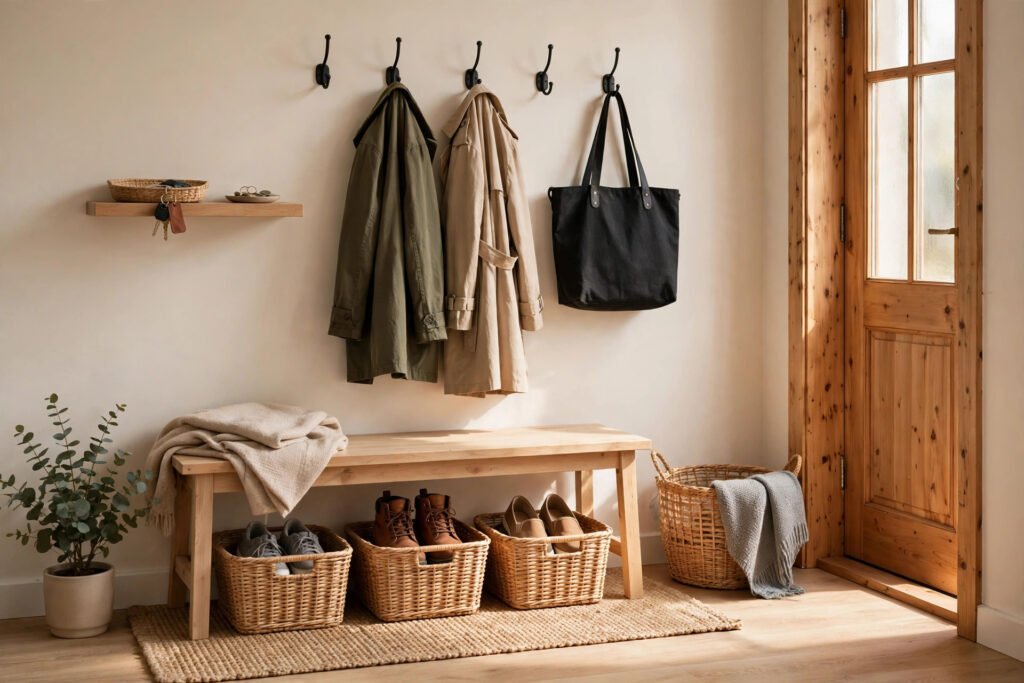
A bench is the single most useful piece of entryway furniture you can buy on a budget, because it does two jobs at once. You sit on it to put your shoes on, and the space underneath — or inside it — hides the shoes, bags and clutter you do not want to see.
A storage bench with a lift-up lid usually costs roughly $40–$80, while a simple open bench with a shelf underneath can cost roughly $25–$50 — check the current price before buying. If even that is too much, a sturdy wooden crate turned on its side with a cushion on top makes a perfectly good bench, and the crate itself becomes a shoe cubby.
Put a small basket or two under an open bench for reusable shopping bags, the dog lead and a spare umbrella. Our guide to the best budget storage ottomans for small spaces has more lidded pieces that work just as well in a hallway as they do in a living room.
3. Use Hooks Instead of a Coat Stand
A coat stand takes up floor space and always seems to fall over at the worst moment. A row of wall hooks does the same job better and costs far less: three or four sturdy hooks on a wooden rail, fixed at adult height with a lower row for children, holds coats, bags and hats for the whole family.
A rail with four or five hooks usually costs roughly $10–$25 — check the current price before buying — and you can fit it in the time it takes to hang a picture. Choose double-prong hooks so a coat and a bag can share one without sliding off.
4. Contain the Small Stuff in Baskets and Trays
Keys, sunglasses, post, loose change, the shopping list — the small things are what make an entryway feel chaotic, even when the big things are tidy. The fix is to give every category its own small container and put the containers in one place.
A shallow tray on a console table or a shelf is the classic spot for keys and sunglasses: everything lands in the same place every time, so nothing gets lost. A small lidded basket holds gloves, hats and scarves in winter and sun cream in summer; a set of two or three woven baskets usually costs roughly $12–$25 — check the current price before buying. For more ideas on keeping small spaces tidy, our guide on how to organise a small closet on a budget uses the same one-home-for-everything rule inside a wardrobe.
5. Make the Wall Work With Shelves and Peg Rails
When floor space is tight, the wall is your best storage. A single floating shelf above the bench or the hooks holds the things you reach for on the way out — keys in a small dish, a torch, a tin of shoe polish — and keeps them off every other surface in the house.
Two short shelves, one above the other, work better than one long one: the lower shelf takes the everyday items and the upper shelf holds a plant or a photo so the entryway still feels welcoming. A pair of small floating shelves usually costs roughly $15–$30 — check the current price before buying.
Our guide to affordable wall shelves for small spaces has more ideas for using vertical space when the floor is already full.
6. Sort the Post Before It Becomes a Pile
Post is the quiet clutter-maker in every entryway. It arrives daily, it has nowhere obvious to go, and within a week there is a leaning tower of envelopes on the nearest surface. A simple wall-mounted letter holder or a small basket by the door stops the pile before it starts.
A wall-mounted holder usually costs roughly $10–$20 — check the current price before buying — and it keeps post upright and visible so bills do not get buried under takeaway menus. Pair it with a tiny recycling basket or a paper bag right beside it: junk mail goes straight in, and only the post that matters stays on the holder.
Build a thirty-second habit around it: post goes in the holder, junk goes in the bag, and the holder gets sorted each evening.
7. Use the Door Itself as Storage
The back of the front door and the inside of a hallway cupboard door are storage space most people forget they own. Over-door hooks hold coats, bags and a dressing gown without a single screw, and an over-door organiser with pockets holds everything from cleaning cloths to spare batteries.
Over-door hooks usually cost roughly $8–$15 — check the current price before buying — and they come off without leaving a mark, which makes them ideal for renters. If your door is a fire door, check the hooks do not stop it closing properly before you load them up.
Putting It All Together
Start with the one that solves your biggest annoyance — shoes, coats or keys — then add the next. A tidy entryway is built one small habit and one small piece of storage at a time.
Keep the look calm by sticking to one or two materials — wood and woven baskets, or black metal and white shelves — so the storage reads as part of the decor rather than a pile of containers. Our guide to budget entryway decor ideas has simple styling tips that work with exactly the pieces above, and our affordable entryway mirror ideas show how one mirror can make even a narrow hallway feel twice as wide.
The best entryway storage is the storage you actually use, so choose pieces that fit your real routine — the coats you own, the shoes you wear, the things you reach for on the way out.
Frequently Asked Questions
What is the cheapest way to add entryway storage?
A row of wall hooks and a small shoe rack is the cheapest useful set-up, usually costing roughly $25–$55 in total — check the current prices before buying. Add one tray for keys and you have covered shoes, coats and small items for less than the cost of a single piece of fitted furniture.
How do I organise a very small entryway with no floor space?
Use the wall and the door: wall hooks for coats, a floating shelf for keys and post, and an over-door organiser for the small stuff. A slim shoe rack against the wall, or shoes kept in the bedroom, handles the footwear.
What should I store in the entryway?
Only what you use on the way in or out: the shoes you wear most, one coat per person, keys, sunglasses, the dog lead, umbrellas and the post. Everything else belongs in a bedroom or a cupboard.
How do I keep the entryway tidy once it is organised?
Give everything one home and keep the system small: one pair of shoes per person by the door, post sorted the moment you come in, and a five-minute reset once a week.
Is a storage bench worth it in a small hallway?
Yes, if it replaces something rather than adding to the clutter: a bench that hides shoes inside it replaces both a shoe rack and a chair. Measure first and leave at least 90 cm of clear walkway in front of it so the door still opens comfortably.